Tehran's mass turnout is a message — to the regime and to Washington
Aerial imagery from Tasnim shows central Tehran packed beyond capacity on 5 July 2026. The size of the crowd is the story — and so is the uncertainty about who, exactly, is being mourned.
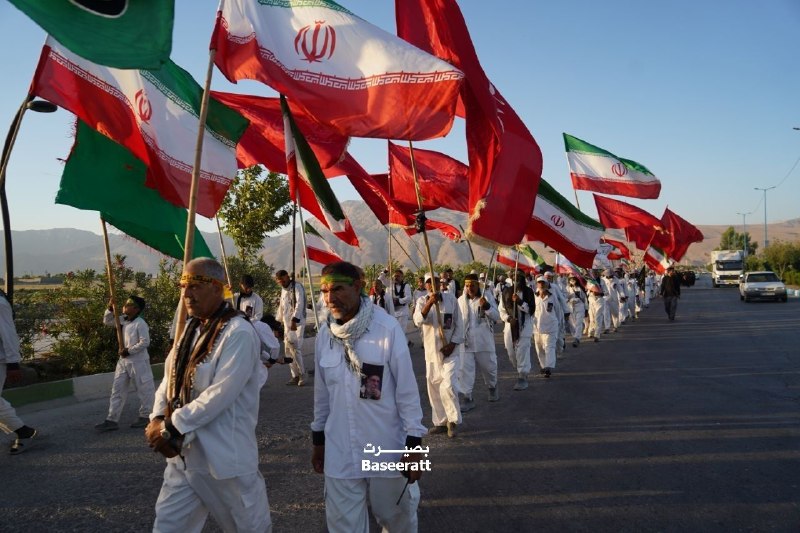
Aerial imagery distributed by the Iranian state outlet Tasnim News on 5 July 2026 shows central Tehran — and the vast Mosala prayer ground on its southern edge — packed beyond capacity, with crowds spilling into adjacent streets. The frames, captioned in Farsi and English, describe "the biggest prayer in the history of the revolution" and reference martyrdom commemorations framed around the hashtag Badarqa Aghai Shahid Iran — "At the Cost of Our Lives, Iran of the Martyrs."
What the imagery makes plain is a show of mass mobilisation. The harder question — what it is mobilising for, and on whose terms — is what the next several days of Iranian state signalling, opposition organising, and Western diplomacy will be reading closely.
What the footage actually shows
Three Tasnim dispatches, timestamped 16:41, 16:48, and 17:24 UTC on 5 July, frame the scene as a state-organised act of mourning rather than spontaneous grief. The early post refers to Khuzestani shrouds being transported toward Tehran — a detail that anchors the commemoration geographically inside Iran's Arab-majority southwest, where Israeli strikes have reportedly been heaviest in recent weeks. The later captions escalate into open political vocabulary: streets "with no place to throw a needle," and the claim that this is the largest such prayer since the 1979 revolution's founding.
Iranian state media routinely inflates crowd counts at major commemorations; the June 2025 funeral of President Ebrahim Raisi was the most recent benchmark. Independent verification of the turnout from satellite or non-state imagery is not yet available. The honest reading is that the size is genuine and very large, and that the political packaging is also genuine and very much engineered.
Who is being mourned — and who is being addressed
The Khuzestan reference is the most informative clue in the thread. The province has absorbed a disproportionate share of Israeli air strikes since the 12-day war of June 2025, and the regime has framed civilian losses there — at oil installations, in the city of Ahvaz, and across petrochemical corridors — as a national sacrifice. Funerals of this scale function simultaneously as a domestic legitimacy ritual and as a foreign-policy message: to the Supreme National Security Council in Tehran, to the Israeli war cabinet in Jerusalem, and to a White House that has been negotiating, intermittently, since the June ceasefire.
The framing is not subtle. Badarqa Aghai Shahid Iran — "Iran of the Martyrs" — is a regime slogan in the same family as Allahu Akbar banners at state funerals and the Ya Hossein invocations of Karbala. The intended audience includes the Iranian street, but the secondary audience is just as deliberate: Gulf neighbours who quietly cooperated with US basing during the war, European negotiators trying to revive a nuclear framework, and an Israeli public whose mood has shifted visibly toward de-escalation since the fighting stopped.
The structural read
Mass mourning in autocracies is rarely just mourning. It is a kind of fiscal balance-sheet exercise: the regime pays out political capital (legitimacy, narrative control, grief monopoly) and receives in return a measurable quantity of demonstrated public alignment. That demonstrated alignment matters most when the regime is weakest — when sanctions bite, when the rial collapses, when the regional proxy network has been physically damaged.
By that accounting, the timing is not accidental. The Tehran stock exchange has been closed since mid-June. Inflation remains in double digits. The nuclear file is open again, with Washington and Tehran having exchanged technical drafts through Omani intermediaries in late June. A state that can put a million bodies into Mosala on five days' notice is reminding both its own exhausted population and its external interlocutors that the social contract, however brittle, still holds enough weight to be deployed as leverage.
What the counter-reading would look like
The Western wire line on Iranian state funerals is well-rehearsed: choreography, coercion, bused-in crowds, mobile-network throttling to suppress counter-imagery. Each of these is plausible. Tehran does bus supporters in. It does restrict bandwidth during major events. The opposition abroad, including the monarchist and republican factions, will over the coming days circulate their own count and their own imagery.
The honest assessment is that both readings can be partially true. Crowds of this magnitude cannot be assembled without significant voluntary participation. They also cannot be assembled without significant state logistics. The proportion — and that proportion is the political fact that matters — is not visible from a single set of aerial frames released by the regime's own news agency.
Stakes
If the funeral cycle consolidates around a martyrdom frame, three things follow. First, the nuclear negotiations get harder: a regime that has just buried its dead in a televised national act has less domestic room to accept anything short of full sanctions relief. Second, the Israeli-Iranian shadow war, paused rather than ended after the June ceasefire, loses whatever residual restraint the funerals' optics were meant to produce. Third, the Gulf states — already jittery about being left outside US-Iran-Saudi trilateral talks — read the footage as a message about how Tehran intends to behave in any post-war architecture: assertive, mobilised, and willing to spend its people as political capital.
The crowd in Tehran is doing what crowds in Tehran have done since 1979. The state is doing what the state does. The new variable is the audience abroad, and whether Western and Gulf readers will treat the imagery as evidence of a regime at the height of its confidence, or at the height of its need to perform it.
Desk note: Monexus has treated Tasnim's footage as primary state-source material rather than as wire reporting, and has flagged the turnout figures as state-attributed. Where independent verification is absent, that absence is named in the piece rather than papered over.
Wire provenance
This editorial synthesis draws on the following public wire/social posts:
- https://t.me/tasnimnews_en
- https://t.me/tasnimnews_en
- https://t.me/tasnimnews_en