Chants in a Tehran mosque, and the gap between street theatre and statecraft
Footage from a Tehran mosque on 5 July 2026 shows crowds chanting 'Death to America, death to Israel.' The slogan is old, loud and sincere. What it actually signals is more contested.
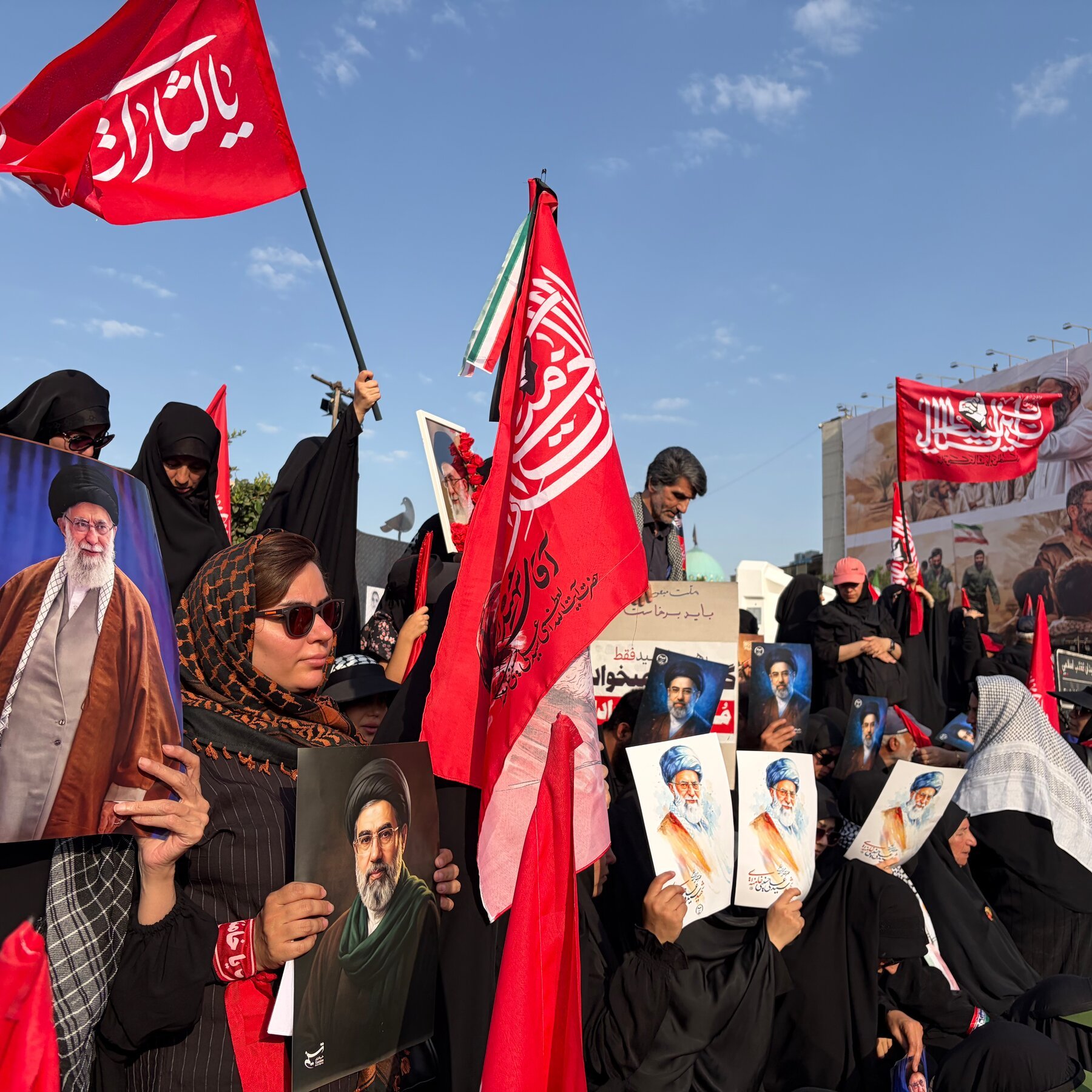
Footage circulated by Iranian outlets on 5 July 2026 shows worshippers at Tehran Grand Mosque chanting "Death to America, death to Israel," with red flags laid out across the courtyard and a large white cloth unfurled alongside them. Both Tasnim News and Al Jazeera English's English-language coverage carried the same scenes within minutes of each other, the former at 14:46 UTC and the latter flagged by Tasnim's Persian channel at 14:42 UTC. The choreography is familiar: choreographed sloganeering, religious symbolism pressed into service of a foreign-policy line, the camera held wide enough to suggest a crowd and tight enough to crop the empty patches.
The slogan is forty-seven years old. It predates the current supreme leader, the current president, the current parliament and most of the protesters in frame. Treating it as breaking news is a category error; treating it as nothing is also a category error, because the same words get deployed by the same institutions at moments of acute diplomatic tension, and the choice to roll them out says something about the room they were spoken in.
Reading the room
The footage matters less for what was shouted than for who was on hand to film it. Tasnim is the outlet closest to the Islamic Revolutionary Guard Corps and a habitual carrier of regime choreography; Al Jazeera English's presence as the quoted observer is a reminder that Doha's English-language service still transmits Iranian state-adjacent framing wholesale to non-Farsi-speaking audiences, often without the framing caveats its own Arabic service applies. The convergence is not a conspiracy. It is how the Iranian state has learned to package itself for two distinct audiences at once — domestic mobilisation in Farsi, English-language confirmation via outlets with global reach.
There is also the question of timing. The 5 July date falls during the mourning month of Muharram, when Shia commemorations of the Battle of Karbala peak, and red flags carry specific devotional weight that does not translate into the headline. Western readers who arrive at the clip cold see rage; Iranians watching the same clip in context see grief weaponised into foreign policy. Both readings are partly right.
What the slogan is doing
The phrase performs two jobs simultaneously. Outwardly, it positions the Islamic Republic as the unyielding pole of an axis that includes but extends beyond the Palestinian cause — a posture the regime has maintained since the revolution and which its adversaries, in Israel and in Washington, take at face value. Inwardly, it disciplines the domestic audience: the chant is a line one can be on the correct side of without doing anything costly, and a line against which dissenters can be measured and harassed.
Western analysts tend to focus on the first job and miss the second. The first is largely performative; it costs nothing to shout and obliges nothing in particular, because the regime has spent four decades building a foreign policy that can absorb the slogan without acting on it. The second is structural. It is how a clerical state that has lost most of its popular legitimacy since 2022 continues to fill mosques in 2026 without having to deliver anything material to the people inside them.
The gap between street theatre and statecraft
The interesting question is what is not being shouted. Iran's regional posture has shifted pragmatically over the past year. The country has kept its nuclear file suspended in technical cooperation with the IAEA; it has tolerated, however grudgingly, the restoration of a degree of working relationship with Gulf neighbours that would have been unthinkable in 2019. A regime that intends imminent escalation does not need the mosque crowd — it needs the missile batteries, and those are managed quietly.
This is the pattern worth naming plainly. Authoritarian and theocratic regimes alike use visible street theatre to set the ceiling of acceptable discourse, then conduct actual policy well below it. The slogan tells allies and enemies where the red lines are drawn in rhetoric; the diplomatic channel, where one exists, tells counterparties where the red lines are drawn in fact. The two are not the same map, and treating them as the same map is the mistake both hawks and doves in Western capitals reliably make.
The hawks read the slogan, decide Tehran is on the brink, and push for confrontation on the basis of theatrical evidence. The doves read the slogan, decide it is just noise, and miss the disciplinary function the chant performs on a population that is still restive four years on from the largest protests since the revolution's founding. A serious reading has to hold both jobs of the slogan in view at once.
What remains uncertain
The footage circulated on 5 July does not, on its own, establish whether the gathering was a routine Muharram commemoration onto which foreign-policy language was grafted, or whether it was a deliberate signal timed to a specific negotiation, incident or anniversary that the publicly available clips do not name. The sources do not specify the officiating cleric, the organising body, or whether senior civilian or military officials attended. Al Jazeera English's role here is as a quoter of the slogan, not as an independent reporter on the ground. Tasnim is a participant in the framing it transmits.
That gap matters. The honest answer is that we do not know what the chants are reacting to, only that they are being broadcast — and that the decision to broadcast, in 2026, is itself the news.
Desk note: Monexus treats state-adjacent outlets such as Tasnim and PressTV as primary carriers of regime framing rather than as neutral observers, and quotes them with that caveat intact. Al Jazeera English remains a useful wire for regional coverage but inherits the framing choices of its sources when it relays their language directly.
Wire provenance
This editorial synthesis draws on the following public wire/social posts:
- https://t.me/tasnimnews_en
- https://t.me/tasnimnews_en
- https://t.me/JahanTasnim