Tehran's farewell, and the politics of scale
Iran's state-aligned outlets report crowds in the millions descending on central Tehran for Ayatollah Khamenei's funeral. The numbers are impossible to verify — and the spectacle itself is the point.
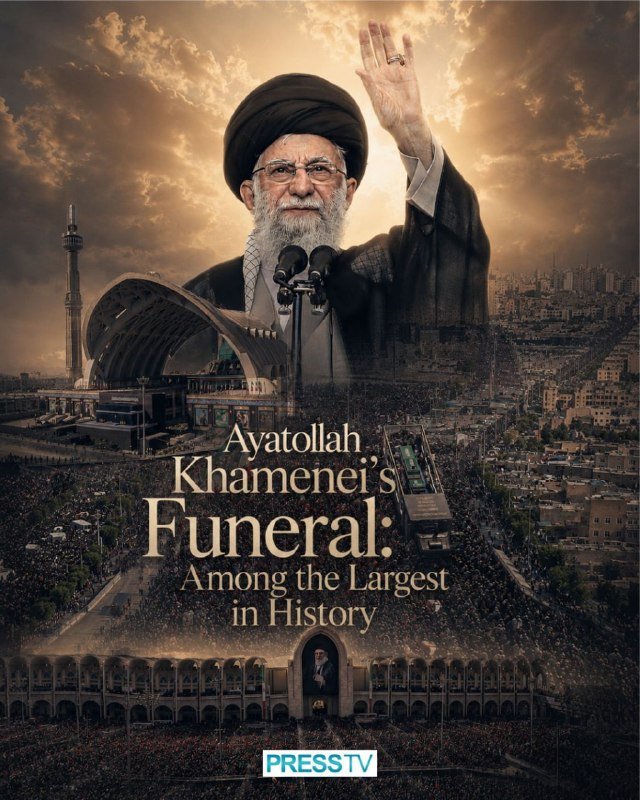
Iranian state-aligned outlets report a mobilisation of scale that, by the numbers, would dwarf any funeral in the modern Middle East. Press TV's Maryam Azarchehr told viewers from Tehran's Grand Mosalla on 5 July 2026 that "more than 9 million people have already participate[d]" in the second day of the farewell ceremony for Ayatollah Ali Khamenei, the Islamic Republic's leader for nearly four decades. A separate Press TV bulletin the same morning cited a transport official who logged more than seven million metro journeys during the proceedings — an order-of-magnitude claim that, if accurate, would exceed the daily ridership of Berlin's U-Bahn multiplied several times over.
The figures are not independently verifiable. They arrive through a single, state-aligned channel whose role is to amplify, not audit, the optics of national grief. That does not mean nothing is happening. It means the spectacle has become the argument, and the argument is being delivered in body counts.
What the wires are saying
Three Press TV items posted to a public Telegram channel between roughly 11:00 and 12:00 UTC on 5 July 2026 frame the day's narrative. The first cites Booker Ngesa of the Kenya Palestine Solidarity Movement declaring, in the form of a tribute, that "the legacy of martyred Ayatollah Khamenei will outlive US imperialism." The second is Azarchehr's on-the-ground broadcast asserting nine-million-plus attendance. The third quotes an unnamed Tehran transport official confirming seven-million-plus metro taps. Taken together, the through-line is consistent: scale is loyalty, and loyalty is scale.
Why the numbers should not be swallowed whole
Crowd counts at state funerals are political instruments across regimes, but the Republic's track record makes the unverified figures here worth flagging plainly. Aggregate counts at past Iranian state ceremonies have routinely been disputed by outside demographers, and transport-tap totals can be inflated by double-counting entries and exits across a system used for ordinary commuting, not just ceremonial attendance. None of this means the crowd is small. The Mosalla sits in central Tehran, the metro network is real, and millions of Iranians did turn out across multiple days of mourning. What is missing is a methodology that a reader can reconcile against any independent baseline.
The counter-narrative, on the channel's own terms
It is worth marking what the package does not contain. There is no diaspora mourner cohort quoted, no Western wire correspondent embedded, and no Iranian opposition outlet given airtime. The foreign-tribute voice is a Pan-African solidarity activist — a politically legible choice in coverage that, by structure rather than by statement, places the Islamic Republic's leadership in conversation with anti-imperial movements in the Global South. That is a frame, not a census; it tells the reader which solidarities the producers want visible, and which they do not.
Structural read
A farewell of this kind, in a country under heavy sanctions and regional pressure, is doing three jobs at once. It signals internal continuity at a moment of succession. It signals to Israel's security establishment, to Saudi Arabia, and to Washington that the regime's command over domestic space remains intact. And it signals — through curated foreign guests — that the Republic intends to widen, not narrow, its claim to leadership of a broader anti-Western bloc. To read the ceremony as merely mournful is to miss the wiring.
Stakes, in plain terms
If the projected scale is even approximately real, Iran's clerical establishment has bought itself breathing room at exactly the moment its regional axis — damaged by the war in Gaza and the squeeze on Hezbollah — most needed it. If the figures are inflated, the cost is smaller than the regime's critics suggest: official-state spectacle is cheap in the short run and expensive only when the gap between claim and street becomes physically undeniable. Either way, the next test is not attendance at the Mosalla. It is whether the succession that follows holds the line in Lebanon, in Yemen, and in any renewed confrontation with Israel. This article draws on state-aligned reporting exclusively. The headline crowd figures should be read as claims, not counts, until independent verification surfaces.
Wire provenance
This editorial synthesis draws on the following public wire/social posts:
- https://t.me/presstv/28971
- https://t.me/presstv/28969
- https://t.me/presstv/28966