Viral videos and the camera-test problem: when bystander footage rewrites a police narrative
Three short clips from one Telegram channel this weekend capture a deeper anxiety: a video record that appears to contradict an official one, and a politics of outrage built around the gap.
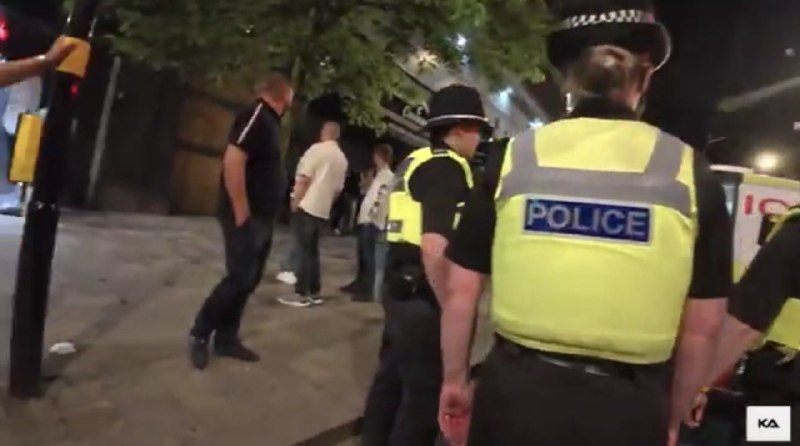
Three short clips posted to the Telegram channel @MyLordBebo on the morning of 5 July 2026 have done a great deal of quiet work in the past few hours. One shows a white-shirted man being restrained near a group of police officers. Another is a bystander's reaction shot, the camera turning towards the incident at speed. A third is text on screen asking whether it is plausible that a camera-wielding passer-by, some distance off, could see and record the moment while the officers who were closer insist that they did not. None of the videos, taken together, proves anything conclusive on its own. The wider claim that has grown around them — that police routinely claim not to have seen what bystander cameras plainly caught — deserves a colder look.
The temptation in moments like this is to treat the footage as a verdict. Mobile-phone video is, in many cases, the best evidence available: it is timestamped to within seconds, geolocatable, and outside the editorial control of either side. But bystander footage is also a snippet. It compresses a confrontation into its most legible frame, drops the seconds before and after the camera was on, and inherits whatever the bystander thought the story was. When the camera is close enough to show faces and actions, it usually does not show motive. When it is wide enough to show motive, it usually cannot show who struck first. The argument that a camera-wielding passer-by recorded an event officers closer by say they missed is not, on its own, evidence that an officer lied. It is evidence that the officers' account and the bystander's account describe different events, which is the ordinary condition of disputed street encounters long before mobile phones existed.
From snippet to saga
What has changed is the speed at which a snippet becomes a saga. The earliest post from @MyLordBebo on 5 July timestamped to 08:00 UTC carries the same pointed framing as the two posts that follow in the next half hour: an open-ended question, a presumption of bad faith, and a call to share. By the time a 08:30 UTC repost lists a generic punitive pun in the caption — "Can we please do with politicians what Bangladeshi guys do to annoying kids?" — the visual material has already done its first round of work, and the channel is pushing into a second register of invective. The camera is no longer the centre of the story. The camera has become a warrant for a much older grievance: that the people with power, in this case the police, are treated as more credible than the people without it.
The arithmetic of virality rewards that move. Short, instrumented footage clears platform filters quickly because it travels well: vertical orientation, contained motion, a single figure of authority against a single civilian. The text that frames the footage is doing something different, and it is doing it openly. The most striking post in the sequence is the one that compares a video-recording passer-by to a nearby police squad and asks, plainly, how the officers can reasonably claim not to have seen what unfolded. It is a question, but it is also an indictment built in advance of any conclusion.
Why the framing lands even without a verdict
The reason the framing lands is structural. Even when no court has heard the case, even when the only published record is a Telegram channel, the public now arrives at these incidents with a default suspicion that official accounts are self-serving. That suspicion is not irrational. It is the residue of a decade of cases in which dashboard, body-worn, and bystander footage eventually forced corrections to earlier police statements. Each such correction reinforced the working assumption that the officer's account is provisional at best and mendacious at worst until the video settles the question. By 2026, the burden of proof in any street encounter with police has, in the public imagination, subtly inverted: cameras are presumed to tell the truth; official reports are presumed to need corroboration.
That inversion is itself a media story. Newsrooms that once led with a police statement now lead, when they can, with bystander footage and follow with the official line as the contested element. The legal principle of innocence until proven guilty has not changed; the editorial principle often has. And Telegram channels, free of the newsroom's editorial constraint and of most of its legal caution, have absorbed the new presumption with little friction. When a police spokesperson declines to comment, the channel reads silence as confirmation. When officers are visibly present in a clip but say in a statement that they were not, the channel reads contradiction as cover-up.
The camera-test problem
The harder question is what to do when the video does not, in fact, settle the question. The three posts in the @MyLordBebo sequence on 5 July illustrate the common failure mode. The first two establish that a single bystander, further from the incident than the officers, recorded the event. The third builds an inference from that geometry: that the officers' claim not to have seen the attack is implausible, and that pressing charges against the white-shirted man is therefore suspect. Each link in the inference is plausible. Together they are not, on their own, evidence of anything. The bystander's distance from the event does not establish what the bystander saw; it establishes only what the bystander could plausibly have captured on a phone camera at that range. The officers' presence in the area does not establish that they were looking at this specific subject at this specific second. The decision to press charges is consistent with several accounts, not just the one the channel prefers.
This is what might be called the camera-test problem. Video evidence has raised the floor of public accountability faster than it has lifted the ceiling. It routinely surfaces in cases where the official story collapses on contact with the image. It rarely settles cases where the image and the official story describe different moments of the same event. The gap between those two regimes — video as smoking gun and video as honest disagreement — is where the current politics of outrage now lives. It is also where Telegram channels, newsrooms, and courts tend to talk past each other, because each is using "the footage" to argue different things. The channel uses it as proof of a pattern. The press uses it as a factual anchor for an open question. The court, if the case goes that far, will treat it as one item among many. None of them is wrong about what the footage is, and none of them is using it the way the others are.
Stakes and the road ahead
The stakes are concrete on every side of the encounter that produced the @MyLordBebo clips. For the white-shirted man in the video, the question of whether the charges survive scrutiny will turn on evidence far beyond the bystander's recording — on officer testimony, on body-worn footage if it exists, on witness statements, on the forensic detail of any injury. For the officers, the credibility cost of another apparently mismatched public claim is the slow kind: nothing dramatic, but a deposit against the next accusation that will be harder to dispute. For the news ecosystem, the present pattern entrenches a frame in which bystander video is presumptively truthful and official accounts are presumptively self-serving — a frame that is sometimes right and sometimes wrong, and that does not discriminate between the two as confidently as its advocates assume.
What remains uncertain is whether the underlying case will be reported beyond Telegram at all. The sources do not specify which police force is involved, the location of the incident, the charges in question, or whether any newsroom has independently verified the channel's framing. Without those details, the clips remain what they are: a snippet, a text overlay, and an inference. The most that can be said with confidence is that the videos are real, that they have circulated widely in a few hours, and that the public argument they have provoked will outlast the legal questions they cannot, on their own, resolve. The camera is not always the witness. It is, increasingly, the venue.
This article is grounded only in three posts from the Telegram channel @MyLordBebo on 5 July 2026. Monexus has not independently verified the location, the identity of those filmed, or the status of any criminal proceedings; the inference drawn in some of the posts is treated here as a framing choice, not as an established fact.
Wire provenance
This editorial synthesis draws on the following public wire/social posts:
- https://t.me/MyLordBebo
- https://t.me/MyLordBebo
- https://t.me/MyLordBebo
- https://en.wikipedia.org/wiki/Bodily-integrity