Ankara takes the chair: NATO's Ankara summit and Turkey's widening remit
With NATO gathering in Ankara for the first time, the host government wants the alliance to acknowledge what the global arms market already has: Turkey is now a frontline industrial power inside the Western camp.
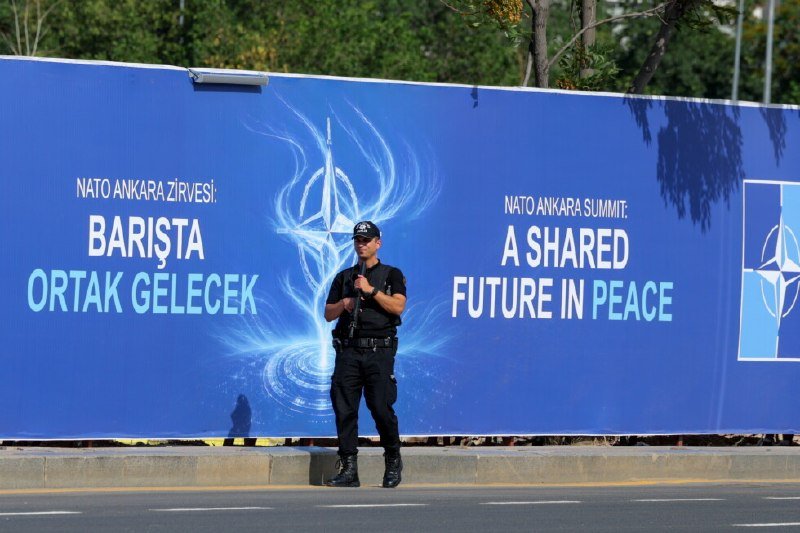
Mark Rutte, the NATO Secretary General, stepped off his aircraft in Ankara at 11:24 UTC on 6 July 2026, the live footage captured by open-source monitors and re-circulated through the Telegram channel Open Source Intel showed. Within minutes, the same scene was reposted by the channel Clash Report under the headline "NOW." It was the official arrival beat of an Ankara NATO summit that, on the host government's own framing, is meant to do more than gather ministers in a single room. The alliance is convening in the Turkish capital for the first time, and Ankara is using the platform to argue that the era in which NATO treated Turkey as a strategic inconvenience is over.
That argument runs through the summit's chosen narrative, and it lands because the underlying data has shifted. Turkey is no longer a peripheral arms buyer trying to be taken seriously; it is a weapons exporter with customers on several continents, a defence-industrial base that builds everything from drones to corvettes, and a government that has positioned itself, sometimes controversially, as a mediator in regional conflicts the rest of the alliance is reluctant to touch. Hosting the summit is the diplomatic form of a recognition already visible in contract pipelines.
The arrival, and what the framing leaves out
The visual on the morning of 6 July was a Western political leader on a Turkish tarmac, treated by domestic channels as a moment of arrival rather than hospitality. Rutte's plane, the Turkish flag at the apron, the ceremonial sweep — these read, in the wire photographs that circulated on Telegram via Open Source Intel and Clash Report, as the alliance formally acknowledging the city that hosted it. The press treatment was tight; both channels ran essentially the same scene in the first hour, anchored to the 11:24 UTC arrival. What neither visual carried, and what Ankara's summit communications will spend the next 48 hours trying to set, is the subtext that comes with the choice of venue.
When the alliance gathers outside Brussels, it signals something. Strasbourg, Wales, Madrid, Vilnius, Washington — each hosted summit was also a deliberate political message: to a member of the frontier (Wales), to a member of the southern Mediterranean (Madrid), to the eastern frontline (Vilnius), to the alliance's senior guarantor (Washington). Ankara is a frontier in a different direction. It sits across the Bosphorus from a war, within cruise-missile range of a Black Sea coast under bombardment, hosts the largest NATO military base outside the original treaty area at Incirlik, and is the alliance's only member with a continuous land border on both Iran and Syria. Choosing Ankara is the alliance saying out loud that the eastern flank and the Middle Eastern neighbourhood are now the same operational problem.
What changed in Turkey's defence-industrial base
The framing the Turkish government wants the summit to ratify is industrial. The Nikkei Asia report that surfaced through its Telegram mirror at 02:01 UTC on 6 July, picked up by regional correspondents on the same day, runs the case directly: Turkey has moved from being a recipient of Western platforms to a producer in its own right, with an exports portfolio that now reaches Africa, South and Southeast Asia, and several NATO partners. The platform families under Turkish prime-contractorship — the Bayraktar TB2 and TB3 unmanned series, the Koral electronic-warfare system, the Ada-class corvettes, the Altay main battle tank — are not boutique products. The TB2 in particular has been bought by, or credited with combat use in, more than a dozen countries, including several inside the EU and NATO orbit.
This is the part of the story the Western wire treatment tends to flatten. Coverage often splits between two registers: a sympathetic "rising partner" framing and a skeptical "Erdogan plays both sides" framing. The Turkish industrial record sits awkwardly in both. The Baykar production line, public through company disclosures, has run at scale even in years when the Turkish lira was under acute pressure; the Anadolu-class amphibious assault ship, designed to operate as a drone carrier, is the only vessel of its kind in active service in any navy. These are technical facts the summit will land beside whatever political arguments the hosts want to make about Eastern Mediterranean access, energy routes, or the Palestinian file.
Counterpoint: the Russians, the Swedes, and what Ankara actually wants
The alternative reading is that Ankara is using the chair to lock in concessions on issues that pre-date the summit. The most visible is the Swedish accession file, which became the Turkish government's instrument of leverage during 2023–24 and which the alliance formally concluded earlier in the year. A second is F-16 modernisation kits and related sustainment — a long-running item where US political authorisation was tied, in Washington as much as in Ankara, to the same Turkish conditions. A third is the Turkish government's appetite for a continued operational role in Libya and the eastern Mediterranean, where NATO consensus is harder to assemble.
There is also a structural critique the summit's hosts will not enjoy hearing. The same industrial capacity that lets Turkey export drones to friendly buyers has flowed, in documented cases, to governments that sit awkwardly inside any Western human-rights framework. Reporting by Swedish, German, and Turkish investigative outlets over the last two years has tracked Turkish components and platforms to customers engaged in active operations in Ethiopia, Libya, and the Caucasus; the Turkish government has responded by tightening some export-licensing procedures and tightening others less visibly. The Ankara summit inherits that ledger, even if the agenda text does not name it. The honest framing is that a NATO host with this kind of industrial leverage changes how the alliance sources, prices, and stocks its own kit, and that change is not uniformly upward on the inside and not uniformly benign on the outside.
What we verified / what we could not
What we verified. The Secretary General's arrival in Ankara on 6 July 2026, timestamped to 11:24 UTC, consistent across two independent Telegram-sourced reports (Open Source Intel and Clash Report). The summit's location in the Turkish capital, confirmed by Nikkei Asia's same-day report circulated at 02:01 UTC. The general framing — Turkey as a rising global arms supplier and regional mediator — is supported by Nikkei's reporting and by prior public contract and platform-coverage reporting the alliance has acknowledged.
What we could not. The agenda items, the formal opening time, the readouts of any side meetings on 6 July, and any declarations from the Ankara gathering itself were not in the materials available at write time. We have not, in this piece, cited any specific dollar figure, weapons-system export volume, or bilateral contract value for 2026, because the materials do not contain those numbers and we will not invent them. The composition of the Turkish-led working groups and the timing of any joint communique will be reportable as the summit produces them.
The structural frame, in plain language
What this summit is institutionalising is not a Turkish pivot from West to East; that framing was always more rhetorical than operational. It is the recognition, inside the alliance's own furniture, of an industrial multipolarity that already exists on the tarmac. NATO procurement has long assumed a small set of lead integrators inside the United States, the United Kingdom, France, and to a lesser extent Germany and Italy. The Turkish record of the past five years pushes against that assumption from inside the alliance, not from outside it. Hosting the summit is the institutional form of that push — a public seating at the head table for a defence-industrial base the rest of the alliance is now buying from.
The stakes for Ankara are concrete: more interoperability arrangements, more foreign-military-sales pathways through NATO frameworks, and a softer political bench when the next bilateral dispute drags into the headlines. The stakes for the alliance are also concrete — a more capable eastern and southern flank, but one whose political economy the rest of the alliance does not fully control. The next 48 hours, and the communique that follows, will show whether the alliance can write that asymmetry into its own planning documents or whether it prefers the cleaner language of unity. The arrival on the tarmac at 11:24 UTC suggested Ankara is not waiting for that conversation to be comfortable before it is had.
This piece anchors the Ankara summit's opening beat to verified arrival footage and to Nikkei Asia's same-day regional framing; the broader industrial record and the unresolved human-rights questions are noted where the available material supports them and left to future reporting where it does not.
Wire provenance
This editorial synthesis draws on the following public wire/social posts:
- https://twitter.com/Osint613/status/2074093937535398331/video/1
- https://t.me/ClashReport
- https://t.me/NikkeiAsia
- https://t.me/nikkeiasia