Neymar walks away — and the questions Brazil's federation cannot keep deferring
Neymar's international retirement lands on the morning after Brazil's shock elimination — and lays bare a federation whose talent conveyor still works, but whose adult-team architecture has not kept pace.
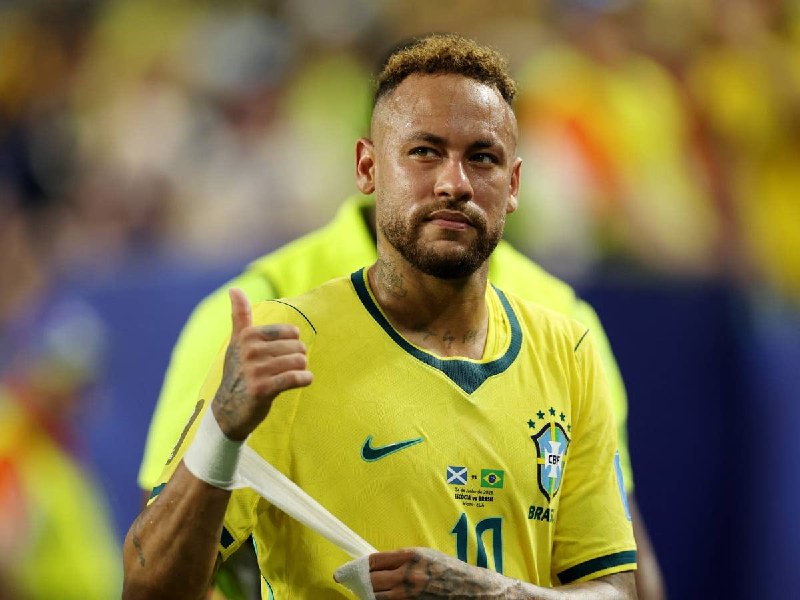
Neymar announced the end of his international career on 6 July 2026, hours after Brazil's shock exit from a tournament the Seleção had been widely expected to navigate deep into. "I tried, I tried… now it's over," the 33-year-old forward said, in remarks carried by The Indian Express, conceding that the dream of a World Cup triumph on home-equivalent stages will remain unfulfilled. The line lands with the weight of a decade of injuries, two of Europe's most expensive transfers, a Saudi detour, and a national-team narrative that never quite delivered what the talent ledger suggested it should.
Brazil have not won a World Cup since 2002. That is now a generation-long drought for a country that treats the tournament as something close to a state religion. Neymar's exit does not, on its own, explain the drought — but it does close the most personalised chapter of it. The forward who was supposed to be Pelé's heir leaves with the country still searching, and the federation facing the same structural questions it has been deferring since 2014.
The exit nobody planned around
Brazil's elimination, as reported by The Indian Express, is the proximate cause of the announcement. The squad arrived with the expectation of progression; the tournament has instead exposed the gap between the depth of Brazil's talent pipeline and the thinness of the senior team's tactical coherence. Neymar's departure removes the last remaining reference point of the pre-Ancelotti era — a side that has cycled through four permanent managers since Tite's departure and has not settled on an identity. The federation's choice in 2026 will be less about who replaces Neymar and more about whether the Seleção plays like the country's academy sides or like a club outfit constructed around individual match-winners.
The structural problem behind the talent
Brazil produces more elite footballers than any country on earth. That is not editorial hyperbole — it is the operational result of a youth system that scouts aggressively, integrates street football into academy play, and exports aggressively to European leagues. The problem has never been the production line. It has been the federation's refusal, decade after decade, to professionalise the bridge between U-20 success and senior-team performance. The Indian Express reporting on Brazil's exit frames the issue as one of tournament preparation; the underlying diagnosis is closer to governance. Clubs profit from the export market; the federation, starved of that revenue, makes do with what arrives.
What this means for the next cycle
In the short term, the federation will look for a new talisman — the assumption being that Brazil's football culture cannot function without one. That assumption is the trap. The Seleção's most successful recent tournament, the 2002 win, was a team built around three attackers sharing the load. The 2026 cycle is likelier to reward a system that distributes responsibility across a front four than one that searches for a single Neymar-grade replacement, because there is not one. The structural lesson — that production exceeds integration — will either be absorbed now, or the federation will hand it to the next coach as the same problem in different clothing.
The seriousness underneath the nostalgia
There is a temptation, on days like this, to treat Neymar's exit as a purely symbolic event. It is not. International retirement announcements by generational Brazilian forwards are also moments when the federation's choices become legible. The federation will name a successor coach in the coming weeks, and that appointment will signal whether Brasília — and the CBF's commercial partners — understand that the talent is the easy part. The hard part is what to do with it once it arrives at the airport. Brazil does not need another Neymar; it needs an adult-team architecture that does not require one.
This publication frames Neymar's retirement less as an ending than as the closing of a question Brazil's football federation has spent a decade avoiding: how to convert the world's deepest talent pipeline into a coherent senior side. The wire has, naturally, led on the human moment — the quote, the tears, the photo. The structural read sits one layer underneath, and is the one that will decide whether the next cycle looks different.