Russian barrage hits Kyiv residential blocks and missile-storage site, injuring civilians hours after a week of escalating strikes
A volley of Iskander ballistic and cruise missiles struck central Kyiv overnight, collapsing the upper floors of a Podilskyi district apartment block and triggering secondary detonations at a missile-storage site. Eight were injured in the capital, the latest in a week of resumed mass strikes on the Ukrainian capital.
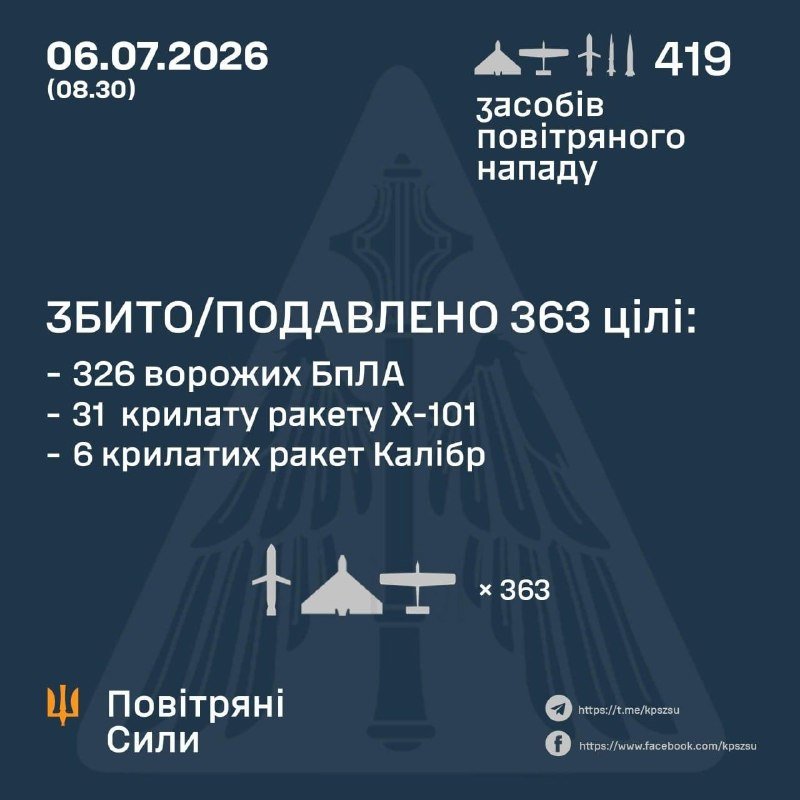
Russian Iskander ballistic and Kh-101 cruise missiles struck central Kyiv in the small hours of 6 July 2026, collapsing the upper floors of a high-rise residential block in the Podilskyi district and igniting secondary detonations at what open-source analysts identified as a missile-storage facility on the capital's outskirts. Deutsche Welle reported at least eight people injured in the capital, with one residential building directly hit, hours after a Russian-state-aligned channel tallied roughly fifteen explosions across the city.
The strike is the most intense single barrage on Kyiv in the past seven days and the second large-scale attack on the capital in under a week, signalling a renewed Russian campaign of tempo against Ukrainian urban centres even as fighting continues along the southern and eastern front lines. Moscow's pattern of mixing decoy drones, subsonic cruise missiles and harder-to-intercept ballistic platforms has, throughout this year, been aimed less at decisive military effect than at exhausting Ukrainian air defences and at putting sustained pressure on the civilian population.
What struck Kyiv and where
Reporting collated from open-source intelligence feeds and Ukrainian-watched channels places the night's action inside a tight geographic window. The Podilskyi district — a dense residential sector on the right bank of the Dnieper — took the most visible hit: video circulated by the Intelslava and OSINTLive channels shows a multi-storey apartment building with its upper floors pancaked onto the lower storeys, consistent with a direct ballistic-missile impact rather than a shrapnel or drone strike. A second cluster of detonations, visible on thermal-imagery accounts overnight, was logged at what OSINT trackers described as a missile-storage site near the capital, where large secondary explosions continued after the initial impact.
Deutsche Welle, citing Kyiv city authorities, reported at least eight injured and one residential building hit in the early-morning wave. The Russian-aligned channel Intelslava attributed the barrage to a mix of Iskander-M ballistic missiles and 3M22 Zircon hypersonic cruise missiles, with roughly fifteen explosions heard across the capital in the space of minutes; the OSINTLive account, drawing on the same blast pattern, identified Iskander ballistic and Kh-101 cruise missiles. As is typical for this category of reporting, exact munition counts cannot be verified from open-source footage alone.
The Russian read
Russian state-aligned channels framed the overnight action in deliberately maximalist terms, characterising the strikes as precision work against military-industrial and command infrastructure and using the language of "Russian terrorists" only when reproducing Ukrainian accounts. That asymmetry of language is itself a useful tell: Russian domestic framing continues to label the air war as a targeted campaign against decision-making centres, energy and weapons facilities, while Ukrainian reporting — and most of the open-source footage from the night — points to a residential block collapsed onto sleeping families.
The Iskander-K and Kh-101 combination in particular is a capability that Russian forces have used throughout the war for both infrastructure and what the Russian Ministry of Defence describes as "military-industrial" targets. The overnight volley, on this reading, sits inside Moscow's stated logic of degrading Ukrainian ability to sustain frontline operations. Whether that logic survives contact with the reality of a flattened apartment block is, of course, the question Kyiv's residents are asking.
Why the tempo has lifted
Two things make the past week of strikes on Kyiv different from the calmer stretches earlier this spring. First, the missile mix has tilted back toward ballistic and long-range cruise platforms — Iskander-M, the Kinzhal family, and reported Zircon use — after several weeks dominated by Iranian-designed Shahed-series one-way attack drones. Ballistic missiles are harder and costlier to intercept than Shaheds; they also imply that Moscow is willing to spend down finite stockpiles of high-end munitions rather than ration them against strategic targets alone.
Second, the targets have moved back into the residential envelope. Deutsche Welle's report explicitly noted that the early-morning attack came after a separate large-scale strike on Kyiv the previous Thursday — a pattern of cadenced attacks designed, most analysts at Western and Ukrainian think-tanks now argue, to break civilian morale and to draw Ukrainian air-defence missiles away from forward-deployed assets protecting the front. The pace is not new; what is new is its return after a brief lull, and the willingness to package ballistic and subsonic cruise missiles in the same wave so that air defenders have to choose what to spend interceptors on.
That calculus has a domestic-Ukrainian cost in shelter-hours, hospital admissions and rolling blackouts. It has a frontline cost too: every interceptor burned over Kyiv is one less over Kharkiv, Sumy, or the Donetsk axis.
What is contested, and what is not
Most of the day's hard facts are not in serious dispute. Eight people were injured in Kyiv by 0147 UTC on 6 July 2026 per Deutsche Welle's reporting; one residential building in the Podilskyi district was directly struck; secondary detonations followed at a missile-storage facility on the city's edge. The Russian-aligned Intelslava account asserts roughly fifteen explosions; the OSINTLive account logs Iskander and Kh-101 missiles. Open-source analysts have so far been unable to independently confirm a Zircon launch from the footage alone, and Russian-state media's broader tactical claims for the strike have not been corroborated by Ukrainian or independent reporting.
What remains genuinely uncertain is the casualty count inside the collapsed Podilskyi block. Initial injury tallies from a city under missile fire almost always undercount; a fuller accounting typically emerges over twenty-four to seventy-two hours as rescue crews finish working the rubble. The material composition of what was struck in the secondary-detonation episode — whether it was, as the open-source trackers inferred, an active missile-storage depot or an adjacent fuel or industrial site — is also still being pieced together from cratering and plume behaviour in social-media footage. Monexus will update the casualty and damage ledger when Ukrainian emergency-services briefings publish consolidated figures.
Desk note: Monexus frames this strike as a Russian attack on a residential area of a sovereign capital, drawing casualty and damage figures from Ukrainian-facing Western wire reporting (Deutsche Welle) and munition identification from independent open-source analysts; Russian-aligned channel Intelslava is used for what Russian-side sources claim was launched, not as a stand-alone factual basis.
Wire provenance
This editorial synthesis draws on the following public wire/social posts:
- https://t.me/intelslava/
- https://t.me/osintlive/
- https://t.me/osintlive/
- https://t.me/AMK_Mapping/