The MoU just died at Bandar Abbas: a US strike, an Iranian port, and a diplomacy that no longer exists
Within hours of US strikes on Shahid Haghani port and the small-boat facility in Bandar Abbas, the frame inside Iran shifted from negotiation to retaliation — and the framework those talks were supposed to produce is being treated, even by regime-aligned voices, as finished.
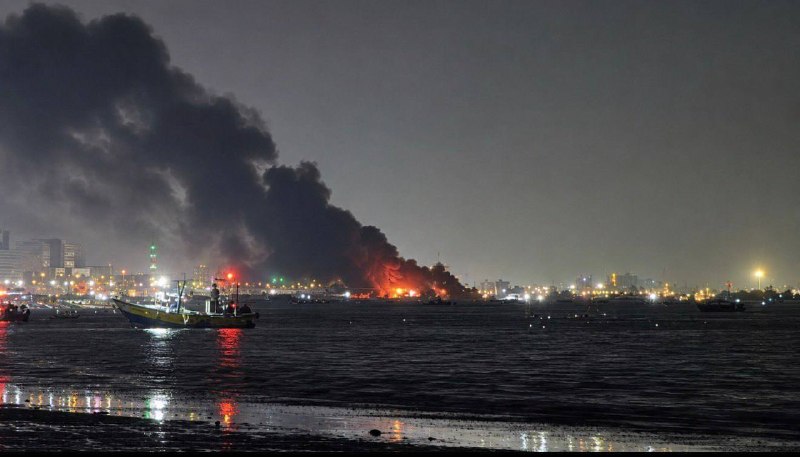
At roughly 21:49 UTC on 7 July 2026, footage circulating on Iranian and pro-Iran Telegram channels showed smoke rising over Bandar Abbas. Within twenty minutes, additional clips — geolocated by channel wfwitness to 27°10'23.78"N 56°15'56.11"E — showed multiple explosions on the southern edge of the city's small-boat port and a large fire still burning. By 22:14 UTC, one widely shared post from the channel FotrosResistancee carried a single declaration: "The MoU is effectively dead."
What is being mourned, and effectively pronounced over, is the framework of understandings between Washington and Tehran that had been the basis of months of back-channel diplomacy. The strikes hit the Shahid Haghani port and adjacent IRGC small-craft berths; reports also surfaced, via the same channel, of strikes against the IRIAF air base at Bandar Abbas, though those reports are not yet independently confirmed. The site being hit is not incidental. Shahid Haghani and the small-boat facility sit at the operational core of the IRGC Navy's fast-attack capability in the Strait of Hormuz.
What was actually struck
The geography is the point. Bandar Abbas is the IRGC Navy's primary base in the Persian Gulf, the staging ground for the swarm-tactic fast boats that have, for two decades, defined Iran's asymmetric deterrent against Gulf shipping and US naval deployments. Channels aligned with the Iranian opposition — FotrosResistancee, the channel's name a deliberate invocation of the Fotros Brigade — were the loudest amplifiers of the strikes' significance. Their footage and commentary emphasised two targets: the Shahid Haghani container facility, and the small-boat port where IRGC patrol craft are moored.
The Telegram aggregator @intelslava reposted additional scenes of the strike at 22:05 UTC. The Middle East Spectator carried the event under its "US/Iran — Bandar Abbas" header at 22:16 UTC. None of the posts identify a casualty count; wfwitness and the Iranian-opposition channels have focused on the kinetic footage rather than humanitarian toll. The Iranian state apparatus has, at time of writing, not produced an official casualty figure visible in the channels aggregating this material.
The counter-narrative, and why it cuts
The official Iranian framing, carried in regime-adjacent channels, is that this is an act of war against Iranian sovereignty — a frame that any sovereign state, Iranian or otherwise, would be entitled to deploy when a foreign military hits its ports. What makes the framing harder to dismiss than usual is the speed at which it has migrated across the political spectrum inside Iran. The line "the MoU is effectively dead" did not originate with a US or European commentator. It came from a Telegram channel that has framed itself as pro-Iranian-resistance, not pro-regime. The diplomatic implications of the strike are being read as terminal not by Western hawks but by voices that have spent years arguing for engagement with Washington.
The unanswered question is whether the strikes were intended as escalation or as a coercive move to reset talks on more favourable terms — the standard ambiguity Washington has historically used when it strikes Iranian assets and proxies. That ambiguity is the only reading under which "the MoU is effectively dead" is wrong. Even Iranian sources treating the framework as finished acknowledge they do not know whether some version of talks could be reconstituted from the wreckage.
What the framework actually was
The "MoU" in question — to the extent the term has been used in the channels carrying this material — is shorthand for a package of understandings that had reportedly been under negotiation between US and Iranian intermediaries for much of 2026: a de-escalation track, a partial-sanctions relief track, and a mutual-restraint track on Iran's nuclear and missile programmes in exchange for guarantees against further Israeli and US strikes. The package had never been publicly published. Its existence was inferred from a pattern of leaks, op-eds by former officials, and quiet statements from Gulf intermediaries.
Strikes on the IRGC's operational heartland are not compatible with that framework in any straightforward reading. They are compatible with a framework in which Washington has decided the cost of negotiating with Iran's current configuration exceeds the cost of degrading it militarily — a calculation that has precedent in US policy toward Iran across multiple administrations, including the 2020 elimination of IRGC Quds Force commander Qasem Soleimani. What is newer is that the strike appears to have been carried out against fixed IRGC naval infrastructure rather than against a specific individual or convoy, raising the cost of any future Iranian response by removing the option of a like-for-like retaliatory strike.
Stakes, and what we still do not know
If the strikes hold at the scale footage suggests, the immediate casualty is the diplomacy itself. Iranian state media have, per the channel echoes, framed the attack as requiring retaliation, but the form of that retaliation has not yet been signalled. The Strait of Hormuz — through which roughly a fifth of global oil trade moves — is the natural leverage point, and any sustained Iranian action there would have global economic consequences well beyond the bilateral relationship.
The unanswered questions are several. The casualty count from the strikes has not been disclosed by Iranian authorities via any channel tracked in this thread. The scale of damage to Shahid Haghani port's container operations — a civilian commercial facility adjacent to the IRGC berths — is not yet clear. Whether Iranian air defences engaged the incoming strike, and with what effect, is also unverified in the available material.
What the footage and commentary do establish, on the record this publication has reviewed, is narrower but consequential: that US military action hit the operational core of the IRGC Navy at Bandar Abbas at the close of 7 July 2026, that the strikes are being read inside Iran as the end of an unfinished diplomatic track, and that the diplomatic track itself was fragile enough that a single strike was sufficient to break it.
This publication is treating the initial Telegram-channel reporting as the primary record pending corroboration from wire services and official statements, none of which appear in the monitored thread at the time of writing. The line between footage of a strike and footage of a strike's aftermath — sometimes hard to fix in real-time social-media traffic — should be treated as soft until independent geolocation confirms target attribution.
Wire provenance
This editorial synthesis draws on the following public wire/social posts:
- https://t.me/FotrosResistancee
- https://t.me/wfwitness
- https://t.me/wfwitness
- https://t.me/intelslava
- https://t.me/FotrosResistancee
- https://t.me/Middle_East_Spectator