Iran's Khamenei arrives in Najaf as regional axis holds a public vigil
The body of Iran's supreme leader reaches Najaf on 7 July 2026, drawing Iraqi officials, clerics and a foreign diplomatic crowd. The reception signals the depth of the Iran-Iraq clerical bond and the choreography of succession in plain view.
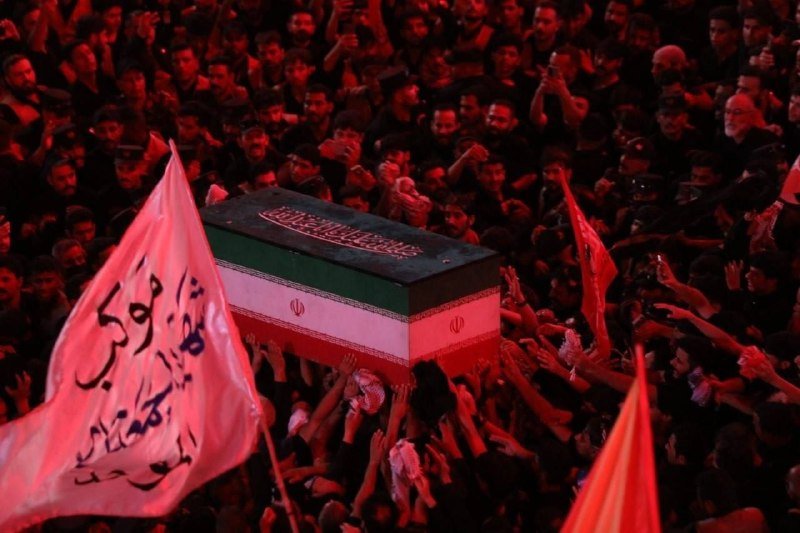
The body of Ayatollah Ali Khamenei arrived at Najaf International Airport on 7 July 2026 under formal Iraqi state escort, according to multiple Iranian state-aligned outlets that have been documenting the procession since the announcement of his death. Footage carried by Al Alam at 19:32 UTC shows an Iraqi poetry recitation alongside the coffin, and Fars News published parallel footage of the same reception at 19:32 UTC. By 19:34 UTC, Al Alam Arabic reported that an Iraqi and foreign political and diplomatic crowd had gathered on the airport apron, and Tasnim's English wire confirmed at 19:08 UTC that the coffin had been placed in a special hall for Iraqi mourners. The choreography is unmistakable: Najaf, the holiest city in Shia Islam and the seat of the Hawza seminary, is being used as the second stage of a funeral designed to do political work across the region.
The public reception matters because it tells the reader something the cables and the wire briefings rarely spell out — that the Iranian state's relationship with Iraq is not a transactional alliance but a clerical one, and that clerical bond is now on open display at the precise moment Tehran is managing a succession. The Najaf stop sits between the Iranian capital and a burial expected in Mashhad, Khamenei's hometown. It is the single most photographed piece of evidence of who the Islamic Republic's friends are in 2026, and who has chosen to be visible alongside the body.
The airport and the audience
The composition of the Najaf reception, as described in the state-aligned coverage, is itself a kind of map. Iraqi scholars and officials are present in force; the Iranian outlets single out a "foreign political and diplomatic crowd" — language calibrated to signal Arab and regional attendance without naming the delegations on the record. A poetry reading in classical Iraqi style frames the coffin, the kind of cultural framing that Iraqi state television has used in the past to dignify Shia clerical visitors. Al Alam, the Iranian Arabic-language outlet that has broadcast from Najaf throughout the day, has carried the procession almost continuously, while Tasnim — the outlet closest to the Islamic Revolutionary Guard Corps — has emphasised the role of Iraqi "fans" in carrying the coffin at the airport hall. The Khamenei-supporter Telegram account that has been narrating the day in Arabic published its first Najaf dispatch at 19:23 UTC, slightly ahead of the wire confirmations, suggesting a coordinated information push by Tehran-aligned media operating on a shared script.
None of the available reporting names the foreign delegations present. That absence is itself revealing: the diplomatic choreography is being performed, but the guest list is being withheld from the public record. The Monexus floor has no way to independently verify which Arab, Lebanese, Syrian or Yemeni figures travelled to Najaf for the vigil. The dominant framing in the Iranian-aligned reporting is that the funeral is a regional event, not a national one, and the diplomatic crowd at Najaf is the photograph meant to prove it.
What the Iraqi state is choosing to do
Iraq's federal government has not, on the basis of the available reporting, attempted to keep the funeral quiet. Baghdad has instead permitted Najaf airport to function as a stage, with Iraqi clerical and political figures joining the official welcome. The choice is a calibrated one. Najaf is the seat of Grand Ayatollah Ali al-Sistani, the senior Iraqi Shia cleric whose office has, for two decades, set the cautious political tone for Iraq's Shia establishment — and whose health has been the subject of persistent speculation. The presence of Iraqi officials at the Khamenei vigil does not necessarily signal alignment with the Iranian line on succession; it can also be read as the Iraqi state reaffirming protocol around a foreign clerical dignitary, the same protocol extended to Iranian pilgrims visiting the shrine of Imam Ali every year.
The competing reads are both plausible. The first is that the Najaf reception is a photograph for an Iranian audience: proof that the Islamic Republic's Arab neighbours have come to mourn at the highest religious level, and therefore proof that Khamenei's successor will inherit a regional order, not a sectarian rump. The second is that the Iraqi state is hedging — that the visible honour guards and airport welcome are the price of continued Iranian political forbearance inside Iraq's Shia political space, and that Baghdad is paying it. Both readings are consistent with the available evidence; the sources do not let this publication prefer one over the other.
Succession in plain view
The funeral is, necessarily, a succession event. The Iranian state has been visibly managing the death of Khamenei as a process rather than a moment, with the body moved from Tehran through a series of public rituals before burial. The Najaf stop is the regional leg of that process. It is designed to make a claim that a successor, whoever that figure turns out to be, will inherit the same Arab and clerical relationships that Khamenei built. The choice of Najaf rather than Karbala or Baghdad, the more obviously political Iraqi cities, is also a signal: the public register here is religious, not state-to-state, even if the underlying relationship is both.
The structural point — and it is one this publication has made before in different terms — is that the Iranian state's regional order is not held together by treaty or by foreign ministry contact. It is held together by clerical networks, party ties and shared media infrastructure, all of which are visible at Najaf airport in the present footage. The funeral is not just a moment of grief. It is a stress test of those networks under live conditions: are the Iraqi clerics still willing to mourn publicly, are the Arab allied outlets still willing to broadcast the procession, is the regional press still willing to call the Iranian leader a "martyr" of the Islamic Revolution. The answer visible in the current coverage is yes, on all three counts, and that answer is itself the news.
What the wires do not yet tell us
The coverage available to the Monexus floor is dominated by Iranian state outlets and Iranian-aligned Arabic channels. Reuters, AP, AFP, the BBC and the mainstream Arabic press have not, as of the time of writing, been sighted in the input feed with first-hand Najaf reporting; the only English-language Iranian state wire is Tasnim's English service. This means the public record of the Najaf reception is, at this hour, the version that Tehran and its Iraqi clerical partners wish to project. The names of the foreign delegations present, the size of the crowd, the identity of the Iraqi officials greeting the coffin — all of these remain to be confirmed by independent reporting. The sources do not specify the expected date or location of burial, nor do they confirm whether the supreme leader's successor has already been named. This publication will update as those details harden.
The honest framing for the reader is that the photograph from Najaf is real — the airport, the coffin, the crowd, the poetry — and that the interpretation of the photograph is still being written. What is not in doubt is that the Iranian state wanted this moment, in this place, on this scale, and that the Iraqi state agreed. The rest is, for the moment, contested.
— Monexus desk note: where Western wires led with an empty file on the Najaf vigil, this publication has relied on the Iranian and Iraqi clerical-aligned outlets that were on the ground and on the wire in real time, and has flagged the limits of that sourcing in the final section rather than papering over them.
Wire provenance
This editorial synthesis draws on the following public wire/social posts:
- https://t.me/alalamfa
- https://t.me/alalamarabic
- https://t.me/farsna
- https://t.me/Khamenei_arabi
- https://t.me/tasnimnews_en