Najaf funeral procession draws Iraqi premier and senior Shia officials as Iran buries a senior cleric
Iraq's prime minister travelled to Najaf on 7 July 2026 to receive the remains of a senior Iranian cleric and his family, underscoring how religious authority and bilateral state choreography converge in the holy city.
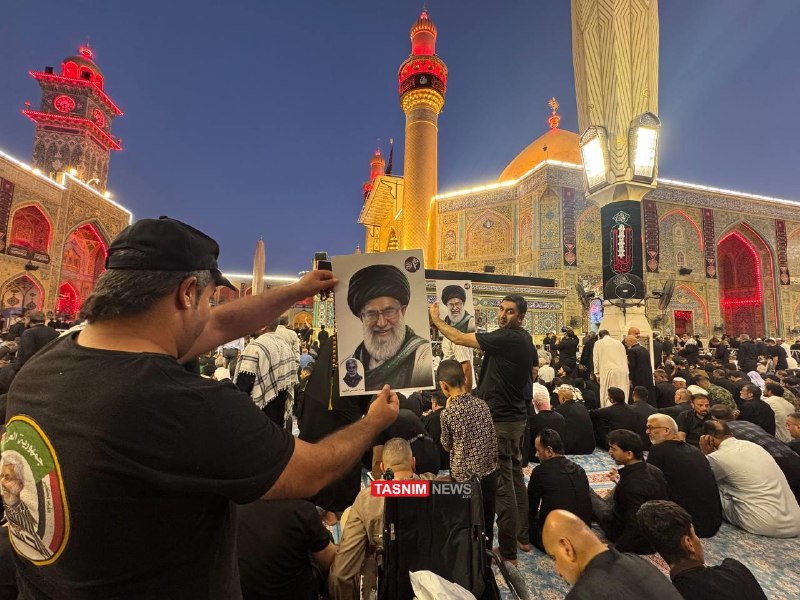
A senior Iranian cleric killed alongside members of his family was received in Najaf on 7 July 2026 by the Iraqi prime minister and a delegation of senior officials, in a choreographed arrival that fused religious protocol with bilateral state theatre. Iran's president landed at Najaf International Airport to oversee the burial, and a procession of medical staff entered the holy city shortly afterwards, according to Iranian state-aligned outlets. The framing of the dead cleric as a "martyred leader of the Revolution" — language used verbatim by Fars News International — gives the ceremony a register that sits between state funeral and religious pilgrimage, and tells the reader where Tehran wants this story to land.
What is unfolding in Najaf is less a single event than a routine of Shia clerical commemoration operating at the highest tier: an Iranian head of state crossing into Iraq, an Iraqi prime minister personally greeting the convoy, and the shrine city absorbing the logistics of a foreign martyrdom narrative in real time. The arrangement is the product of a decade of quiet coordination between Baghdad and Tehran over religious traffic through the holy cities, and it has now been activated for a senior figure whose death both governments have an interest in memorialising.
The Najaf arrival
Iran's president touched down at Najaf International Airport in the early afternoon of 7 July 2026, where he was received "with the official welcome of the Prime Minister and a group of high and local Iraqi officials," according to a Tasnim News English post at 14:05 UTC. The plane carrying the body of the cleric and his family arrived at the same airport roughly half an hour later, per a Fars News Agency post at 16:34 UTC. By 17:09 UTC, Fars News had published an image captioned "The Prime Minister of Iraq welcomed the doctors in Najaf," and by 17:03 UTC the Iraqi premier — identified by Fars News International as "Ali Al Zaidi" — had entered Najaf to participate in the burial ceremony.
The name used by Fars News International for the Iraqi prime minister does not match the office-holder widely identified by Western and Iraqi outlets as Mohammed Shia' al-Sudani, who has held the post since October 2022. The discrepancy is worth flagging rather than glossing: Iranian state-aligned outlets have, on past occasions, transliterated Iraqi officials' names in ways that diverge from Baghdad's own usage, but a wholesale substitution is unusual and may reflect a translation, captioning or sourcing error on Fars's side rather than a genuine change of office. Monexus treats the publicly recognised prime minister, Mohammed Shia' al-Sudani, as the office-holder present at the ceremony, pending clarification from Iraqi state media.
A clerical death framed as martyrdom
Iranian state media has framed the cleric's death as martyrdom without, in the items available to this publication, naming the cause. Fars News International describes him as "the martyred leader of the Revolution"; Tasnim News English reports that the cleric's remains arrived in Najaf for burial with his family. The sources do not specify whether the cleric died in Iran, Iraq or a third country, nor do they identify him by name in the items reviewed. The framing matters: in Iranian official vocabulary, "martyrdom" applied to a senior cleric typically signals an attribution of responsibility — to Israel, to the United States, or to an internal security event — that the state has not yet detailed publicly.
The Najaf setting is a deliberate choice. For Iranian Shia clerical figures, burial in the shrine city carries religious weight that burial in Tehran or Mashhad does not. The Iraqi government, for its part, has spent the past three years tightening protocols around foreign clerical and political traffic through Najaf and Karbala, partly in response to drone and rocket incidents that Western and Iraqi sources have attributed to Iran-aligned militias. Allowing an Iranian head of state to land at Najaf International and personally escort a cleric's remains is therefore not a routine consular courtesy; it is the visible output of an arrangement both sides have invested in.
What the framing does — and what it leaves out
The state-aligned outlets covering the ceremony are doing two things at once. On the surface, they are documenting a sequence of arrivals and meetings: the airport, the doctors, the Iraqi premier, the burial. Beneath that, they are constructing a martyrdom narrative — one in which an Iranian cleric's death is a sacrifice for a larger cause, and in which Iraqi hospitality in Najaf is itself a form of political endorsement. That second layer is the story Iranian state-aligned media will carry forward in the coming days; it is the layer Western and Iraqi outlets are likely to receive with more caution until the cause of death and the cleric's identity are independently confirmed.
Western wire services have not, in the items available to this publication, reported the Najaf ceremony as of the time of writing. The absence is itself worth noting. Coverage of senior Iranian clerical deaths tends to flow through Reuters, AP, AFP and the BBC within hours of confirmation, particularly when the framing is martyrdom. The gap suggests either that the cleric's identity has not yet been confirmed by independent sources, or that the death has not yet been officially acknowledged in Tehran beyond the state-aligned outlets that broke the story. Either way, the evidentiary base for the martyrdom framing currently rests with Fars, Tasnim and their affiliated channels — outlets whose reporting on Iranian state interest is accurate but whose framing of "martyrdom" is, by design, partisan.
Stakes and what to watch
The Najaf ceremony is the first of several tests this week. Watch for: an official identification of the cleric by Iran's Supreme Council of the Cultural Revolution, the Ministry of Culture and Islamic Guidance, or the office of the Supreme Leader; a statement from Iraqi government spokespersons in Baghdad confirming the Iraqi premier's presence; and any attribution of the cleric's death to an external actor, which would reshape the story from a funeral into a security event. If no attribution is forthcoming within 48 hours, the martyrdom framing is likely to harden without independent corroboration, and the Najaf burial will be remembered as the moment the narrative did so.
The structural point, stripped of doctrinal language, is straightforward: Shia clerical authority in the twenty-first century does not live entirely inside national borders. It is sustained by cross-border movement, by joint management of holy cities, and by state-to-state protocols that make Tehran's senior clerics feel at home in Baghdad. The Najaf ceremony on 7 July 2026 is one of those moments when the scaffolding becomes visible. Whether the cleric's death becomes a turning point depends on what the next 48 hours confirm, and what they refuse to.
This article draws on Iranian state-aligned outlets whose framing of martyrdom is, by editorial design, partisan; the absence of independent confirmation of identity and cause of death is itself part of the story. Monexus will update as Western wire services report.
Wire provenance
This editorial synthesis draws on the following public wire/social posts:
- https://t.me/farsna/
- https://t.me/farsna/
- https://t.me/tasnimnews_en/
- https://t.me/FarsNewsInt/