Strikes on southern Iran: what the wire says, and what it does not
Explosions were reported in Sirik on the southern Iranian coast in the late evening of 7 July 2026. The first wave of reporting is fragmentary, much of it routed through channels that have a stake in the framing.
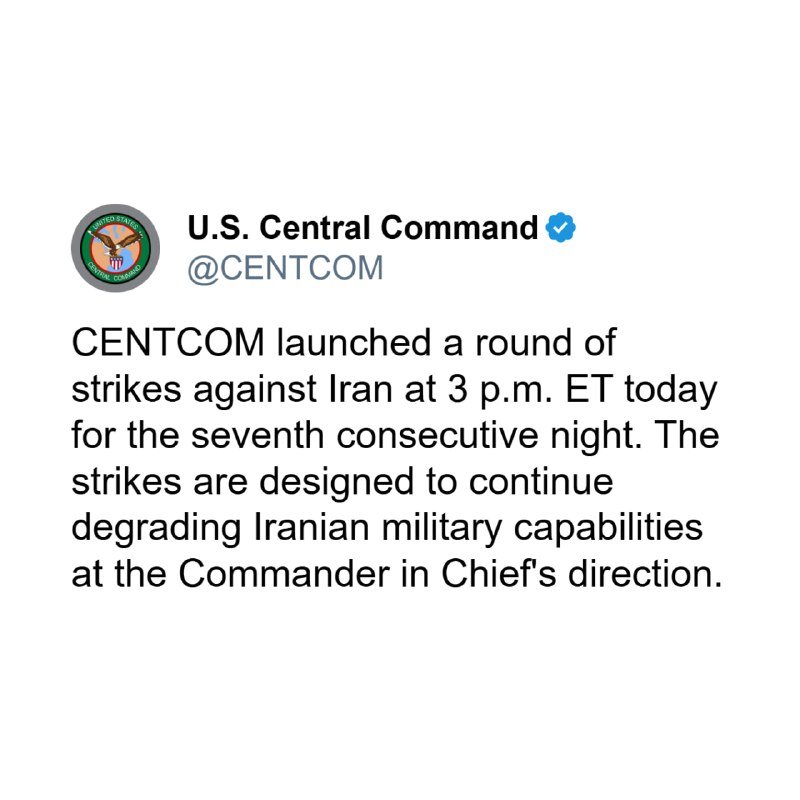
Explosions echoed across the southern Iranian coastal town of Sirik shortly after 21:00 UTC on 7 July 2026, with separate channels reporting that Iranian fighter jets were active over the same coastline and that US forces had launched strikes on Iranian territory. The earliest alerts came from regional intelligence accounts; the strike attribution came from one pro-multipolarity channel and has not, at the time of writing, been corroborated by a Western wire, an Iranian official statement, or a US Central Command release.
Within roughly fifteen minutes a coherent picture began to take shape: blasts on the southern coast, scramble activity reported by accounts monitoring Iranian air traffic, and a single channel asserting the strikes were American. The shape of the evening is clear. The provenance of the most consequential claim in it is not.
What broke first
The first item in the cluster surfaced at 21:06 UTC, when an account tracking Iranian military movements reported explosions along Iran's south coast. A second account, this one affiliated with an Iranian opposition network, posted the more specific localisation — Sirik, in Hormozgan province — at 21:07 UTC. A third account, broadly read by regional analysts, repeated the same Sirik localisation at 21:10 UTC and added that Iranian fighter jets were active over the southern coastline, suggesting scramble activity rather than passive observation. By 21:15 UTC, regional outlets carrying the wire had upgraded the framing to "explosions in Iran," without specifying the cause. At 21:20 UTC, one channel carried the line "US launches strikes on Iran."
That is the full spine of the public record as of writing: a coast, a town, a scramble, and a single attributed claim of US action.
What the framing leaves out
The most consequential sentence in the cluster is also the weakest as evidence. The 21:20 UTC item attributing the strikes to the United States comes from one channel whose editorial line is openly pro-multipolarity and sceptical of Western military action. By the channel's own standard practice, breaking claims are reported with speed over precision. That does not make the claim false — Sirik sits well within the operational reach of US Central Command, and the southern coast houses missile and naval infrastructure that has featured in previous American targeting packages — but it does mean the attribution has so far been carried by a single outlet with no on-the-ground sourcing visible.
Iranian state media, including outlets such as PressTV, Mehr, and Tasnim, had not, at the time of writing, confirmed or denied US involvement. The absence matters: Tehran has, in past episodes, been quick to publish official casualty figures and attribution when it has chosen to escalate the information war, and equally quick to compress reporting when it has preferred operational ambiguity. The Iranian opposition account that localised the strike to Sirik carries no Tehran-level confirmation either.
A Reuters or Associated Press string on the strike was not in the cluster as received. Nor was an Iranian government statement, a Pentagon briefing, or a Central Command release. The reporting picture, in other words, is a single-claim pin cushioned by two better-sourced geographical observations — explosions were heard, and jets were airborne.
The geography matters
Sirik sits on the coast of Hormozgan province, the southern shore of Iran that faces the Strait of Hormuz. The strait is the chokepoint through which a significant share of globally traded seaborne oil transits. The province houses part of Iran's missile, fast-attack-craft, and air-defence infrastructure; it is also the launch geography Iran has used, in previous cycles, for asymmetric retaliation. A strike package on the southern coast is, by design, a strike package on Iran's ability to threaten Gulf shipping and on its forward air defences. Whatever the cause of the explosions, the location places the event inside the strategic question of maritime chokepoint control.
That structural fact — Hormuz as the global oil industry's pinch point — has driven previous escalations between Washington and Tehran, including the 2019 episode in which Iran shot down a US drone over the strait and the tanker seizures on both sides of 2019 and 2024. Reporting that localises an event to the southern coast without naming the strategic geography is reporting that has lost the forest for the trees.
Stakes, and what is still unknown
If the strikes were American, the question becomes one of scope. A targeted strike on a missile site or a Revolutionary Guards Corps facility is a discrete coercive move; a broader strike package on the southern coast would mark an escalation of a different order, and would carry an obvious retaliation corridor through Hormuz shipping, Iraqi militia action, and Hezbollah reactivation in Lebanon's south. The reporting available does not separate those possibilities.
If the strikes were not American — if the explosions were an internal incident, a missile test, or another state's action — the same channel's strike attribution will, in coming hours, look like a notable miss. Either outcome sharpens, rather than softens, the question of how the international wire treats attribution from partisan channels in the first minutes of a fast-moving event.
What remains uncertain, as of the time of writing: the count and nature of impacted sites inside Iran, the identity of the striking force, any Iranian official statement, any Pentagon or Central Command read-out, any market move in Brent crude, and any movement in Gulf shipping. Each of those will arrive in the next hours. Until then, the public record is two geographic observations and one attribution, all of them filtered through channels that have a stake in how the story reads.
How Monexus framed this vs the wire: the first wave of claims attributed the strikes to the United States on the strength of a single channel with an editorial line that is openly sceptical of Western military action. Monexus has carried the geographic observations — explosions in Sirik, scramble activity over the coast — as better-sourced than the attribution, and has flagged the attribution's provenance rather than ratifying it.
Wire provenance
This editorial synthesis draws on the following public wire/social posts:
- https://t.me/bricsnews
- https://t.me/bricsnews
- https://t.me/TheCradleMedia
- https://t.me/rnintel
- https://t.me/FotrosResistancee
- https://t.me/rnintel