Two Wars, One Week, and the Limits of Telegraph Diplomacy
Ballistic missiles over Kyiv and strikes on southern Iran landed within hours of each other. The pattern says more about Washington and Moscow's playbooks than about the conflicts themselves.
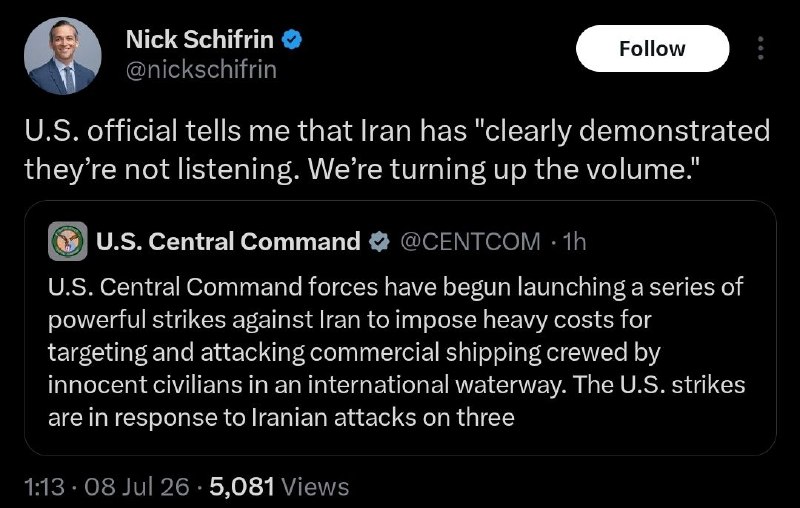
It is the evening of 7 July 2026, and within roughly the same hour a Telegram channel called DDGeopolitics posts two threads that, taken together, sketch a portrait of how the world's two hottest flashpoints are being run in 2026: by signal, not by strategy. At 21:20 UTC the channel reports that Washington has confirmed strikes on southern Iran, with a follow-up at 21:52 UTC carrying what it labels "scenes from Bandar Abbas." At 21:35 and 22:02 UTC, the same channel posts footage of ballistic missile strikes on Kyiv, with Ukrainian accounts noting that explosions registered before air-raid sirens activated. Two wars, two coasts of the Eurasian landmass, both narrated in the same clipped visual grammar.
The temptation is to read these as parallel crises. They are not. They are the same crisis, told from two different theatres, and the way each side is communicating about them is now the most important data point in either conflict.
The American game: pressure as product
Start with Iran. The 21:20 UTC post announces that the United States has confirmed strikes on southern Iran. The 22:24 UTC follow-up — "US Officials to PBS Correspondent: 'We're turning up the volume!'" — is more revealing than the strike itself. Read that line carefully. It is not a leak. It is a press strategy, openly described. The line is meant to be quoted.
What we are watching in 2026 is the maturation of a specific American doctrine: escalation as a communications channel. Strikes are not (only) designed to destroy targets; they are designed to set the price of the next diplomatic conversation. The on-the-record quote to PBS is the second payload of the munition. The first hits a radar installation south of Bandar Abbas; the second lands in the briefing cycle of every Middle East editor with a deadline.
The structural problem with this doctrine is that it has no off-ramp. Pressure that is publicly narrated as pressure cannot be quietly de-escalated without a domestic cost. The administration that says "we're turning up the volume" to a PBS correspondent on a Tuesday has told its own base that the volume is the policy. Any later walk-back is a confession that the volume was a pose. The Iranian side — through Tasnim, PressTV, IRNA — will read the same evidence and reach the opposite conclusion: that the United States is a power that needs to perform its threats in order to make them credible, and is therefore bluffable at the margin. Both readings are partly right. That is the danger.
The Russian game: tempo as a weapon
Now Kyiv. The 21:35 and 22:02 UTC posts describe ballistic missile strikes on the Ukrainian capital, with fires breaking out and power outages reported. The detail that ought to stop a reader is small and almost parenthetical: Ukrainian channels say the explosions happened before the air-raid alarm sounded. That is not a weather note. It is a statement about Russian targeting doctrine.
Moscow's playbook in 2026 has settled into a recognisable rhythm. Cruise and ballistic missile salvos are timed for maximum infrastructural and psychological effect — evening hours, business districts, the moment the city is fullest and the air-defence crews are most fatigued. The pre-alarm detail matters because it implies either hypersonic delivery profiles that outrun the warning chain, or a deliberate compression of the early-warning timeline to deny Kyiv the buffer that turns a missile alert into an orderly sheltering. Either way, the message is the same: the Russian state is no longer competing on the battlefield for territory at the operational pace of 2022–2023. It is competing on tempo — on the experience of war for civilians, on the political metabolism of the Ukrainian government, and on the patience of the European donors underwriting the air-defence interceptors that make the rest possible.
The counter-read, the one Moscow-aligned channels will offer, is that this is a measured response to Ukrainian long-range strikes inside Russia and to the steady drumbeat of Western-supplied long-range systems. There is real evidence behind that framing: Ukrainian strikes on Russian refinery and military infrastructure have intensified across 2026, and the Kremlin has been explicit that it will treat those as casus belli for deeper attacks on Ukrainian cities. The structural point is that both sides now have a public story that justifies the next round. The story is the weapon.
What the two theatres share
Strip away the geography and the two threads on DDGeopolitics are running the same operation. In both cases, the public-facing claim is delivered before the strategic objective is achieved. In the Iran case, the administration tells a journalist what the strike is for before the strike has produced the diplomatic movement it is nominally designed to elicit. In the Kyiv case, the salvo is delivered before the air-defence system can warn the population, which is to say, before the civilians it is meant to coerce have any chance to organise a response. Information sequence, not military sequence, is the primary instrument.
This is what "turning up the volume" actually means in practice. It is not a metaphor for bombing harder. It is a description of a communications regime in which the act of announcing an operation is a load-bearing part of the operation itself. Telegram channels, X posts, on-the-record quotes to PBS, satellite imagery of Bandar Abbas released inside an hour — these are not adjuncts to the strike. They are the second front, and for some audiences they are the only front.
The serious part
There is a version of this doctrine that works, and a version that does not. The version that works assumes the other side has a face-saving exit and a domestic political incentive to take it. The version that does not assumes that every escalation is reversible if the price is paid in the right currency — usually someone else's. Washington, in 2026, is betting that Tehran can be brought back to a negotiating format through calibrated kinetic pressure paired with the implicit promise that the pressure can be turned down. Moscow is betting that Kyiv's coalition of supporters can be broken through the slow accumulation of civilian cost, on the theory that democratic publics tolerate punishment only up to a threshold, and that the threshold can be located by probing it.
Both bets can fail. The Iranian bet fails if Tehran's leadership concludes that the American public narrative is a trap — that any concession will be read at home as proof the pressure worked, which guarantees more pressure. The Russian bet fails if the European response to a single bad night in Kyiv is not fatigue but a sudden, large rearmament, or if a US administration concludes that the political cost of being seen to lose Ukraine outweighs the cost of deepening the commitment. Neither of those failures is impossible in 2026. Both are within the realm of the plausible.
The thing to watch, then, is not the next strike. It is the next quote. When a US official stops telling PBS correspondents that the volume is being turned up, the policy has changed. When a Russian milblogger stops framing Kyiv strikes in tempo terms and starts framing them in operational terms, the objective has changed. Until then, what we are watching is not two wars but one — a contest over which capital can sustain the louder signal longest, and which set of editors can be made to carry it furthest.
Desk note: Monexus is treating the DDGeopolitics thread as a wire of last resort for both theatres. Where a Western or regional outlet (Reuters, BBC, Al Jazeera, Axios on the Iran file; Kyiv Post, Ukrainska Pravda, the Institute for the Study of War on the Ukraine file) has a confirmed version of the same event, that outlet's account is preferred; the Telegram channel is used here as evidence of the information environment, not of the underlying facts. The Iran strikes in particular remain contested in their precise target set and casualty footprint; the framing above is about US signalling, not about target characterisation.
Wire provenance
This editorial synthesis draws on the following public wire/social posts:
- https://t.me/DDGeopolitics
- https://t.me/DDGeopolitics
- https://t.me/DDGeopolitics
- https://t.me/DDGeopolitics
- https://t.me/DDGeopolitics