The Strait Closes: How a 36-Hour Arc From Hormuz Strikes to Revoked Oil Waivers Redrew the US-Iran Chessboard
In the span of a single trading session, IRGC attacks on commercial shipping were answered by US airstrikes on southwestern Iran and a revoked oil-export license. The world's busiest oil chokepoint is now an active combat zone.
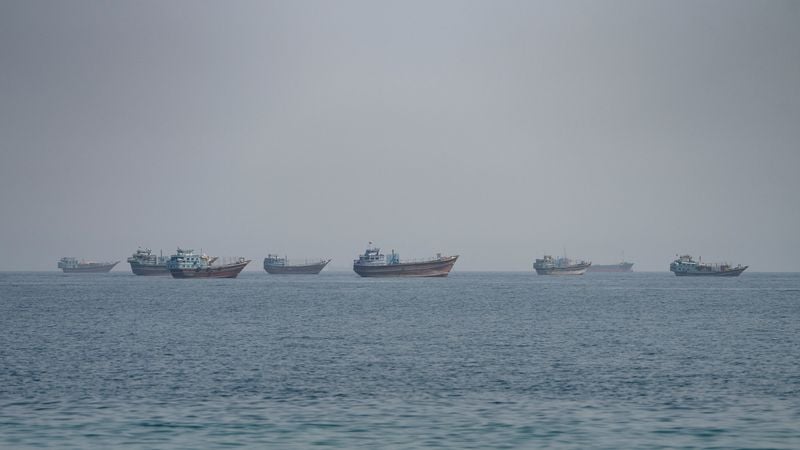
At 16:27 UTC on 7 July 2026, news wires began carrying footage from the Strait of Hormuz: Iranian forces had intensified attacks on commercial vessels in the narrow corridor between Iran and the Arabian peninsula. By 16:59 UTC, Tehran had publicly asserted a sovereign right to control "parts" of the waterway. By 22:36 UTC, a second wave of strikes on Iranian territory was reported under way, and US authorities had revoked a general license that had allowed Iran to export oil, the instrument Tehran had used to monetise its crude while formal sanctions remained in force. The arc — from asymmetric harassment of foreign shipping, through a declared claim of partial sovereignty, to a kinetic US response and a financial chokehold — unfolded inside a single trading session on a Tuesday in early July.
What happened in those hours is not a flashpoint. It is a reversion. The narrow thirty-mile-wide corridor through which roughly a fifth of the world's seaborne oil passes has been a contested military space for forty years; on this Tuesday, it returned to one.
What the day actually contained
The sequence, as it emerged across the afternoon and evening of 7 July 2026, had three distinct phases.
First, the maritime phase. According to a Guardian-sourced alert circulated by market-news channels shortly before 17:00 UTC, Iran had intensified attacks on commercial vessels in the Strait of Hormuz. Iran International and wire reporting in subsequent days traced the most prominent strikes to the Islamic Revolutionary Guard Corps (IRGC), the regime's expeditionary arm, rather than to the regular navy — a distinction that matters, because IRGC maritime action is what Tehran uses when it wants to retain plausible deniability and to weaponise ambiguity about which part of the Iranian state acted. Three commercial vessels in transit were named in early reports.
Second, the sovereignty phase. Within hours, Tehran declared a right to control "parts" of the strait. The phrasing is precise: not full closure, not blockade, but the assertion of partial jurisdiction over a waterway that international maritime law has consistently treated as an international strait in which transit passage must remain unimpeded. The claim sits on top of decades of IRGC harassment — seizures of tankers, drone strikes, mine-laying exercises — designed to demonstrate that Iran can, at moments of its choosing, make the world's most important oil corridor uninsurable.
Third, the US response. Reporting from Axios, circulated by market-news accounts shortly after 19:00 UTC, indicated that the United States had revoked Iran's oil-export waivers in response to the IRGC attacks. By 22:36 UTC, additional reporting described a major US bombing campaign against targets in southwestern Iran. By 23:11 UTC, correspondent Trey Yingst reported that US forces were actively striking southwestern Iran in response to the IRGC action against the three commercial vessels.
The financial instrument — the oil-export license — deserves particular attention. A general license is a permission slip issued by the US Treasury that, even when sanctions are in force, carves out specific categories of permitted activity. By revoking it, Washington has not only tightened the screws further on Iranian revenues; it has signalled that the carve-out was a privilege, not an entitlement, and that maritime force and oil access are now treated as a single ledger.
Why the Strait, and why now
The Strait of Hormuz is the narrowest segment of the route by which oil leaves the Persian Gulf. It is bounded by Iran to the north and Oman to the south. Through it, on most trading days, passes the crude that fills the tanks of Korean, Japanese, Indian, Chinese and European refineries. Insurance premiums on tankers transiting the strait are a leading indicator of how the rest of the world reads the risk; war-risk premia crossing a threshold, or oil-tanker flags starting to be withdrawn, does more to move the price of Brent than any communique.
The strategic logic of the recent escalation runs in two directions at once, which is part of what makes escalation so hard to reverse. From Iran's side, the strait is leverage: an ability, at relatively low cost, to threaten global supply without confronting a peer military directly. From the US side, the strait is a treaty obligation under which Washington has, since the Carter Doctrine of 1980, declared that it will use force to keep the Gulf's oil flowing freely. The two logics have lived in unstable coexistence for decades — punctuated by the Tanker War of the late 1980s, by Iranian mine-laying in the strait in the 1990s, by seizures of tankers under the Obama administration, and by drone strikes on Saudi oil infrastructure in 2019. The events of 7 July 2026 sit inside that pattern.
A second-order factor is the broader shape of US-Iran relations. Reporting on diplomatic channels in recent weeks had emphasised back-channel contacts mediated by Oman and Qatar, in part designed to keep a narrow corridor of de-escalation open. The revocation of the oil-export license — a measure that would have been unthinkable in the middle of a serious negotiation — is itself a piece of evidence about how those talks stood when the maritime attacks began.
The claim that doesn't quite hold
Two interpretations of this sequence are available, and the gap between them matters.
The dominant read, in most Western wire reporting, is that Iran is escalating and the US is responding. The pattern — IRGC harassment, a sovereignty claim, then US strikes — fits that frame. Under this reading, Tehran has decided that the leverage value of disrupting the strait now exceeds the cost of an American counter-strike, perhaps because the strait is currently more important to Iran's adversaries than to Iran itself: Iran exports relatively little crude through the legal licensing channel anyway, so the loss of the license is not the central cost, but the American response raises domestic pressure inside Iran in unpredictable ways.
A second read, available in more cautious analyst notes and in some market commentary, runs in the opposite direction. It holds that the IRGC action may not reflect a single coherent Iranian decision. The IRGC's hardline faction has, in past cycles, launched operations that the regular Iranian state had not authorised — most clearly during the early months of the previous Trump administration, when IRGC projectiles struck US positions in Syria without, by most accounts, a green light from the Supreme National Security Council. Under this reading, Tehran is dealing with a domestic actor that has both the capability and the incentive to provoke a wider war, and the US response is treating the whole of Iran as the responsible party. Both readings are coherent; the evidence on this Tuesday does not yet allow a confident choice between them.
The financial-architecture layer
What most reporting on the 7 July escalation has not yet absorbed is that the US response was not just kinetic. The revocation of Iran's oil-export license is an act of financial statecraft. A general license is the kind of instrument Washington uses when it wants to adjust pressure without rewriting the underlying sanctions architecture; pulling it tightens the screws without provoking a separate legal fight. But the timing — within hours of the maritime strikes, and on the same day as the bombing — folds finance into the military cycle. Maritime violence and oil access are now treated as a single ledger.
This matters because the oil-export license had functioned, in effect, as a release valve. By allowing a defined quantity of Iranian crude to reach international markets under controlled conditions, it kept price premia lower than they would otherwise be and gave Tehran a partial revenue flow. Closing that valve will, on the timeline of days and weeks rather than hours, raise the cost of any escalation to Iran's external customers — China and India in particular — and will accelerate the search for non-dollar payment channels around Iranian crude that began earlier this decade.
That is the structural pattern: every time the US tightens the financial screws on a sanctioned oil exporter, the response downstream is some version of settlement outside the dollar system, denominated in yuan, dirham, rupee, or local-currency escrow. The recent escalation does not invent that pattern; it intensifies it.
The stakes, concretely
On a 30-day horizon, the operative stakes are not in Iran or the United States but in the refineries that depend on the strait remaining open. Shipping insurance is priced in days; tanker rerouting decisions are priced in weeks. If premia cross a threshold at which owners refuse to transit, three Asian economies — South Korea, Japan, and India — face immediate crude-supply gaps. China has built up strategic reserves and has been increasing non-dollar trade with Iran for several years; it is better cushioned than Tokyo or Seoul, but not immune.
On a six-month horizon, the stakes are financial. Each escalation in the strait accelerates two ongoing processes: the diversification of trade settlement currencies by Iran's customers, and the slow institutionalisation of dollar-workarounds for sanctioned states. Both processes are already underway; the question is whether the events of 7 July 2026 accelerate them into a phase where they become features of the system rather than workarounds within it.
On a multi-year horizon, the question is whether the Carter Doctrine, the underlying US commitment to keeping the Gulf's oil flowing, has reached the limit of what it can sustain. The US Navy's posture in the Gulf has been the world's most expensive insurance policy for forty years. Each escalation raises, quietly, the question of how long it remains the cheapest option for the United States.
What remains uncertain
The sources available at the close of 7 July 2026 do not yet establish several things that will shape the next phase of the story. They do not specify whether the diplomatic channels that had been running through Oman and Qatar before the escalation have now been suspended, or whether they remain a quiet line. They do not establish the identity of the three commercial vessels named in early reporting, nor the flag states under which they were operating. They do not specify the precise scope of the US bombing campaign beyond its geographical framing as "southwestern Iran," nor whether it has been confined to IRGC facilities or extended to regular Iranian military infrastructure. They do not specify how Iran's customers — China, India, and others — have begun to react in real time, beyond the general posture that such customers have held in previous escalation cycles. And the dominant framing — that the IRGC action reflects a unified Iranian decision — has not been independently confirmed against alternative explanations. These are the points on which the next forty-eight hours of reporting will turn.
Desk note: The wire in the hours after the strikes emphasised the maritime phase and the kinetic response. Monexus's read is that the revocation of the oil-export license belongs to the same story and is in some ways the more durable piece of it.
Wire provenance
This editorial synthesis draws on the following public wire/social posts:
- https://t.me/osintlive
- https://t.me/megatron_ron
- https://t.me/megatron_ron
- https://t.me/osintlive