China moves to wall off its frontier AI from foreign users, drawing Alibaba, ByteDance and Z.ai into early consultations
Beijing is preparing to forbid overseas access to its most capable models. The consultations now underway with Alibaba, ByteDance and Z.ai signal that the world's second-largest AI power intends to treat frontier weights as a strategic asset.
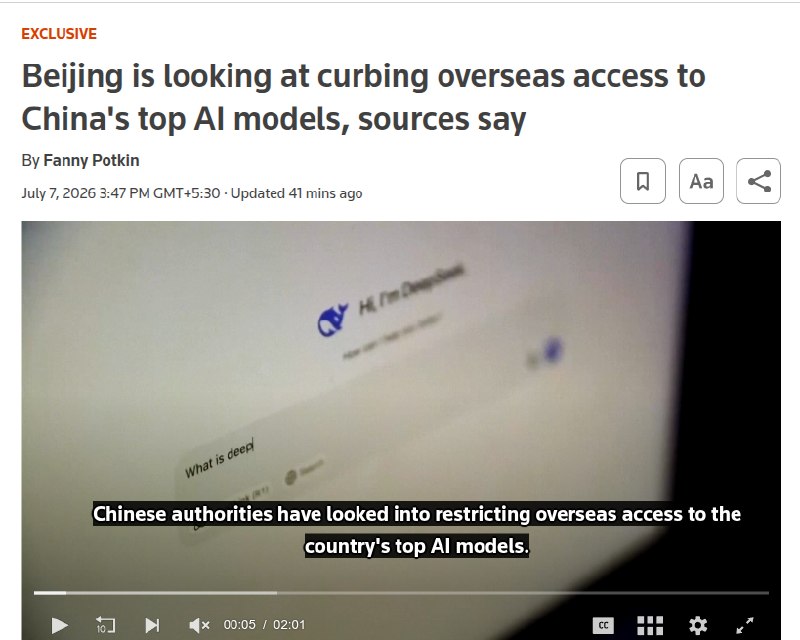
China's Ministry of Commerce has begun formal consultations with the country's largest model-builders over a plan to deny foreigners access to the country's most advanced AI systems. According to three separate industry channels reporting the development on 7–8 July 2026, officials have already sat down with Alibaba, ByteDance and the Beijing-based lab Z.ai, with the explicit aim of keeping frontier-grade Chinese weights inside the domestic market.
The move, if enacted, would redraw the geography of frontier AI. For two years Chinese labs have shipped openly — releasing model weights, hosting public APIs, courting global developers. The new posture would invert that, treating cutting-edge AI less as a commercial export and more as a sovereign resource on par with semiconductors, telecommunications equipment and rare-earth processing technology. It also lands at a moment when US export controls on advanced GPUs have bitten into Chinese training runs, sharpening the case in Beijing that what remains domestically must be defended as an asset rather than given away for marginal revenue.
What the consultations actually cover
The early rounds of engagement, as described by the channels that surfaced the story, are narrowly focused on frontier-tier systems — the models that compete at the top of widely cited benchmarks, not the long tail of open-source releases that Chinese labs also maintain. Ministry of Commerce officials are said to be working through a definition of "frontier" that would hold up against rapid iteration: a fixed parameter count, an external benchmark threshold, or some combination. The choice matters, because every Chinese lab's roadmap assumes the label will move with capability rather than freeze on a static spec sheet.
Alibaba's cloud unit and ByteDance's Doubao team both operate flagship models that would plausibly fall inside any reasonable frontier definition. Z.ai, the spin-out best known outside China for its GLM family, has positioned itself explicitly as a frontier house. None of the three has publicly confirmed the substance of the meetings; the consultations are being treated as policy-preparatory, which in Beijing practice means a rule is being drafted and the industry is being given a chance to shape its edges before publication.
A secondary question the channels flag is enforcement. A frontier-model restriction has to define who counts as a "foreign user," what counts as "access," and which technical pathways — API, hosted chat product, downloadable weights, research collaboration — fall inside the perimeter. Each of those definitions is technically tractable and politically charged.
Why now: the structural pressure on both sides
The timing is not accidental. From Beijing's vantage point, three pressures are converging. First, the US Commerce Department's successive rounds of GPU export controls have throttled the supply of leading-edge accelerators available to Chinese labs, making each remaining training cluster more strategically valuable. Second, China's own domestic AI market is large enough to absorb the output of its leading labs without recourse to overseas customers; marginal foreign revenue is no longer the make-or-break variable it was in 2023 and 2024. Third, frontier-model capability is increasingly read inside China's policy establishment as a general-purpose dual-use technology — useful for scientific research, certainly, but also for cyber operations, autonomous systems, surveillance-adjacent applications, and the long catalogue of "intelligent warfare" use-cases that Chinese military writings have begun to enumerate openly.
From Washington's vantage point the policy choice looks familiar: the same logic that produced the October 2022 chip-export regime, the October 2023 refresh, and the successive tightening of advanced-node lithography rules is now being mirrored from the other side of the Pacific. The asymmetry, however, is real. The US controls targeted physical inputs that flow through a narrow list of choke points. China would be restricting a digital output that can be exfiltrated through a thousand routes — API calls, paper publications, model distillation, researcher mobility — and the policy's effectiveness will turn on whether Beijing can police those routes more credibly than Washington has policed its own.
What the Chinese argument looks like, stated fairly
The Chinese position, when pressed, is not principally about commercial protectionism. Officials and state-aligned commentators have argued for two years that AI capability is closer to electricity or telecommunications infrastructure than to consumer software: a base-layer technology whose uncontrolled diffusion reshapes power balances in ways the originator cannot retrieve. The standard formulation, repeated in policy journals and at trade forums, is that a country which has invested heavily in a general-purpose technology is entitled to govern its outbound flow the same way any country governs arms, cryptography, or dual-use chemicals. The structure of that argument is not unique to China; it tracks debates inside the United States and the European Union about outbound investment screening and AI diffusion rules. The difference is one of starting point: Washington's default is permissive export with targeted controls; Beijing's default is restricted export with targeted releases.
A second, more practical strand of the Chinese argument is reciprocity. Chinese labs point out that US frontier models are already effectively unavailable inside China through normal commercial channels — the major US houses do not serve Chinese end-users, and Chinese-developed applications built on top of US APIs have been progressively delisted. From that vantage point, a Chinese restriction on outbound frontier access looks less like a provocation and more like a symmetric adjustment to a wall that was already half-built from the other direction.
The plausible alternative reads
Two competing framings deserve airtime before settling on a verdict. The first reads the move as straightforward industrial policy: Chinese labs are catching up fast, and the easiest way to convert capability into leverage is to deny foreigners the chance to evaluate, fine-tune, and benchmark against the latest weights. Under this reading, the policy is essentially a quality-control mechanism dressed in sovereignty language.
The second reads the move as a defensive response to a specific export-control escalation — most plausibly a forthcoming US or allied tightening that would, in Beijing's calculation, make frontier Chinese models the only training-quality weights reachable in large parts of the Global South. Pre-emptively closing the door, on this account, preserves Beijing's room to negotiate later openings from a position of scarcity rather than glut.
The framing that holds up best against the available reporting is a hybrid. Beijing is doing what successful latecomer industrial powers have historically done with general-purpose technologies it views as strategically decisive: controlling the spigot, defining the categories, and reserving the right to grant exceptions case by case. The model is closer to France's approach to nuclear technology in the 1970s, or Japan's management of semiconductor lithography in the 1980s, than to a one-off protectionist gesture. Whether that comparison is flattering or unflattering depends on where the reader sits.
Stakes and what remains unresolved
For multinational software companies that have built Chinese models into their global product roadmaps, the practical consequence is straightforward: route access to frontier-tier Chinese systems through domestic Chinese subsidiaries, with the friction, latency and compliance cost that implies. For the open-source community — which has long treated Chinese model releases as a public good — the stakes are higher. Z.ai and other Chinese houses have been among the most prolific releasers of competitive open weights in 2025 and 2026. A frontier restriction does not necessarily forbid open releases of mid-tier models, but the line between "frontier" and "near-frontier" is exactly where most of the useful release activity happens.
For the Global South, the policy carries a clear second-order signal. Countries that had positioned themselves as neutral ground — hosting Chinese, American and European model deployments side by side — should expect Beijing to push for greater control over which frontier systems their researchers and government agencies can reach. The diplomatic texture of AI diplomacy, already thickening, will get heavier.
Three things the public record does not yet resolve. First, the precise definition of "frontier" the Ministry of Commerce will land on — and whether it will be a static technical threshold or a dynamic, regulator-discretionary label. Second, the scope of the carve-outs for academic collaboration, which both Chinese and foreign researchers have an interest in preserving. Third, the enforcement perimeter: whether the rule will function as a hard legal ban, a licensing regime, or a softer administrative-guidance document that gives regulators discretion. The consultations now underway are precisely the period in which those three parameters get set.
Until those details land, the direction of travel is the news. Beijing has decided that frontier AI is a resource it can no longer afford to give away as a free good, and it is using the same playbook it has used for telecoms equipment, rare earths and dual-use chemicals. The rest of the world is now negotiating whether to accept that framing or to push back — and the answer will shape which AI systems are available where, on what terms, for the rest of the decade.
Desk note: the wire today is overwhelmingly Western, and frames this story as a Chinese turn inward. Monexus has steelmanned the Chinese position — frontier weights as strategic infrastructure, reciprocity against a US export regime that has been tightening for three years — while noting the enforcement questions Beijing has not yet answered.
Wire provenance
This editorial synthesis draws on the following public wire/social posts:
- https://t.me/aipost
- https://t.me/producthunt
- https://t.me/AngelList