The blockade that isn't, and the oil market that won't behave
On 8 July 2026 the US president publicly dangled a naval blockade of Iran, admitted oil would spike, and read out a putative Iranian funeral-promise. The market read the script.
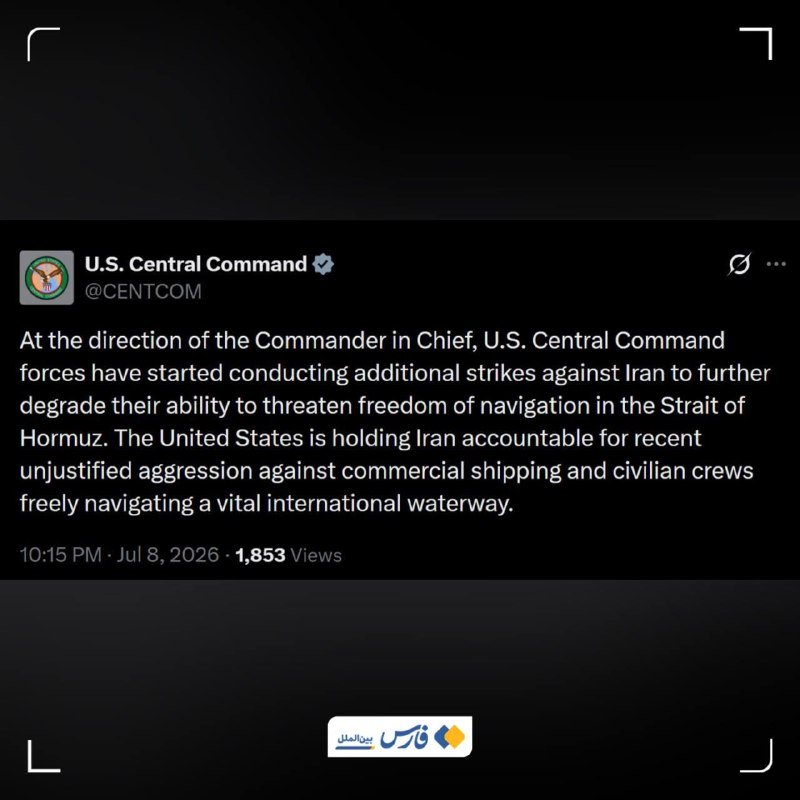
By 14:24 UTC on 8 July 2026, the United States had not blockaded the Strait of Hormuz. It had, however, made sure everyone knew it might. Open Source Intel carried the remarks as the US president told reporters that a blockade "will only be a blockade for Iran," warning that Tehran "of course, they'll drop some mines if they can," and separately noting that Fox News had been briefed that the US military was "prepared to reinstate" such an operation if ordered. The statements were rhetorical more than operational — but the oil market does not draw that distinction for free.
The point of the exercise, stripped of theatre, is that an American blockade of Iranian exports has become a casually invoked lever. That is the story beneath the story.
A blockade you announce before you impose
An effective maritime interdiction is, by construction, a fait accompli. Mine-clearance vessels reposition overnight; insurance underwriters revise war-risk premia within hours; refiners in Asia scramble for non-Iranian barrels on a Sunday night. What an effective blockade cannot survive is a press conference in which the blockading power's own head of state enumerates the countermeasures the target will take. Yet that is precisely what happened at 14:24 UTC. The declaration functioned less as an operational order than as a price signal — a way to remind Brent traders that a tightening lever exists, and that pulling it is back on the table.
The same briefing cycle carried the now-familiar quasi-confession: "Anytime we hit Iran, oil goes up. It's alright." The candour is the point. There is no pretense that the policy is costless; the pretense is only that the cost will be borne by someone other than American consumers. Whether that is true depends on whether the blockade is real or merely threatened — and on 8 July it remained, unmistakably, the latter.
The nuclear site that nobody else can reach
Minutes later, at 14:55 UTC, the briefing pivoted to Iran's enrichment infrastructure. The US president described the relevant facility as buried so deep beneath a mountain that "nobody's going to be able to get it except us, because we have the equipment." The boast is worth reading carefully. It is simultaneously a deterrent signal to Tehran — Washington's reach exceeds that of regional rivals — and a quiet admission that the problem cannot be solved by Israel alone. It also tells the Iranian negotiator that the American bargaining position rests on a unique strike capability rather than on a diplomatic off-ramp.
The structural point: enrichment facilities sited under mountains are not disarmed by negotiation; they are disarmed either by access (which requires a deal Iran has no present incentive to sign) or by a strike whose political and economic spillovers the US president openly concedes in advance. Neither option is cheap. Both are now in the conversation.
Lebanon, hostage talk, and the choreography of threats
The same 14:55 UTC tranche included the prediction that Israel would "withdraw troops from southern Lebanon." Read in isolation, it looks like a confidence-building gesture. Read against the rest of the day's signalling, it is one more instrument in a portfolio: blockade against oil, leverage against enrichment, a calibrated troop-pull forecast against the Iran-aligned axis. Each instrument is announced separately; the cumulative effect is to compress the Iranian decision space.
The funeral remark fits the same pattern. The US president claimed Iran had asked the US not to strike during an Iranian funeral, that he had agreed, and that Iran then "attacked three ships." If accurate, the implication is that Iranian bad faith has closed off the restraint channel. If partially constructed — the kind of claim that often comes wrapped in unattributed anecdote — it functions as the rhetorical permission slip for the next escalation. The sources do not specify which of the two readings is correct, and that ambiguity is itself part of the signalling.
What this looks like in the oil complex
A threatened Hormuz blockade is a tax on shipping war-risk premia. Lloyd's-listed underwriters re-price transit within hours of credible signalling. Asian refiners — the marginal buyers of Iranian crude — quietly line up Saudi, UAE and US Gulf barrels as a hedge. The price spike the US president openly anticipates is, in this sense, a privately collected tariff that funds the geopolitical posture. US consumers absorb the upstream cost at the pump; the Treasury avoids the line-item cost of a formal operation. That arithmetic is what makes the threat usable in a way that actual deployment would not be.
The counter-frame is that credible threats, repeatedly withdrawn, lose force. Each round of announcement-then-non-event erodes the deterrent premium. Iranian planners, watching the briefing cycle in real time, learn exactly what the US will telegraph in advance — and what it will not. That asymmetry favours the patient negotiator and penalises the impulsive declarator.
Stakes, and what to watch
If the trajectory continues, three things become more probable. First, the oil curve shifts into a permanent risk premium of one to three dollars a barrel on the threat alone, irrespective of whether a blockade is ever imposed. Second, Iran accelerates the dispersal of its export infrastructure — floating storage, dark-fleet ship-to-ship transfers, refinery-of-record arrangements — that makes a future interdiction more porous. Third, the credibility ceiling on US signalling drops, leaving future administrations with fewer cheap rhetorical levers and a higher threshold for genuine action.
What the sources do not resolve is the most important question: whether 8 July was bargaining or prelude. The US president does not always distinguish the two for his audience, and the oil market, for its part, prices the worst reading first. That is the asymmetry this publication will be tracking.
— Monexus Staff Writer
Desk note: Monexus treated 8 July's briefing cycle as a single signalling event rather than three separate stories, on the view that the blockade threat, the enrichment boast, and the Lebanon forecast are instruments of one posture. The framing departs from wire copy, which reported each remark as a discrete headline.
Wire provenance
This editorial synthesis draws on the following public wire/social posts:
- https://t.me/s/osintlive
- https://t.me/s/osintlive
- https://t.me/s/osintlive
- https://t.me/s/osintlive
- https://t.me/s/osintlive
- https://t.me/s/osintlive