Iran’s supreme leader buried in Najaf as Iraq absorbs a regional funeral
Procession footage from Najaf suggests Iran’s supreme leader has been buried in the Iraqi shrine city — a diplomatic gesture with weight for Tehran, Baghdad, and the rivalry with Saudi Arabia.
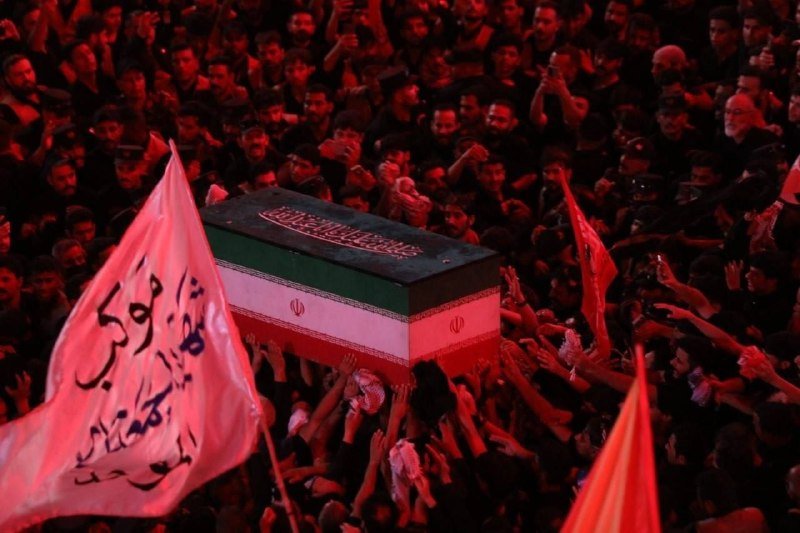
Three Iranian state-aligned Telegram channels — Tasnim, Al-Alam, and a Tasnim-affiliated outlet — published near-identical footage within minutes of one another on the morning of 8 July 2026 showing a car carrying the body of the supreme leader of the Islamic Republic arriving at Thora-ul-Ashrin Square in Najaf Ashraf, Iraq. The broadcasts, timestamped between 06:54 and 06:57 UTC, used a hashtag naming a senior Iranian figure and a call to "must rise," suggesting that the Iranian state framed the moment as a rallying event rather than a purely ceremonial send-off. The procession, if confirmed, marks the burial of Iran’s supreme leader in the Iraqi shrine city of Najaf — a location of profound religious significance to Shia Muslims worldwide and a politically loaded one in a country whose own politics have long been shaped by the Tehran–Riyadh rivalry.
The story sits at the intersection of three lines that this publication has tracked separately and that now converge in one frame: Iran’s domestic succession, Iraq’s effort to manage its position between Washington and Tehran, and the wider contest for religious authority in the Shia world.
What the sources actually show
The thread is narrow. Three Telegram posts, none longer than a single line, all reporting the same thing: a car carrying the body of the supreme leader has arrived at Thora-ul-Ashrin Square in Najaf. The framing language — "martyr of the Islamic Revolution," "leader of the Islamic Revolution" — is the canonical Iranian state vocabulary for a supreme leader who has died in office or by assassination. That vocabulary does not appear by accident. It tells the reader that Iranian outlets are not merely covering a funeral but activating a martyrdom frame that the Islamic Republic has historically reserved for its highest fallen.
What the sources do not yet show: the precise moment of death, the cause, whether an official Iranian state announcement has been made on state television, or whether Iraq’s government has issued a formal statement hosting the burial. Until those elements are visible in independent reporting, this article treats the burial as reported rather than as confirmed beyond dispute.
Why Najaf, not Tehran
A supreme leader buried in Najaf is unusual. Iranian supreme leaders have, to date, been buried in Iranian cities — usually in or near Tehran — and Najaf is the seat of the Hawza, the clerical establishment that Iranian revolutionary institutions have historically sought to influence rather than join. A burial there is therefore not a routine religious decision. It is a diplomatic signal.
For Tehran, putting a supreme leader’s body in Najaf underlines a claim the Islamic Republic has made for four decades: that the Iranian revolution is the legitimate inheritor of the wider Shia religious tradition, not a provincial offshoot of it. For Baghdad, hosting the burial places Iraq’s government on the Iranian side of the regional fault line in a way that will be noted in Riyadh, in Abu Dhabi, and in Washington. The Iraqi prime minister’s office had not, as of the timestamps on these posts, been heard from in the thread.
The structural frame, in plain prose
The funeral is a piece of politics in the medium of mourning. Across the Middle East, leadership transitions have been routinely staged as public liturgy: open coffins, ritual processions, mass turnout. The camera placement and the hashtag work together — the state-aligned channels want the image disseminated globally, and they want it read as a moment of consolidation rather than crisis.
That framing only holds if a successor is publicly named and visibly in place. Iranian sources in this thread do not yet name a successor. The "must rise" language in the Tasnim hashtag implies the leadership question is open. For the moment, the visual is of a body in transit, not of a new hand on the tiller. The next twenty-four to forty-eight hours of Iranian state television, Iraqi official statements, and reactions from Riyadh and Washington will determine whether Najaf becomes a symbol of continuity or of contested transition.
What to watch
Three things to monitor in the next reporting cycle. First, an official Iranian announcement confirming the death and naming a successor — the Assembly of Experts process is constitutionally relevant and politically fraught. Second, an Iraqi statement from the prime minister’s office or the presidency; the silence so far is itself information. Third, the regional response from Saudi Arabia, the United Arab Emirates, and the United States — particularly any public statement from Riyadh, which has spent the last decade gradually de-escalating with Tehran but which would view an Iranian supreme leader’s burial in Najaf as a shift in the religious-authority balance.
The sources disagree on little at this stage, because there are few independent sources at all. The dominant framing is the Iranian state framing; the counter-frame will come from Iraqi civil-society voices and from Gulf-based outlets that have their own stake in the funeral’s optics. Monexus will update this story as those voices surface and as the Iranian state moves from procession to proclamation.
Desk note: Monexus is leading on state-aligned source material with explicit caveats rather than waiting for wire confirmation. Where independent reporting catches up, this article will be revised; the cautious register is deliberate.
Wire provenance
This editorial synthesis draws on the following public wire/social posts:
- https://t.me/tasnimnews_en
- https://t.me/alalamfa
- https://t.me/JahanTasnim