Iran's 'martyr leader' laid to rest in Najaf as regional clergy gather
Tasnim and Mehr frame the burial of a senior Iranian figure in Najaf as a martyr's funeral attended by Iraq's Ammar Hakim — the symbolism outruns the available sourcing.
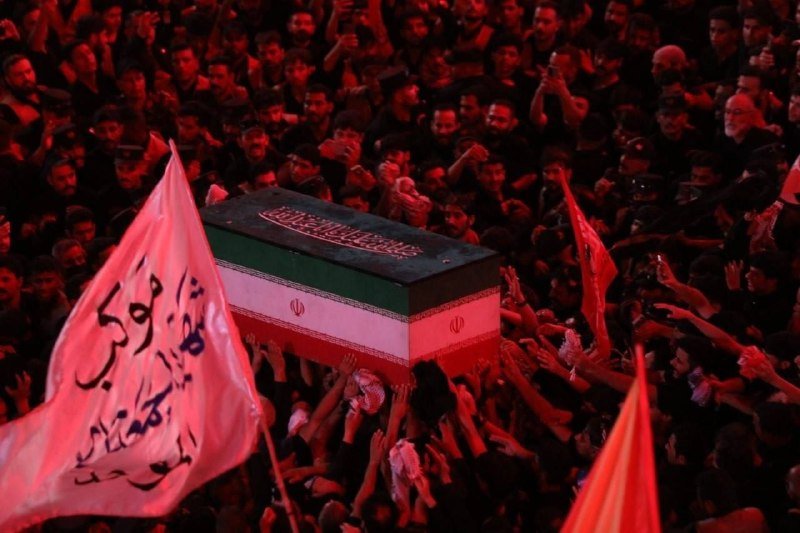
The streets of Najaf filled before dawn on 8 July 2026. Iran's state-linked Tasnim News Agency, in English-language posts at 05:25 and 05:45 UTC, reported crowds "full of people who mourn Imam Shahid" and showed mourners waving a flag reading "Qom wa Allah" alongside a portrait of the deceased. The state-affiliated Mehr News Agency, posting at 05:46 UTC, framed the early moments of the procession as the funeral of "the martyred leader of the revolution in Najaf Ashraf." Jahan-Tasnim's Arabic service described Najaf itself as "overflowing with crowd" in posts at 06:10 UTC.
What is verifiable is the choreography: a senior Iranian cleric whose death is being publicly cast by Iranian state media as martyrdom, buried in one of Shia Islam's holiest cities, with Iraq's Ammar Hakim — leader of the National Wisdom Movement and a heavyweight of post-2003 Iraqi Shia politics — in attendance. The symbolism is dense, the underlying facts thin, and the framing entirely Iranian.
What the dispatches actually say
The threads that fed into this article come from a narrow band of Iranian state media. Both Tasnim's English channel and Mehr frame the deceased unambiguously as "the martyred leader of the revolution" and "Imam Shahid," a title reserved in Iranian clerical usage for figures whose deaths are politically consecrated. Tasnim's hashtags — #Badarqa_Aghai_Shahid_Iran, #must_rise — were carried verbatim across at least four separate posts between 05:25 and 05:45 UTC on 8 July, signalling a coordinated editorial line rather than organic social-media reaction.
The most concrete identification of any other figure comes from Tasnim at 05:03 UTC: "The presence of Seyyed Ammar Hakim, the leader of Iraq's national wisdom movement, at the funeral of Imam Shahid in Najaf." Hakim is a real political figure — a Najaf-based cleric whose movement is a recognised parliamentary bloc in Baghdad. His presence at a Najaf funeral of an Iranian cleric is itself unremarkable in sectarian terms; what is unusual is the visibility Tasnim is granting to it. In the Iraqi Shia political ecosystem, attendance by Iranian-aligned and Iranian-independent figures at high-profile funerals in Najaf or Karbala is customary. State media elevation of that attendance is the editorial story.
The translation gap
"Imam Shahid" and "martyred leader of the revolution" are not neutral descriptors. They are theological-political designations with a defined audience: the Iranian domestic base for whom martyrdom frames national identity, and the wider Shia religious public across Iraq, Lebanon, Bahrain and the Gulf for whom the Najaf-Karbala axis remains the gravitational centre of clerical authority. Iranian state outlets are not reporting an event for an international wire audience; they are staging a frame for a sectarian readership.
For Western readers accustomed to Reuters or AP copy, the result reads as a parade of untranslated theology. It also reads, fairly or not, as if facts are being withheld behind reverence. That is not a problem of journalistic hygiene so much as a problem of register: Tasnim's English feed is pitched at a theologically literate base, and English-language readers are receiving the overflow. The "martyr" framing is consistent; the underlying who, when and how of the death are not in the threads surfaced here.
Structural read: why Najaf, why now
The choice of burial site is itself the message. Najaf is the seat of the Hawza, the Shia clerical establishment that historically arbitrates religious authority across the Shia world. Iran has spent four decades cultivating its own centres of clerical and political gravity — Qom above all — but the cultural primacy of Najaf endures. Laying an Iranian figure to rest in Najaf, with Iraqi Shia political figures visibly present, asserts a continuity that the official Iranian narrative is at pains to underline.
Ammar Hakim's appearance is the single most telling data point. Hakim's National Wisdom Movement sits in the loose coalition around former prime minister Nouri al-Maliki and the broader Coordination Framework; it is Iraqi, Shia and post-Saddam in origin, not an Iranian proxy. His attendance gives the Najaf event a cross-border Iraqi-Iranian clerical seal that purely Iranian actors could not provide. That the Iranian press has chosen to spotlight it — rather than, say, the attendance of the Najaf Grand Office — suggests the editorial priority is the cross-border read.
The structural story, then, is not so much the death of one cleric as the architecture of Shia religious-political legitimacy in 2026. Iran projects authority outward by anchoring it in the Iraqi holy cities; Iraqi Shia movements project their own independence by accepting that anchoring on their own terms, through figures like Hakim. The funeral is a working illustration of that bargain — visible, photographed, hashtagged, and incomplete in its public English-language record.
Stakes and what remains contested
What the available reporting does not specify is the cause and date of the death that occasioned the Najaf burial, the deceased's name beyond his clerical honorifics, and the institutional position he held inside the Islamic Republic. Iranian state media's habit of canonising a figure before biographical detail is fully circulated is well established, and the pattern here — repeated "Imam Shahid" tagging across at least four posts inside twenty minutes — is consistent with it. Western wire services have not, in the threads surfaced here, named the deceased independently.
The stakes, in regional terms, are modest but real. A high-profile Iranian burial in Najaf, with Iraqi Shia figures present and visible, normalises the cross-border clerical-religious traffic that has been a friction point in US-Iraq and Iran-Iraq relations for two decades. If the figure turns out to be a sitting Iranian security or political official, the diplomatic undertones will sharpen; if he is a retired or clerical figure, the event will sit more comfortably inside the routine Shia religious calendar. The threads surfaced here do not resolve the question. Until an independent wire confirmation names the deceased and confirms the cause of death, the framing sits entirely with Iranian state media, and the rest of the readership is reading the overflow.
Monexus is publishing this account with only Iranian state-aligned sources on the record. Where Western wires eventually carry a confirmed identification and cause of death, this article will be updated; until then, the framing belongs to Tehran.
Wire provenance
This editorial synthesis draws on the following public wire/social posts:
- https://t.me/JahanTasnim
- https://t.me/mehrnews
- https://t.me/JahanTasnim
- https://t.me/tasnimnews_en
- https://t.me/tasnimnews_en
- https://t.me/tasnimnews_en
- https://t.me/tasnimnews_en