The Strait Cannot Hold: What the Iran-US Air-and-Sea Skirmish of July 8 Reveals About the End of the Long Deterrence
Anti-ship missiles fired at US Navy vessels and a follow-on USAF strike on the southern port of Sirik, hours apart, mark the first direct US-Iranian exchange since February — and the first in or near the Strait under a wartime tempo.
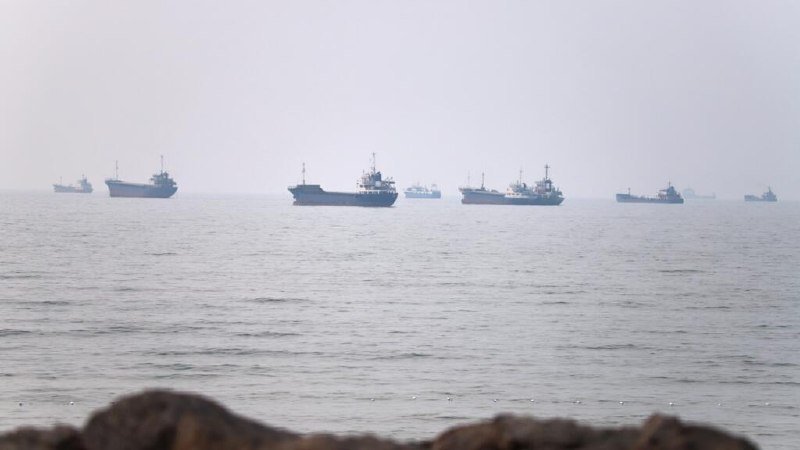
In the small hours of 8 July 2026, channels affiliated with Iran's IRGC Ministry of Intelligence carried word that IRGC Navy forces had fired anti-ship missiles at US Navy vessels in the Gulf, and Western-aligned military monitors circulated footage of a US Air Force strike on the southern Iranian port of Sirik. The two dispatches landed within hours of each other. They do not, on their own, prove a sustained exchange of fire: one is sourced to Iranian state-aligned channels, the other to a Telegram war-monitor account that aggregates open-source imagery. Read together, however, they describe an operational tempo that has not existed between the United States and Iran since the February flare-up — and they pose a sharper question than the headlines suggest. The question is not whether Washington and Tehran are at war. The question is whether the deterrence architecture that has kept the Strait of Hormuz quietly commercial for the last forty years still exists in any operational sense.
What the dispatches actually say
The first item, timestamped 00:37 UTC on 8 July, comes from the Telegram channel BellumActaNews citing IRGC Ministry of Intelligence outlets: it reports IRGC Navy anti-ship missile launches against US Navy ships, with no geographical specifics in the thread body. The second, timestamped 22:43 UTC on 7 July, reports a USAF airstrike against Sirik — a port on Iran's southern coast roughly 160 kilometres east of the Strait's narrowest point. The third, from WarMonitors at 22:47 UTC, frames the pair as a return to a much older geography of regional power: "It's 793 AD all over again." Read in reverse chronological order, the sequence is reverse of the actual event flow — the Sirik strike lands first in the local day, the missile report follows in the early hours of UTC 8 July, which is the local morning of 8 July in Tehran. The arithmetic favours a single operational day, not two separate crises. Reporting on a peer outlet will need to confirm target packages, hit assessment, and the identity of the US vessels involved; the Telegram layer alone cannot answer those questions.
Why Sirik matters
Sirik is not a symbolic target. It is a small port complex in Hormozgan Province that has hosted Iranian fast-attack craft, anti-ship missile batteries, and coastal radar infrastructure designed for the asymmetric maritime doctrine Iran has refined since the 1980s. A strike there, if confirmed by US Central Command or by reliable open-source imagery, would represent the first declared US action against an active IRGC-Navy posture on the mainland in this conflict cycle. A counterpart, IRGC anti-ship missile launches at US surface combatants, would mark the reciprocal: the first time in this exchange that Iran has used its principal maritime-kill weapon system against a US naval target rather than against shipping traffic or proxy forces. The combination is a doctrinal escalation, not a rhetorical one.
The counter-narrative: this may not be what it looks like
Both items originate on Telegram channels that openly align with one side. BellumActaNews's IRGC-sourced citation is an Iranian framing apparatus, designed for both domestic consumption and a regional audience that reads Iranian military Telegram the way Western analysts read CENTCOM releases. WarMonitors adds interpretive spin. Neither is a neutral open-source-intelligence account. It is plausible — though not established by the available threads — that the Sirik strike hit a pre-positioned IRGC launcher rather than a populated port facility, or that the IRGC missile report conflates a test launch with an engagement. Both readings are possible. What is harder to read away is the time-stamp proximity. Two such reports, within hours of each other, on a day with no announced diplomatic track, point to a coordinated escalation rather than two unrelated incidents.
The structural frame: the end of implicit Hormuz
For four decades the Strait of Hormuz has run on an unwritten contract: Iran tolerates commercial traffic in exchange for the world tolerating Iran's coastline. The contract works because the marginal cost of disrupting a fifth of global seaborne oil is high enough that neither side prefers to bear it. That contract has been eroding since 2019, when Iran began incrementally harassing commercial tankers, and it has all but collapsed in 2026 under the weight of two parallel pressures. The first is the Israeli-Iranian air war that began in October 2024, which has pulled US and Iranian assets into a shared operational space inside Osumaq, Ilam, and Lorestan airspace. The second is the steady drift of the US carrier presence out of the Gulf and into the eastern Mediterranean and Arabian Sea, lengthening Iranian response times and, conversely, raising the value of a single Iranian first strike before US air power can be brought to bear. The 8 July sequence reads as the consequence of that drift: a US attempt to degrade Iran's coastal kill chain before it can be used at scale, met by an Iranian attempt to use that kill chain before it is degraded.
Stakes over the next thirty days
If the Iran-US exchange is confined to coastal batteries and isolated naval targets, the commercial oil market will absorb it inside a week. If it spreads to commercial shipping — and the IRGC's stated doctrine explicitly contemplates closing the Strait under existential pressure — the calculus changes. Roughly twenty million barrels of oil a day transit Hormuz. The Insurance war-risk surcharges that followed the 2019 tanker incidents added several dollars per barrel within days; a sustained closure would add tens of dollars per barrel within weeks, with second-order effects on Asian energy importers — China, India, Japan, South Korea — that have spent two years building parallel payment and tanker-scheduling arrangements to insulate themselves from exactly this scenario. Tehran knows that leverage. Washington knows Tehran knows it. The dispatch that says "it's 793 AD all over again" is gesturing, with historical brevity, at the Abbasid-caliphate pivot to a Persian Gulf maritime order under the Tulunids and Samanids. The structural comparison is unfair but illuminating: the prize at stake is not the water itself but the commercial and political system that runs through it.
What remains genuinely uncertain
Two material questions remain open as of this writing. First, the identity, location, and damage state of the US vessels named in the IRGC report. Without confirmation from the US Navy, the Operational Identification of the affected ships, or independent maritime-tracking data (AIS gaps around Hormuz are routine and not by themselves diagnostic), the missile-launch report cannot be verified at more than the channel-sourcing level. Second, the target package of the Sirik strike. A strike on a coastal radar site and a strike on a petrochemical terminal are both compatible with the channel's bare wording; the policy consequences differ by an order of magnitude. Until CENTCOM publishes a release, or until analysts with high-resolution commercial-satellite access publish a before-and-after pair, this article's account of the strike's scope is provisional. Monexus will update as those confirmations arrive.
— Desk note: Monexus is reporting the 7-8 July Iran-US sequence from Telegram-source dispatches rather than wire confirmation. We are flagging the sourcing chain explicitly because the items are operationally significant and because a sustained exchange at this tempo has not been seen since February. Where independent confirmation arrives, this article will be updated accordingly.
Wire provenance
This editorial synthesis draws on the following public wire/social posts:
- https://t.me/BellumActaNews
- https://t.me/BellumActaNews
- https://t.me/WarMonitors