Mass funeral in Najaf closes a week that reshaped Iran's wartime political order
Tens of thousands packed Thawra al-Ashrin Square in Najaf on Wednesday for the burial of senior Iranian figures killed in last week's strikes, a choreography of mourning that doubles as a regional warning.
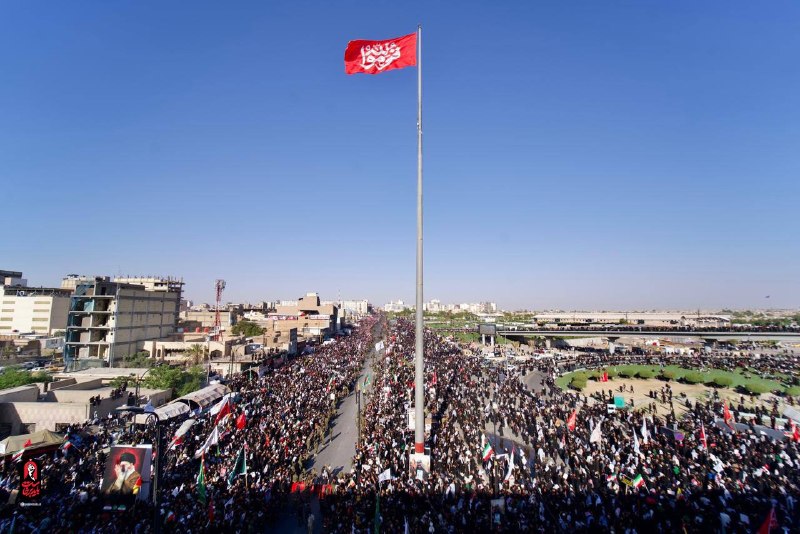
Tens of thousands of Iraqi mourners packed Thawra al-Ashrin Square in Najaf on the morning of 8 July 2026, lining the cortege that carried the bodies of senior Iranian figures described by Iranian state media as commanders of the Islamic Revolution. Tasnim News's English service reported at 06:57 UTC that the vehicles bearing the bodies had arrived at the square, branding the procession #Badrqa_Aghai_Shahid_Iran ("the document of the martyr commander of Iran") under hashtags designed to maximise regional reach.
The funeral is not a private rite. It is a public, choreographed statement about the scale of the losses Iran absorbed in last week's round of strikes, the depth of the Iraqi Shia religious and political establishment's alignment with Tehran, and the message the Axis of Resistance intends to send before any ceasefire talks resume.
A city built for a million, asked to hold many more
Najaf's Wadi al-Salam cemetery, adjacent to the square, is the largest cemetery in the world. It can absorb almost unlimited interment; the city itself cannot. Local authorities have spent the last three days redirecting pilgrims and mourners through side streets, opening overflow prayer spaces in seminaries, and broadcasting the funeral schedule on loudspeakers. Iranian state media has framed the turnout as a referendum on Iraqi sovereignty: the crowds, in their telling, are choosing a pole rather than reacting to one.
Read against the wire-service line that depicts Iraqi Shia politics as a lever between Washington and Tehran, the footage complicates the picture. Crowds in Najaf are not new — the shrine of Imam Ali draws millions each year — but a coordinated Shia-mobilisation framed around martyred Iranian commanders is. It tells us less about Iraqi public opinion than about an institutional infrastructure — Sadrist networks, Badr Corps veterans, Hashd al-Shaabi (Popular Mobilisation Forces) affiliates — that can move hundreds of thousands into a single square on roughly seventy-two hours' notice.
The losses Iran is willing to show
The Iranian state has released the names of the dead in drips rather than a single official casualty list. Western outlets reporting off Iranian opposition channels and Israeli briefings have placed the senior officer toll in the high single digits, with additional losses among Syria- and Lebanon-based intermediaries. Iranian state media, by contrast, is constructing a martyrdom narrative in which the dead are simultaneously battlefield commanders, theological scholars and founding members of the post-1979 order.
This matters because martyrdom framing, in Iranian state discourse, confers legitimacy on successors. The previous cycle of senior casualties — November 2020, the assassination of Mohsen Fakhrizadeh; January 2020, the killing of Qasem Soleimani in a US drone strike in Baghdad; and the November 2023 wave of IRGC losses in Syria attributed to Israeli air strikes — each produced a successor cohort whose authority rested on inheritance of the slain figure's network.
In other words: the bodies in Najaf are being interred, but the institutional places they occupied are being filled. Who occupies them, and with what portfolio, will define the next phase of Iranian regional policy more than any statement from the Ministry of Foreign Affairs.
Why Najaf, not Tehran
Tehran's Behesht-e Zahra cemetery could have absorbed the burials. Choosing Najaf is the message. Najaf is the seat of the Hawza, the Shia clerical establishment that confers religious authority across the Arab Shia world. A burial there is also a burial adjacent to the shrine of Imam Ali, the first Shia Imam — a claim to authority that runs older than the Islamic Republic.
Two readings are plausible. The first, kinder to the Iranian framing, is that the Hawza's symbolic weight was sought because the dead are being cast as transnational Shia figures, not merely Iranian officers. The second, favoured by analysts skeptical of Iranian state media, is that burying figures in Najaf rather than Tehran signals a confidence problem at home: the clerical establishment wants the Iraqi public, not the Iranian public, to be the immediate audience.
A third reading, narrower, is administrative. Iran did not want a replay of the Kerman funeral of Soleimani in January 2020, which drew an estimated millions and ended with a stampede that killed dozens. Najaf offers scale, religious legitimacy and a foreign venue whose security services are friendly.
Stakes: a regional order, or a regional argument
Three audiences will be measuring this week's events against each other: the Iranian leadership, judging whether the replacement cohort can hold the regional network together; the Iraqi government in Baghdad, which must balance Iranian-aligned mobilisation against a US treasury that still holds leverage over the Iraqi dinar; and the Israeli and American intelligence services, watching the succession unfold in real time.
For Tehran, the funeral is a down-payment on a successor structure. For Baghdad, it is a stress test of state authority over public space. For Tel Aviv and Washington, it is an early indicator of who in the Hashd al-Shaabi-affiliated ecosystem has been promoted.
The most likely counter-frame is that the turnout understates Iraqi ambivalence. Hashd turnout at Shia shrines is high even in periods of political tension with Tehran; the optic of a unified Iraqi Shia street is partly an artefact of which crowds are mobilisable. But to lean too hard on this reading is to misread the institutional plumbing. Iraq's Shia paramilitary ecosystem has spent eighteen years building the capacity to fill Najaf's squares on foreign-policy cue. The funeral demonstrates that the plumbing still works. Counter-claims about diminishing Iraqi buy-in are a comfort to Western audiences, not a fact on the ground.
What the sources do not specify, and what we could not verify: the formal identities of the dead, the size of the officer cohort killed in the strikes, and whether the Iranian public received the funeral on the same scale as the Iraqi public. Tasnim and Mehr News frame the burials as Iraqi; Iranian-state coverage of comparable events inside Iran is the missing dataset. Until independent reporting confirms the casualty list, the institutional succession the funeral is choreographing can be inferred but not named.
How Monexus framed this against the wire: the major Western services have focused on the casualty count and the regional security implications; this piece treats the funeral as an act of political choreography — what it tells us about Iranian succession strategy, Iraqi institutional alignment, and the regional audience Tehran is addressing.
Wire provenance
This editorial synthesis draws on the following public wire/social posts:
- https://t.me/Tasnimnews_en/
- https://t.me/JahanTasnim/
- https://t.me/JahanTasnim/
- https://t.me/mehrnews/