A chokepoint re-litigated: the Strait of Hormuz returns as a contested frontier
Iran's renewed assertions of partial sovereignty over the Strait of Hormuz, followed by US strikes and attacks on commercial shipping, have turned the world's most consequential maritime corridor into a live policy dispute.
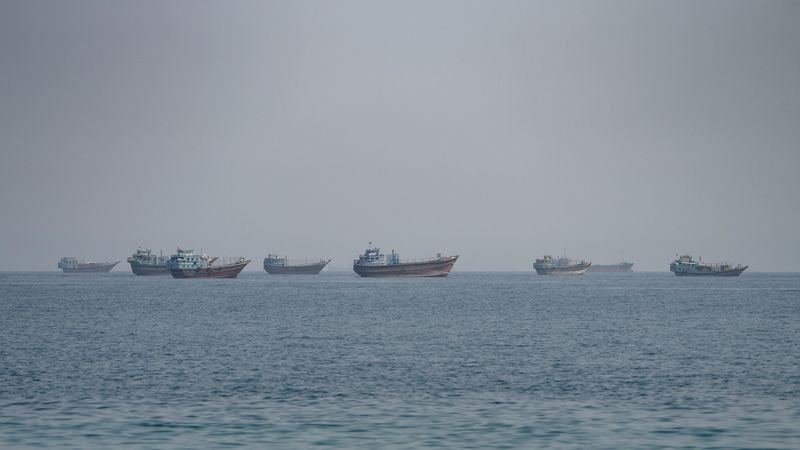
Lead
At 01:20 UTC on 8 July 2026, Reuters reported that the United States had resumed strikes on Iran after attacks on commercial vessels in the Strait of Hormuz. Roughly thirteen minutes earlier, Middle East Eye had relayed a US military statement describing a "series of powerful strikes" carried out over those same attacks on ships transiting the corridor. The sequencing matters: a rhetorical escalation out of Tehran on the afternoon of 7 July, measured and brief, was followed inside hours by kinetic action on the water and then by an American air response, with the whole episode compressed into a window measured in single calendar days.
For two decades the Strait has functioned in Western strategic writing as a transit lane first and a contested space second: oil and liquefied natural gas move, and political risk is priced at the margin. The events of 7–8 July reset that framing. They put the question of who decides what passes through the Strait — and on whose terms — back into the foreground of global economic statecraft, with the United States and Iran once again the named parties and commercial shipping the immediate collateral.
Nut graf
The dispute now playing out along 21 nautical miles of water is not a fresh rupture so much as the reactivation of a long-running argument. Iran's stated position, carried by social-media accounts tracking regime messaging and surfaced via the prediction market Polymarket at 16:34 UTC on 7 July, is that Tehran holds a "sovereign right to control 'parts' of the Strait of Hormuz." Polymarket's own market structure put the implied probability of Iran introducing formal Hormuz transit fees by the end of the following month at 50% as of 16:35 UTC the same day. By 01:07 UTC on 8 July, the United States was bombing Iranian targets it said were responsible for attacks on commercial vessels. The wire framing — Reuters, Middle East Eye, the Guardian as cited via Unusual Whales — converged on a single reading: a contested corridor, a kinetic weekend, a market repricing already underway.
What follows is what the public record currently supports, what it does not, and why the structure of the dispute matters beyond the headlines.
The corridor and its load
The Strait of Hormuz is the maritime pinch between the Persian Gulf and the Gulf of Oman, bordered by Iran to the north and Oman and the United Arab Emirates to the south. The chokepoint is narrow enough that shipping on the inbound and outbound lanes is separated by only two miles. It is also the route through which the great majority of Gulf-exported crude oil and a substantial share of liquefied natural gas leave the region for Asian, European and African markets. When the political temperature rises over the Strait, the economic consequences propagate unusually fast — through insurance war-risk premiums, through tanker reroutings, and through the price of crude in Singapore and Rotterdam.
The Iranian claim advanced on 7 July is not new in form. Iranian officials and commentators have raised the prospect of partial control, transit fees, or selective interdiction of the Strait in previous periods of tension, and the precedent stretches back decades. What appears new in this cycle is the explicit framing of a partial-sovereignty claim — Tehran asserting jurisdiction over discrete segments rather than the corridor as a whole — and the proximity of that claim to a kinetic event. The Polymarket readout at 16:35 UTC suggested traders saw roughly even odds that Iran would formalise fees on shipping within a month.
The American response at 01:20 UTC on 8 July was framed by the US military, per Middle East Eye, as strikes launched in response to attacks on commercial vessels transiting the Strait. Reuters carried the same operational claim: that US action followed Iranian-attributed attacks on shipping in Hormuz. The Guardian's reporting on intensified Iranian attacks on ships in the Strait, relayed via Unusual Whales at 16:27 UTC on 7 July, gave the underlying trigger its first Western-wire attribution.
Reading the Iranian claim on its own terms
The Iranian position, as surfaced through Polymarket's reportage of regime statements, has a legal scaffolding that deserves to be heard rather than waved away. Under the United Nations Convention on the Law of the Sea, transit passage through straits used for international navigation is supposed to be continuous and expeditious; the same convention also recognises coastal-state jurisdiction over territorial seas and allows for certain controls tied to security, customs and resource management. Iran's claim is that, where discrete portions of the Strait fall inside its territorial sea baseline — a contested question but not a frivolous one — it retains regulatory authority. The claim of "parts" rather than the whole is the substantive move: it concedes international transit in the central lanes while asserting rights at the margins.
A regime whose economy is heavily exposed to sanctions, and whose oil exports are constrained by extra-territorial enforcement, has an obvious interest in pricing access to a chokepoint it sits on. A transit-fee regime would not be unprecedented; comparable arrangements exist elsewhere in the world. The structural critique that the West tends to apply — that any Iranian move on the Strait amounts to economic warfare — is not wrong, but it is incomplete. The same legal architecture that the United States invokes for freedom of navigation in other contested waterways applies in the Gulf too, and Iranian officials are entitled to point out the symmetry.
This publication's read is that the Iranian claim is more credible as legal posture than as operating practice. Tehran is unlikely to want to physically close the Strait: doing so would cut off its own exports, antagonise the Gulf states whose waters it would also be impeding, and invite an overwhelming military response. What it can plausibly do is what Polymarket traders on 7 July appeared to price in: formalise a fee regime, interdict specific flagged vessels, or stage enough harassment to push insurance premiums higher and shift a share of revenue its way. The 50% implied probability on a fee regime by the end of August was, on the evidence, neither alarmist nor complacent — it sat close to the base rate for such coercive-but-plausible moves.
The American response and its limits
The US military's account of events, as relayed by Middle East Eye at 01:07 UTC on 8 July, frames the strikes as a discrete retaliation for attacks on commercial vessels, not as the opening of a wider campaign. Reuters' headline at 01:20 UTC the same day carries the same framing: strikes resumed after attacks, with the implication of a tit-for-tat rather than an escalation ladder.
There is a competing reading of US action that the available sources do not directly support but that the structural context invites. Strikes that target Iranian military assets in response to harassment of commercial shipping can be calibrated — a particular radar installation, a particular IRGC-Navy facility, a particular drone or missile site. They can also be expansive, aimed at degrading the Iranian capacity to threaten the Strait for the foreseeable future. The difference is the difference between a price and a verdict. The sources do not specify which kind of strike was carried out on 7–8 July; Reuters and Middle East Eye describe "powerful strikes" and a "series of powerful strikes" without, in the snippets available, naming individual targets.
The limit on the American position is that the United States does not, by itself, move the volume of oil through Hormuz. The buyers are concentrated in Asia — China, India, Japan, South Korea — and the sellers are a mix of Gulf monarchies plus Iran. A US policy that escalates militarily while Asian buyers continue to take Iranian crude does not produce strategic effect commensurate with the kinetic cost. That asymmetry is one of the reasons that previous administrations, including those of both major US parties, have measured their responses to Iranian harassment of shipping with care.
The pattern underneath
What the events of 7–8 July illustrate, beyond the immediate news, is a recurring structural pattern. A chokepoint sits at the centre of global energy logistics. A regional power with constrained economic options sees leverage in the chokepoint and acts to extract rents or signal resolve. A global power with the capacity for force responds militarily, but with a self-imposed ceiling calibrated to its own buyer-side dependencies. The market, in the meantime, reprices risk — through war-risk premiums, through the tanker orderbook, and through the spread between delivered and benchmark crude.
This is not a new pattern. It is the operating environment for the Strait in particular, and for contested maritime space more generally. The mistake that Western commentary regularly makes is to treat each episode as if it were a fresh crisis requiring resolution, when in fact the underlying arrangement is the resolution: an unstable equilibrium that neither side has the interest or capacity to collapse. The Iranian partial-sovereignty claim fits that equilibrium. The Polymarket odds fit it. Even the US strike, in its narrow framing of retaliation for attacks on commercial vessels, fits it.
Where the equilibrium genuinely shifts is in two places. The first is when one side's domestic political logic overrides its strategic logic — when a leadership in Tehran concludes that escalation will consolidate rather than fracture its base, or when a leadership in Washington concludes that a wider war is electorally tolerable. The second is when the external environment changes — when a major Asian buyer diversifies away from Gulf crude on a structural basis, or when a major Gulf producer opens a bypass pipeline that materially reduces Hormuz dependency. Neither shift is documented in the available reporting on the 7–8 July events.
What remains genuinely uncertain
The public record on 7–8 July is thin on details that matter. The sources do not name the specific Iranian units or installations struck by the US military; they do not specify the number or tonnage of commercial vessels attacked; they do not name the flag states of those vessels; and they do not provide casualty figures for either side. The Iranian partial-sovereignty claim is reproduced in the Polymarket-readout form, not in the form of an official Iranian government statement that this publication has independently verified. The market-implied probability of 50% on a Hormuz fee regime by end-August is a market signal, not a forecast grounded in disclosed Iranian policy.
There are also questions of framing the available sources do not resolve. Middle East Eye is carrying a US military statement at face value; Reuters is using the same framing; the Guardian, via Unusual Whales, is reporting intensified Iranian attacks. None of these are Russian-aligned or Iran-aligned sources in the technical sense, but they are all Western-wire or Western-wire-adjacent, and the structural critique that they over-state the Iranian threat and under-state the American role in the underlying dynamic is one that Global-South analysts and Iranian state media would both make. The Iranian counter-narrative — that the US is using harassment incidents as a pretext to degrade Iranian capabilities and tighten an extra-territorial sanctions regime — does not appear in the sources above in a form this publication can quote directly. It belongs in the record as the most plausible alternative read of the same facts.
The honest summary is this: a kinetic weekend along a chokepoint that the global economy cannot do without, framed by the available wire as Iranian attack followed by US retaliation; an Iranian partial-sovereignty claim documented through market-aggregator reporting rather than primary Iranian government text; and a market that, as of 7 July, saw roughly even odds of a formalised fee regime within weeks. The trajectory from here is not foreordained. The structural pattern argues for continued managed tension. The political logic on each side argues against rapid de-escalation. The reader is entitled to know that the public record, as of the publication of this article, supports both the urgency and the uncertainty of the moment.
This publication framed the 7–8 July events as a re-litigation of an old dispute rather than a fresh rupture, and resisted the Western-wire reflex of treating Iranian chokepoint claims as eccentric rather than legally arguable.
Wire provenance
This editorial synthesis draws on the following public wire/social posts:
- http://reut.rs/4vfWF1m