US confirms new strikes on Iran as unconfirmed reports of drone loss and missile launch surface
Washington says a fresh round of strikes on Iran is complete; Iranian-aligned channels claim an MQ-9 was downed over Isfahan and a missile launch from Tabriz. The thread is thin, the claims diverge, and the verified record is narrower than the headlines.
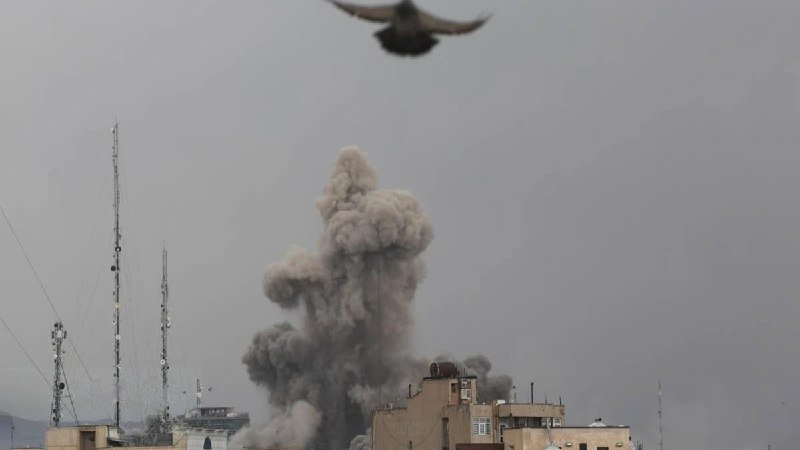
In the early hours of 8 July 2026, two competing accounts of the same night over Iran landed within minutes of each other on open-source channels. Reuters reported, in a 02:50 UTC post, that the United States had completed a new round of strikes on Iran. By 03:06 UTC, the Telegram channel wfwitness was carrying an unconfirmed report that an MQ-9 Reaper drone had been shot down over Isfahan. An hour earlier, at 01:05 UTC, the intelslava channel had flagged an unconfirmed missile launch from Tabriz.
The verified record is narrower than the cumulative signal. A US-confirmed strike series, a claimed drone shoot-down, and a claimed Iranian missile launch are three distinct claims from three distinct provenance streams — a Western wire, a conflict-watch Telegram channel, and an Iran-focused Telegram channel. They do not yet cohere into a single narrative, and the gap between them is where the story actually lives.
What Reuters confirms
Reuters's 02:50 UTC wire, distributed via X, is the load-bearing claim of the morning: a US statement that a new round of strikes on Iran has been completed. The report carries no casualty figures, no target list, and no Iranian on-the-record response inside the post itself. It is the kind of single-sentence wire item that often serves as a placeholder for a fuller story to follow, and the link reut.rs/4f5OVJt is the canonical reference for the framing until Reuters publishes an extended dispatch.
That framing — "the US says it has struck Iran, again" — is consistent with a pattern that has become routine across 2025 and 2026. Strikes on Iranian assets, Iranian proxies, or Iranian territory have been narrated by Washington as discrete, completed operations with a defined scope, even when the political weight of each round accumulates. The Reuters line does not adjudicate legality, intent, or retaliation; it simply records completion as claimed by the US side.
What the Telegram channels claim
The two Telegram items are categorically different in provenance and should be read accordingly. wfwitness, the channel that reported the MQ-9 downing over Isfahan at 03:06 UTC, is an open-source-intelligence aggregator with a track record of fast, sometimes premature, claims during Iran-Israel and Iran-US flashpoints. Its post is flagged as unconfirmed. The claim that an MQ-9 — a US Air Force unmanned surveillance aircraft — was shot down over Isfahan is, if accurate, materially significant: it would represent a successful Iranian air-defence engagement against a high-altitude US asset over central Iran, not over the Persian Gulf or a border region.
The intelslava report at 01:05 UTC of a missile launch from Tabriz is equally thin. Tabriz, in Iran's East Azerbaijan province, hosts both military installations and is within range of several Iranian missile complexes. A launch from Tabriz could be a test, a retaliatory strike, or a decoy; the channel's own framing — unconfirmed — admits as much. Neither Telegram post carries imagery, geolocation coordinates, or corroborating audio. They are raw claims in a conflict zone where raw claims are cheap and verified ones are not.
The asymmetry is the point. A Reuters wire carries institutional weight; a Telegram post does not. Both can be wrong, but they are wrong in different directions and on different timescales. Reuters's error would be a correction appended to a dated article; wfwitness's error would simply scroll off the channel and be forgotten.
What we verified, and what we could not
This publication treats the Reuters 02:50 UTC item as verified to the extent of "the US has stated, via wire, that a new strike round on Iran is complete." Reuters is named in the claim; the US is the attributed actor; the action is bounded in time. Beyond that line, the verified record thins sharply.
Verified:
- A US statement of a completed new round of strikes on Iran, per the Reuters X post dated 2026-07-08T02:50 UTC.
- The existence, as of the same morning, of unconfirmed reports on two Telegram channels of (a) an MQ-9 drone shot down over Isfahan, and (b) a missile launch from Tabriz.
Not verified:
- The MQ-9 downing. No imagery, no US Central Command confirmation, no Iranian state-media confirmation, no second independent channel corroboration appears in the source material reviewed.
- The Tabriz missile launch. Same gap — no imagery, no Iranian official statement, no second-source corroboration.
- Casualty figures, target identities, strike locations, or Iranian retaliatory action. The Reuters wire does not contain any of these; the Telegram posts do not either.
- Whether the claimed MQ-9 loss and the claimed Tabriz launch are connected, sequential, or unrelated events.
The honest reading is that a US strike round happened and was announced, and that two adjacent claims of Iranian action are circulating without corroboration. Anything stronger than that requires sources this publication does not yet have.
The structural frame
Even on a thin record, the pattern is legible. US strikes on Iran have moved from exceptional to episodic across 2025 and 2026, and the news apparatus around them has hardened into a familiar sequence: a US statement of completion, a wave of unverified claims of Iranian retaliation on Telegram and X, a Reuters or AP wire that confirms the US framing and leaves the retaliation claims in suspense, and a follow-up cycle 24 to 72 hours later when satellite imagery, official statements, or on-the-ground reporting either ratifies or quietly retires the early claims.
That sequence matters because it determines what readers actually know. The Western wire layer captures the US framing at high fidelity and captures Iranian framing at the latency of an official statement — which, in a country with centralised information control, may never come, or may come in a form shaped by domestic political need. The Telegram and X layer captures claims at the latency of seconds but at the cost of verification. The gap between the two is where most misreadings of any given night over Iran live, and it is precisely the gap that adversarial information operations on all sides are built to exploit.
A second structural feature: the geography of the claims. Isfahan hosts uranium-conversion facilities and is deep inside Iran, not on a frontier. Tabriz is in the northwest, near the Azerbaijani and Turkish borders. If both unconfirmed claims are accurate, the geographic spread — central Iran and northwestern Iran, hours apart — would be consistent with a distributed Iranian air-defence and missile posture responding across multiple axes rather than a single retaliatory salvo. If either claim is wrong, the pattern dissolves. The geography is suggestive; it is not evidence.
Stakes and the forward view
The immediate stakes are operational: whether US losses were sustained, whether Iranian retaliation materialised, and whether the strike round expands or closes. The medium-term stakes are political on both sides — Washington's ability to sustain a campaign-of-strikes framing without a defined political终点, and Tehran's ability to manage domestic narratives around either successful engagements or successful denials.
What this publication will watch for, in order of evidentiary weight: a US Central Command or Pentagon briefing naming strike outcomes and any aircraft or personnel losses; an Iranian Foreign Ministry or armed forces statement on the Tabriz launch and the Isfahan air-defence claim; satellite imagery from Planet Labs, Maxar, or open-source-intelligence accounts that geolocates strike damage; and a Reuters, AP, or AFP extended dispatch that supersedes the 02:50 UTC placeholder. Until at least one of those lands, the verified record on the morning of 8 July 2026 is: the US says it struck Iran, and two unconfirmed Telegram posts describe what may or may not have come back.
The reader should hold the verified line loosely and the unconfirmed claims more loosely still. The cost of being wrong about a strike round is a correction; the cost of being wrong about a downed drone or a missile launch is a confidently stated fiction that ages badly.
Desk note: Monexus led with Reuters as the verified anchor and explicitly bracketed the Telegram claims as unconfirmed, rather than aggregating them into a single composite narrative. The wire-vs-channel asymmetry is the actual story of this morning; flattening it would have produced a cleaner but less honest piece.
Wire provenance
This editorial synthesis draws on the following public wire/social posts:
- http://reut.rs/4f5OVJt
- https://t.me/wfwitness
- https://t.me/intelslava
