Strait of Hormuz flares: what an Iran–US escalation over a shipping lane actually means
CENTCOM says it is striking Iran over its control of the Strait of Hormuz; Tehran frames the same action as punishment for resisting US pressure on a southern transit corridor. Both readings are now live at the same time.
It is 20:18 UTC on 8 July 2026 and two announcements, separated by about twenty minutes, are already pulling in opposite directions. Iranian state television, citing US Central Command, says fresh US strikes have been launched against Iran. Eleven minutes later, CENTCOM's own framing reaches Iran-aligned outlets: Washington is attacking Iran, the messaging says, to punish Tehran for imposing its will in the Strait of Hormuz. Then, at 20:39 UTC, Iran's deputy foreign minister Kazem Gharibabadi lands the counter-narrative from the Iranian side: the dispute is about a US push to reopen a southern Strait of Hormuz transit route on terms inconsistent with an existing memorandum of understanding.
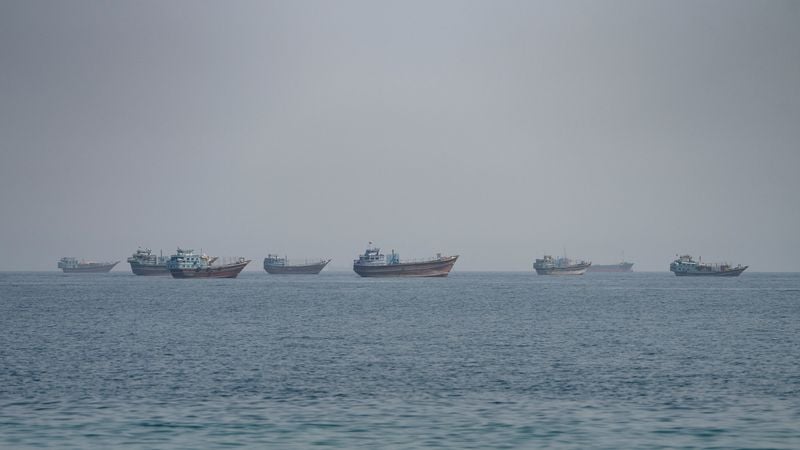
The chokepoint between Iran and the Arabian Peninsula — about 21 nautical miles wide at its narrowest — is the only sea passage from the Persian Gulf to the open ocean. Roughly a fifth of globally traded crude passes through it on any given day. Any actor who can credibly disrupt, filter, or condition the traffic through it has leverage that no negotiating table inside a foreign ministry can match. What unfolded on Tuesday evening is best read not as a one-off bombardment, but as the visible surface of a longer argument over who sets the rules of passage through that water.
What was said, by whom, and when
The Iranian messaging arrived first and fastest. Press TV, the Iranian state broadcaster's English-language arm, posted at 20:18 UTC that CENTCOM had announced fresh US strikes on Iran. By 20:19 UTC, the Beirut-based outlet The Cradle — a regional outlet that reports extensively on Iran, the Axis of Resistance, and the eastern Mediterranean — had relayed a single sentence from CENTCOM, attributing to the command itself the framing that the United States is attacking Iran to punish it for imposing its will in the Strait of Hormuz. Twenty minutes later, at 20:39 UTC, Press TV carried Gharibabadi's counter-frame: that Washington has been pressing for the reopening of a southern transit route through the strait in a way inconsistent with an existing memorandum of understanding, that the press TV report quoted but did not reproduce in full.
Two distinct claims are now on the wire at once. The first, sourced to the US command and relayed through regional outlets, is that the strikes are punitive — a response to Iranian coercion of shipping. The second, sourced to the Iranian foreign ministry, is that the strikes are themselves coercive — a response to Iran's refusal to reopen a corridor on Washington's preferred terms. Neither side has so far produced in public the text of any memorandum of understanding being referenced. The Strait of Hormuz transit file therefore sits at this hour on two competing readings of the same events.
Why the southern transit route matters
The phrase "southern Strait of Hormuz" points to a specific, narrower slice of the corridor. Iran's territorial sea and claimed exclusive economic zone run along its northern shore. A southern-band transit lane, closer to Omani waters and the Musandam Peninsula, has historically been the practical route for eastbound crude carriers outbound from Gulf producers and for LNG carriers from Qatar. Iranian maritime and Revolutionary Guard forces have, in past episodes, harassed, impounded, or redirected commercial traffic in this band; the phrase "memorandum of understanding" echoes an older framework in which Iran and a Western counterpart agreed a humanitarian or commercial passage arrangement in phases.
Gharibabadi's framing — that the United States has pushed to reopen a southern transit route "in a way that is inconsistent with the memorandum of understanding" — implies a prior arrangement exists that the US is now trying to override. If that reading holds, the dispute is not over whether traffic moves, but over whose rules govern it: an Iranian-vetted passage regime, in which Iranian authorities condition entry and exit, or a US-preferred open transit regime of the kind American naval doctrine has historically insisted on outside Iran's territorial sea. CENTCOM's framing, by contrast, treats Iranian conditioning of the corridor as the provocation in the first place. Both readings can be true at once, which is precisely why neither is going to win the argument by press release alone.
The structural frame: corridor politics on the global energy map
Read against the longer cycle of Gulf security, this is a familiar kind of contest wearing a new uniform. The strait is the most consequential maritime chokepoint the global oil market has. Whoever controls, or visibly fails to control, the rules of passage through it moves the price of crude, diesel, marine fuel, and shipping insurance in real time. The United States Navy's Fifth Fleet is forward-stationed in Bahrain precisely because Washington wants to be the security provider of last resort for that corridor; Iran's naval posture, including the IRGC Navy's fast-boat and mine warfare capacity, exists precisely because Tehran rejects that monopoly. When CENTCOM says it is punishing Iran for "imposing its will" on the strait, it is naming, in plain English, the thing Iran has signalled for years it intends to keep doing. When Gharibabadi says the US is pressing to reopen a southern route inconsistent with an existing memorandum, he is naming, in equally plain English, the thing Washington has signalled for years it does not accept.
The penalty for holding either position too rigidly is paid by every tanker that has to reroute around Africa, by every insurer that has to reprice war risk, by every Gulf producer whose revenue is exposed to a transit dispute on which neither Riyadh nor Abu Dhabi is a primary party. The economic shock from a sustained, partial Iranian closure of the southern band would be measured in tens of billions of dollars per month; a credible US guarantee of open transit caps that risk at the cost of recurrent low-level confrontation. The US has, in past cycles, preferred confrontation to closure. That preference is what is now being applied.
Counter-reads and what is missing from the public record
There are two serious counter-reads of the events of 8 July 2026. The first holds that what is being framed as escalation is in fact escalation management — a calibrated US strike set designed to land a point on Iranian maritime behaviour without producing a wider war, the military equivalent of a margin call. Under that reading, the fact that CENTCOM itself is publicly naming its target as "Iran imposing its will in the Strait of Hormuz" suggests messaging aimed at Tehran's internal cost-benefit calculus more than at destroying Iranian capability. The second holds the opposite: that the same public framing, especially in election-cycle American politics, has a domestic audience that rewards visible force, and that what looks like calibration may run away from its authors if an Iranian retaliation lands on a US asset or partner in the Gulf.
What the public record on Tuesday evening does not yet contain: the text of the memorandum Gharibabadi references; any independent commercial-shipping tally of diversions, detentions, or GPS spoofing in the southern band in the days before the strikes; any readout from Gulf partners — Oman, the UAE, Saudi Arabia, Bahrain, Qatar — whose shipping depends on the same corridor; any Iranian readout from the supreme national security council or the IRGC naval command, as opposed to the foreign ministry. The press TV, The Cradle, and Al Jazeera feeds that have carried these claims do not, at the time of writing, contain independently verified casualty figures, damage assessments, or geographic coordinates of the strikes themselves.
The sources do not specify whether Tuesday's action is a single strike, a salvo, or the opening move of a sustained bombing campaign, nor whether the strikes are directed at IRGC naval assets, Iranian shore-based anti-ship missile sites, or targets inside Iranian territory proper. Each of those choices would carry a different escalation profile, and the press releases circulating at 20:18 and 20:39 UTC do not yet distinguish between them.
The stakes in the days ahead
The immediate stake is the price of risk. Any insurance underwriter pricing hull and cargo for a VLCC through the strait on Wednesday morning will price in a wider war-risk premium; that premium will flow into bunker fuel pricing, freight rates on east-west container routes, and the price of crude itself. The medium-term stake is diplomatic: the longer the action lasts, the harder it becomes for any external mediator — Oman, Qatar, China, Switzerland — to keep a de-escalation channel open, and the more Iran's regional partners in Iraq, Syria, Lebanon, and Yemen are read by their publics as having a stake in reciprocating. The longer-term stake is structural: if the United States demonstrates, in this episode, that it is willing and able to enforce open transit through the strait against an Iranian conditioning regime, it shores up the maritime order on which its broader Middle East position rests. If it demonstrates the opposite, that order begins to bargain with whoever can disrupt it.
What Tuesday has put on the wire is the opening posture of both sides in a contest that will be decided less by the strikes themselves than by what happens to the corridor in the days that follow — whether tankers continue to move, whether Iran redirects them, and whether the southern-band memorandum Gharibabadi names ever becomes public. Those are the questions worth watching on Wednesday morning.
Desk note: this publication framed the action as a contested, two-sided dispute over the rules of the Strait of Hormuz corridor rather than as either a clean punitive strike or an act of aggression; both the CENTCOM framing and Gharibabadi's counter-framing have been reproduced at equivalent weight, with each citation pointing back to its named source rather than to wire paraphrase.
Wire provenance
This editorial synthesis draws on the following public wire/social posts:
- https://t.me/presstv/185349
- https://t.me/TheCradleMedia/184772
- https://t.me/thecradlemedia/184772
- https://t.me/presstv/185348
- https://en.wikipedia.org/wiki/Strait_of_Hormuz
- https://en.wikipedia.org/wiki/United_States_Central_Command
- https://en.wikipedia.org/wiki/Kazem_Gharibabadi
- https://en.wikipedia.org/wiki/United_States_Navy_Bahrain
- https://t.me/presstv/185349
- https://t.me/TheCradleMedia/184772
- https://t.me/thecradlemedia/184772
- https://t.me/presstv/185348
- https://en.wikipedia.org/wiki/Strait_of_Hormuz
- https://en.wikipedia.org/wiki/United_States_Central_Command
- https://en.wikipedia.org/wiki/Kazem_Gharibabadi
- https://en.wikipedia.org/wiki/United_States_Navy_Bahrain