Trump's Iran calculus: deal rhetoric masks an escalating tit-for-tat at sea
President Trump floated the prospect of a deal with Tehran while signalling fresh strikes on Iranian shipping — a contradiction that captures where the confrontation actually stands on 8 July 2026.
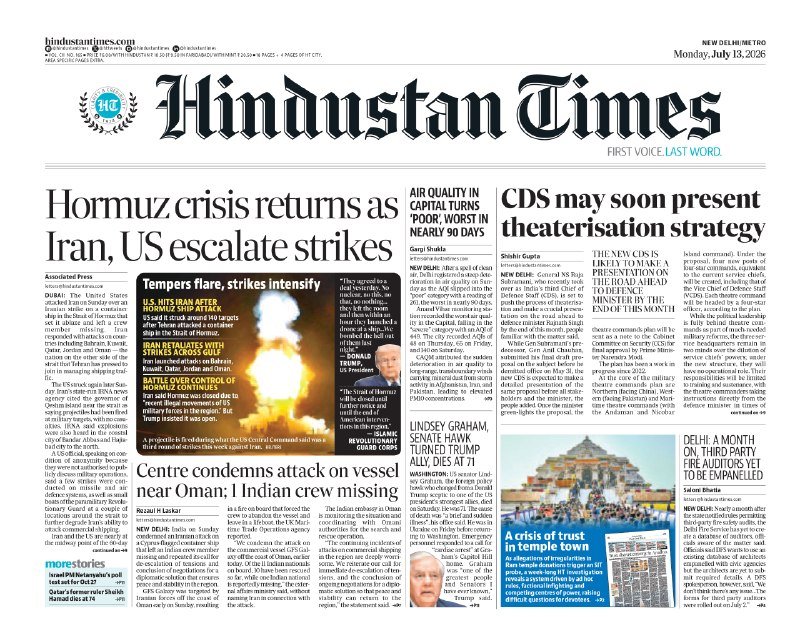
On 8 July 2026 at 22:57 UTC, President Donald Trump told reporters that Iran had called Washington and wanted a deal "so badly" — then, in the same sentence, conceded that he did not know whether Tehran was "worthy" of one or would "honor the deal." Less than an hour later he claimed a 20-to-1 attrition ratio against Iran and warned that any future strike on US interests would trigger an even harder response. The juxtaposition is the story: an administration publicly angling for an off-ramp while simultaneously escalating the kinetic exchange that makes an off-ramp possible.
The structural read is straightforward. Iran is being squeezed between maximalist American demands and an Israeli campaign it cannot ignore, while its own leverage — harassment of shipping in the Gulf, the threat of closure to the Strait of Hormuz, proxy pressure in Iraq and Syria — has lost potency as US and allied forces have hardened convoy protection. Trump is trying to convert that squeeze into a diplomatic win on his own terms. Tehran, for its part, is signalling interest in talks because the cost of staying outside them is rising week by week.
What Trump actually said
The clearest articulation of the administration's two-track posture came at 22:57 UTC on 8 July, when Trump characterised Iran's outreach as urgent while expressing personal doubt about its durability: "Iran called a while ago. They want to make a deal so badly. I just don't know if they are worthy. I don't know if they are going to honor the deal. That's the problem." Three minutes earlier, at 22:54 UTC, he had escalated: "I hear threats all the time. I am number one on their list. If I go, you go." And at 22:56 UTC he framed the current exchange in blunt arithmetic: "We just hit them very hard. We hit them 20 to 1. Every time they hit us, we are going to hit them 20."
The framing the White House is selling to its domestic audience is escalation dominance — a confidence that any Iranian move will be answered at twenty times the scale. The framing it is selling to Tehran is different: an open door, conditional on behaviour. Both cannot be fully true at once, and the gap between them is the operating space in which any deal will or will not be built.
The shipping pretext
Underneath the rhetoric sits a specific chain of incidents. At 21:41 UTC on 8 July, the open-source tracker Liveuamap reported that Trump had described the latest US action as "in retribution for yesterday's bombing of ships by Iran," adding: "If it happens again, it will get much worse." Clash Report carried the same remarks at 21:46 UTC. The pattern fits a familiar escalatory ladder: a strike on commercial vessels attributed to Iran, followed by a retaliatory US strike on Iranian targets, followed by presidential language that deters further action by raising the expected cost.
The economic stakes are concentrated in a narrow waterway. Even partial disruption of the Strait of Hormuz moves Brent crude, raises insurance premia on Gulf shipping, and forces naval coalitions to operate in close quarters — the conditions under which miscalculation is cheapest. Iran's maritime doctrine has long relied on this asymmetry: it does not need to win a naval engagement to impose costs, only to threaten one. Whether the latest strike cycle marks a genuine shift in that doctrine, or a routine spasm within a recurring pattern, is one of the genuinely open questions.
Why the deal rhetoric keeps recurring
Trump's comments on 8 July were not the first time he has held out the prospect of negotiations. The recurring pattern — opening the door, then walking back Iranian credibility — serves two purposes simultaneously. Domestically, it positions the administration as both strong and reasonable: the president who hits twenty-to-one, but who is willing to talk. Internationally, it puts the diplomatic onus on Tehran. Each round of public doubt about whether Iran is "worthy" resets the baseline for what concessions Washington will demand before talks can produce anything.
Reuters captured the underlying tension in a story published 8 July at 22:45 UTC: "Trump wants to leave the Iran war behind. That won't happen soon." The wire's read is that the gap between Trump's preferred outcome (a deal, a quiet Gulf, an end to the daily drumbeat of strikes and counter-strikes) and the structural reality (Iranian capability, Israeli operations, Gulf state anxiety, congressional politics) is too wide for a quick resolution. The Reuters framing is closer to a sober assessment than to the rhetoric from either podium.
Counterpoint: the Iranian read
The Iranian framing of the same set of facts is structurally different and worth taking seriously on its own terms. From Tehran's perspective, the US is conducting an illegal campaign of aggression, the strikes on Iranian assets are unprovoked escalations, and any "deal" on offer is an instrument of capitulation dressed up as diplomacy. Iranian state media — Iran International, PressTV, Tasnim, IRNA, Mehr News — has spent months arguing that the US maximum-pressure playbook has failed at its stated goals even as it has succeeded at inflicting economic damage. The narrative of Iranian "worthiness" that Trump used at 22:57 UTC will be read in Tehran as exactly the kind of conditional-language trap that pre-empts serious negotiation.
The Global South's framing runs in a similar groove. Brazilian, South African, and Indian commentary has consistently framed the confrontation as one in which Iran is being punished for behaviour that other regional actors — including US partners — have practised with impunity. That is not the same thing as endorsing Iranian maritime action against commercial shipping; it is a separate observation about the asymmetry of enforcement. Both can be true.
What remains uncertain
Three things are genuinely unclear as of 22:59 UTC on 8 July. First, whether Iran's reported outreach to Washington is at the level of a foreign minister, a presidential envoy, or a back-channel signal — the granularity matters because it determines how durable any commitment would be. Second, whether the "yesterday's bombing of ships" Trump referenced is a single incident or a cluster of attacks, and whether the attribution to Iran rests on US intelligence, allied intelligence, or open-source forensics. Third, whether the twenty-to-one ratio is a real exchange-rate or a rhetorical figure; the available sources do not specify.
What is clearer is the political logic in Washington. Trump wants a deal. Trump also wants to look like the one who extracted it. Those two preferences will pull the diplomacy in opposite directions until something breaks the tie — either a sufficiently embarrassing Iranian provocation, or a sufficiently costly US escalation, or a credible offer from Tehran that lets the White House declare victory without further military action. None of those has arrived yet, and the public comments on 8 July suggest the administration expects it to be Tehran that blinks first.
Stakes and forward view
If the trajectory continues, the Gulf shipping corridor absorbs the cost: higher premia, more naval presence, more frequent incidents that risk a spiral. Israel retains operational freedom to act against Iranian assets, which complicates any deal Trump might announce because Tehran will demand constraints there as the price of any agreement. Iran's economy stays under sanctions pressure, which is the actual point of the squeeze for Washington's maximalists, but which also limits Tehran's ability to offer the economic concessions that would sweeten a deal. The structural pattern — coercion plus conditional talks plus kinetic pressure — has not produced a settlement in three rounds; there is no evident reason the fourth will be different.
The most plausible near-term outcome is what Reuters described: the war stays in the background of American politics, neither resolved nor allowed to dominate. That suits Trump's preferred posture, but it does not suit Gulf shipping insurance markets, Israeli planners, or Iranian negotiators. They will each push the trajectory in their preferred direction, and the small waterway at the centre of the contest will continue to absorb the consequences.
Desk note: Monexus led with the contradiction at the heart of the day's rhetoric — a president publicly pursuing a deal while publicly detailing escalation dominance — rather than with either pole of the framing. The Reuters wire framed the moment as the gap between presidential preference and structural reality; this article extends that read into the shipping-corridor economics and the Iranian counter-narrative that Western coverage routinely underweights.
Wire provenance
This editorial synthesis draws on the following public wire/social posts:
- https://t.me/ClashReport
- https://t.me/ClashReport
- https://t.me/ClashReport
- https://t.me/ClashReport