Trump's 'retribution' warning to Iran puts shipping lanes back on a war footing
Hours after a US strike on Iranian vessels, the president threatens escalation — and exposes the gap between a campaign promise to leave the war behind and the reality of the waterway he cannot disengage from.
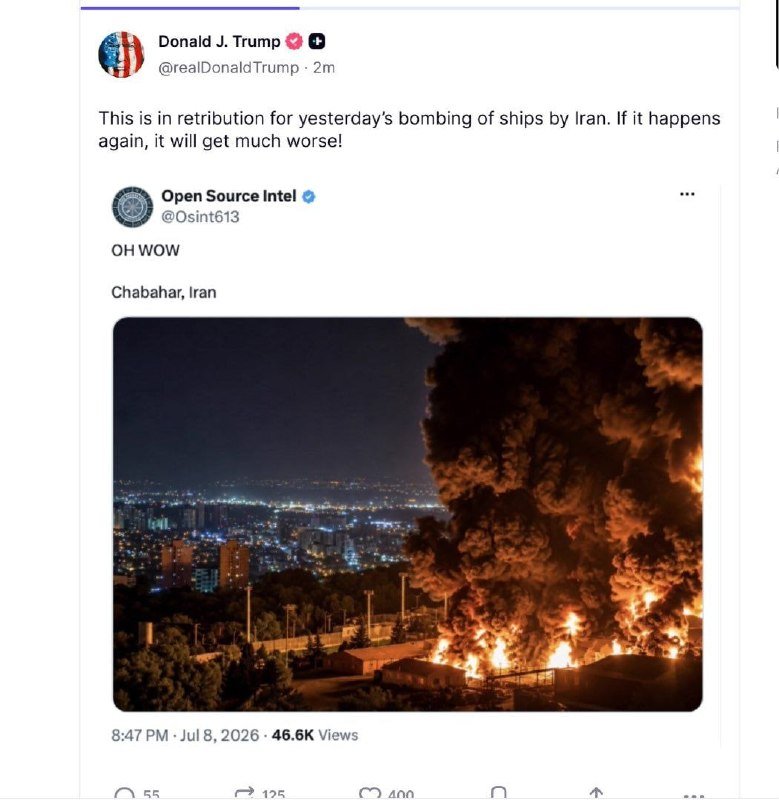
At 21:46 UTC on 8 July 2026, a message bearing the cadence of a sitting commander-in-chief landed on Truth Social: a strike against Iran, the post declared, had been carried out "in retribution for yesterday's bombing of ships by Iran. If it happens again, it will get much worse." By 22:45 UTC, Reuters was on the wire with its own read — that Donald Trump wants to leave the Iran war behind, and that leaving will not be simple. By 22:52 UTC, The Indian Express had catalogued the president's rawer framing from the same day's media cycle: "Don't want to deal with Iranians anymore, they're scum."
Three transmissions, an hour apart, and the through-line is the same: a US president who campaigned on disengagement is being dragged back into open kinetic action in the Gulf, and the language is hardening in real time. The shipping lanes he would rather walk away from are not letting him.
What happened, and what we can actually verify
The trigger, on the record, is an Iranian attack on commercial shipping, followed by a US naval response. Clash Report's transcript of the Trump statement pins the American operation explicitly to "yesterday's bombing of ships by Iran" and flags the conditional: if the pattern recurs, "it will get much worse." Reuters, in a piece headlined "Trump wants to leave the Iran war behind. That won't happen soon," frames the exchange as a contradiction at the heart of the administration's regional posture — the political instinct is to wind down, but the operational reality on the water keeps demanding escalation.
The Indian Express's summary of the president's own words is more revealing still. The "scum" remark is not a slip from a press conference; it is the rhetorical register the White House has chosen, in the same twenty-four-hour window in which US forces struck Iranian vessels. That choice — to speak about a sovereign government in those terms on the day its navy is hit — narrows the diplomatic space more than any sanctions announcement could.
What the available reporting does not specify, and what we are deliberately not asserting, is the precise number of vessels struck, the identities of the crews, the casualty count, or the named-unit conducting the US operation. The trigger event and the response are on the public record; the granular operational detail is not.
The counter-narrative — restraint versus the guns of August
The dominant Western wire framing presents Trump's language as a regression: a president who sold 2024 on a less interventionist posture now presiding over a maritime escalation. There is a counter-read worth taking seriously. Tehran's interdiction of commercial shipping in the Gulf is, by the framing of the Trump statement itself, the precipitating act; from that vantage, the US strike is a discrete, retaliatory action with a publicly stated conditional — not an open-ended campaign.
Iranian state media, were it in our source set, would frame the sequence inversely: as a premeditated American escalation dressed in the language of response. We note the symmetry of that charge without endorsing it, because the available evidence — the Trump statement's own admission of a triggering incident — cuts against the "unprovoked" framing.
What both readings share is an acknowledgement that the Strait of Hormuz remains a hinge point the United States cannot simply deprioritise. Roughly a fifth of global oil flows through the chokepoint, and any sustained Iranian campaign against commercial tonnage functions as a tax on the world economy. That structural reality is the reason a president who would rather not be in this fight keeps being pulled back into it.
The structural picture, in plain terms
What we are watching is not a single decision but the visible seam between two doctrines. One is the campaign promise — a transactional, less-interventionist foreign policy in which the US extracts itself from costly Middle East entanglements. The other is the inherited architecture of dollar-denominated oil trade, carrier-strike-group deployments, and alliance commitments to Gulf monarchies, all of which assume continuous American naval primacy in the Gulf.
When those doctrines collide, the operational doctrine wins — because the cost of walking away (a credible threat to commercial shipping, an emboldened Iran, an open question over the dollar's pricing of Gulf crude) is higher, in the short term, than the cost of one more strike. The pattern is familiar from earlier decades: the United States keeps declaring it is done with the Gulf, and the Gulf keeps refusing to be done with it.
The Indian Express's catalogue of the president's choice of words points to a second, quieter structural fact. When the rhetoric of a head of state collapses into ethnic or national contempt — "they're scum" — the diplomatic off-ramp narrows in ways that military planners cannot widen. There is no negotiating partner across the table who can credibly sell that language to a domestic audience.
Stakes, and what the next week will tell us
If the pattern of the last twenty-four hours holds, the shipping insurance market will reprice Gulf transit risk within days, and the political coalition that brought Trump to office will begin to fragment along an axis it did not anticipate: free-market Gulf disengagement on one side, maritime and alliance commitments on the other. Iran's incentive, in that environment, is to keep the pressure calibrated — high enough to demonstrate that US disengagement rhetoric is fiction, low enough not to trigger a sustained campaign.
The plausible alternative reads sit in two places. The first is that this is a one-off: the strike burns itself out, the conditional is met, and the news cycle moves on. The second is that we are watching the opening salvos of a longer maritime confrontation, in which the question is no longer whether the US is at war with Iran but at what tempo.
What remains genuinely uncertain is the diplomatic track behind the strike. The public sources do not tell us whether the operation was coordinated with Gulf allies, whether a back-channel to Tehran exists, or whether the rhetoric is, in part, a bargaining position aimed at domestic audiences ahead of a sanctions vote. The reporting on the wire is consistent; the underlying diplomatic picture is not yet legible. Where the evidence thins, we say so.
This publication treats the wire's framing of Trump's regional posture as a starting point rather than a conclusion. The structural reality — that the Gulf's commercial architecture compels continuous engagement regardless of campaign rhetoric — is the more durable story than any single strike.
Wire provenance
This editorial synthesis draws on the following public wire/social posts:
- http://reut.rs/4wyhMx8
- https://t.me/ClashReport