Twelve Hours, One War: How Trump's Iran Calculus Collapsed On Itself
Within a single afternoon, the US president declared Iran defeated, threatened its bridges and desalination plants, claimed a ceasefire — and promised new strikes within hours. The contradictions are themselves the message.
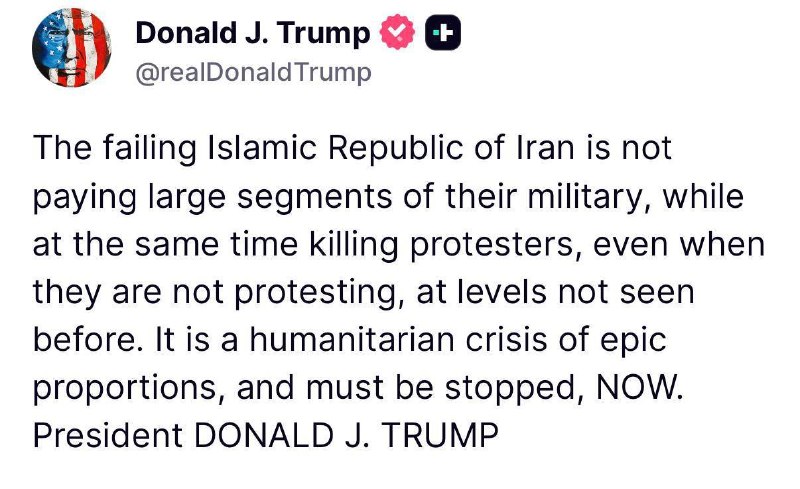
On 8 July 2026, between approximately 14:17 UTC and 21:17 UTC, the United States and Iran drifted into a posture that no White House statement has coherently named: a war declared, suspended, resumed, and threatened again by the same principal within a single news cycle. The pattern is consequential less for any single remark than for what the cumulative inconsistency reveals about the operation in which Washington is now engaged.
The arithmetic of the afternoon is straightforward to reconstruct, even if the policy logic behind it is not. At 14:17 UTC, the US president declared strikes on Iran would resume "tonight." At 16:32 UTC he pivoted to ideology — declaring communism a disaster "for thousands of years." At 16:37 UTC he announced that "Iran has been defeated." At 17:17 UTC he floated the destruction of Iran's desalination infrastructure as a contingent option. At 17:37 UTC he described a ceasefire as effectively in place, branding Iranian leadership "scum," "sick people," and "viscous violent people." At 18:17 UTC he suggested Tehran may be plotting his assassination. At 18:39 UTC he insisted the conflict would be over "very quickly." At 20:57 UTC, Iranian-linked channels reported preparations for a "massive" retaliatory strike on US bases. At 21:17 UTC, smoke was visible over an Iranian urban district. The trajectory from victory to renewed combat in fewer than seven hours is the story.
What the public record actually shows
The facts that can be verified from open sources are narrower than the rhetoric implies. Two confirmed items anchor the day: smoke over an Iranian urban district visible to correspondents on the ground at approximately 21:17 UTC, and reporting from regional channels shortly before that, around 20:57 UTC, that Iran was mobilising for a large-scale retaliatory strike on US military positions in the region. The first indicates active kinetic activity; the second is an attributed preparation claim sourced to Telegram channels in the BRICS-news ecosystem — a designation whose provenance is openly partisan.
Everything else originates from one source: the public statements of a single principal, delivered in his characteristic extempore register. Those statements, taken together, oscillate between victory, ceasefire, renewed bombardment, infrastructure threats, and a personal-security frame. They are not, by themselves, evidence that any of these positions has been operationalised into orders executed by the relevant military chain. They are evidence that the political top of the operation does not have a settled line to communicate.
The counter-narrative, and why it is harder to dismiss than it looks
A patient reading would treat the day's contradictions as posture rather than policy — the visible product of a negotiating style that uses threat, withdrawal, threat, and offer as a single instrument. By that reading, the declaration of defeat and the announcement of a ceasefire are not signs of incoherence but the standard opening of a maximalist bargaining position, with renewed strikes held in reserve as leverage. Iranian retaliation threats, on this reading, become a useful external pressure that allows a face-saving climb-down. The problem with this reading is that it treats a kinetic operation against a sovereign state — with reports of active strikes and visible smoke — as a bargaining chip rather than what it materially is: combat, with its own escalatory logic, casualty count, and diplomatic fall-out, none of which the public statements acknowledge.
The alternative reading is harder. It is that the pattern reveals genuine uncertainty inside the US chain of command about the operational endgame, and that the absence of a stable public position is the surface symptom of a private disagreement about what the next seventy-two hours should look like. There is insufficient public evidence to choose between these readings. What can be said is that the visible record does not credibly support either — the day reads neither as a choreographed shock-and-offer, nor as a coherent campaign plan.
Structural frame: a hegemonic power talking past its own operation
The bigger pattern belongs to the structure of how dominant powers project force in environments where the legal and political mandate for doing so has not been settled. The default mode is to speak in two registers at once: a hard-power register intended for the adversary — bridges, desalination, electric plants, "we can knock it all down in one day" — and a closure register intended for domestic audiences and markets, in which the same operation is described as effectively over. The two registers are not reconcilable, and they do not need to be: each audience hears only the register that addresses it. The cost of the arrangement is that the international audience, and any neutral observer trying to determine what is and is not authorised, hears the contradiction between them. That is where the world is now.
A second structural fact is harder to name plainly. The targets being openly discussed in the public record — civilian infrastructure, desalination facilities, power generation — sit at the edge of, or outside, the law-of-armed-conflict categories that have governed Western-led air campaigns in living memory. A threat to render civilian electrical and water infrastructure inoperable in a country of more than ninety million people is not the same as a strike on a military target. The framing in public has been careful to leave the threshold conditional ("if we have to, we'll take them out"), but the conditionality is itself the warning: the line is being marked publicly, in advance, which is not how armed forces operating under established targeting doctrine normally telegraph. Whether or not the threshold is crossed, the fact that it has been publicly marked changes the conversation that follows.
Precedent: what earlier escalations teach, and what they do not
Earlier episodes — the 1988 air campaign against Iran, the 1998 strikes against Iraqi infrastructure, the 2020 killing of Quds Force commander Qassem Soleimani and the Iranian retaliation against Al Asad airbase, the broader pattern of US-Iran escalation cycles since 2019 — suggest two things. First, public declarations of victory in this relationship have a poor track record of surviving contact with Iranian decision-making. Second, threats against dual-use and civilian-adjacent infrastructure have a way of becoming self-fulfilling: they harden the resolve of target-state leadership to demonstrate that the cost of striking back is real.
A structural caveat applies. Reading current events through earlier episodes assumes a stable Iranian decision-making apparatus capable of cost-benefit calculation in the customary sense. That assumption may be outdated. Reports current to 8 July describe the Iranian system as preparing for a "massive" response in compressed timeframes — language consistent with operational planning under stress. Whether the threat is rhetorical, partly executed, or fully executed is unknown from open sources; only the visible smoke is confirmed.
Stakes: three horizons
The short-horizon stakes are operational. The next forty-eight to seventy-two hours will determine whether the pattern visible on 8 July hardens into a sustained air campaign, settles into a tense but bounded ceasefire, or breaks into a wider regional exchange that draws in Hezbollah, the Iraqi militias, and the Houthi network — each of which has its own escalatory logic and none of which waits for permission from Tehran before acting.
The medium-horizon stakes concern the diplomatic architecture around Iran's nuclear file. A pattern in which the United States oscillates daily between declarations of victory and threats of infrastructure destruction is the worst possible environment for any negotiated settlement. It forecloses the political space in which Iranian negotiators can be seen to make concessions; it raises the domestic cost inside Iran of any deal. The likely effect, if the pattern persists, is to harden the Iranian position while making US-facing partners — the Gulf states, Turkey, the European troika — unwilling to underwrite a process they cannot reliably forecast.
The long-horizon stakes are systemic. A hegemonic power that speaks to its adversary, its own public, and its allies in mutually incompatible registers, on a daily cadence, signals that the coordination problem inside its own apparatus is unsolved. That is information other powers — China, Russia, the wider BRICS+ cohort — will absorb. The political lesson in Beijing and Moscow is straightforward: the more granular the contradictions, the cheaper it is to keep doing business with both sides, and the lower the cost of refusing to align with either. The result, over a five-to-ten-year horizon, is an international environment in which the central organising actor has a louder voice but a softer grip — a structural condition that news consumers will recognise from earlier periods of imperial overstretch.
What remains uncertain
Three things the day's record does not establish. The first is the operational scope of what the visible smoke represents — a strike on a single facility, a wider pattern, an Iranian-side event unrelated to US action. The second is whether the US chain of command has issued a consolidated targeting directive, or whether the public statements have outrun the orders. The third is the actual posture of the Iranian armed forces, where preparation-for-retaliation reports and the language of imminent attack appear in channels whose partisan origin is openly declared. These uncertainties are not defects of the analysis; they are the actual state of the public record.
The honest summary of 8 July 2026 is narrow. One principal issued a series of incompatible statements within a single afternoon. One verifiable kinetic event produced visible smoke over an Iranian urban district. One attributed regional warning described preparation for significant further action. Everything else — the policy logic, the targeting decisions, the diplomatic endgame — is the work of reconstruction around a public record that does not cohere.
— The desk note: Wire reporting on 8 July 2026 has been dominated by the cadence of the principal's own remarks, rather than by independent confirmation of what was struck, by whom, and under what authority. Where this analysis adds anything, it is in refusing to treat the day's volatility as strategy, and in asking plainly what the public record actually supports.
Sources
Wire provenance
This editorial synthesis draws on the following public wire/social posts:
- https://t.me/s/bricsnews
- https://t.me/s/bricsnews
- https://x.com/polymarket/status/
- https://x.com/unusual_whales/status/
- https://x.com/unusual_whales/status/
- https://x.com/unusual_whales/status/
- https://x.com/unusual_whales/status/
- https://x.com/polymarket/status/
- https://x.com/unusual_whales/status/
- https://x.com/unusual_whales/status/
- https://t.me/s/bricsnews
- https://t.me/s/bricsnews
- https://x.com/polymarket/status/
- https://x.com/unusual_whales/status/
- https://x.com/unusual_whales/status/
- https://x.com/unusual_whales/status/
- https://x.com/unusual_whales/status/
- https://x.com/polymarket/status/
- https://x.com/unusual_whales/status/
- https://x.com/unusual_whales/status/