Trump says Iran ceasefire 'has at least temporarily ceased' after US strikes on ships
A US official told CNN late on 8 July 2026 that the ceasefire with Iran has 'at least temporarily ceased,' hours after President Trump said US strikes on Iranian-linked ships were retribution for the previous day's bombings and warned of worse to come.
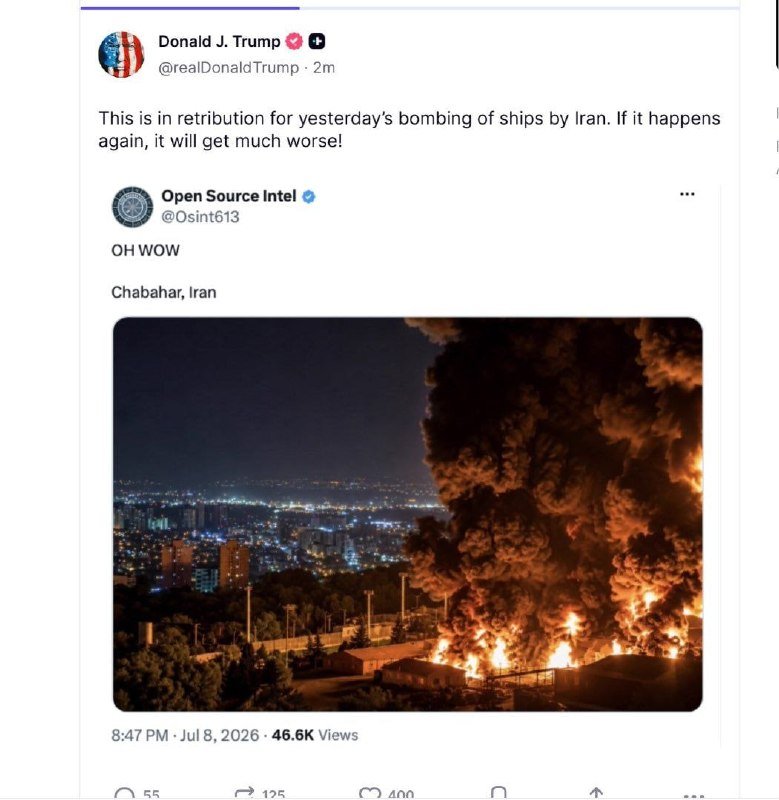
A US official told CNN shortly before 22:00 UTC on 8 July 2026 that the ceasefire with Iran "has at least temporarily ceased," and that "additional strikes have not been ruled out." The framing, carried simultaneously by Telegram channels monitoring the conflict including Clash Report, Middle East Spectator and RN Intel, came hours after President Donald Trump publicly tied a US strike on Iranian-linked vessels to what he called "yesterday's bombing of ships by Iran" and warned that any repetition "will get much worse."
The episode marks the most explicit public acknowledgment yet that the informal arrangement between Washington and Tehran, brokered earlier in 2026 to contain a cycle of tit-for-tat strikes across the Gulf, has effectively collapsed, at least for the moment. Whether it is a tactical pause in hostilities or a structural rupture will depend, as so often in this corridor, on what happens in the next 48 hours.
From ceasefire to rupture in a single broadcast cycle
The sequence on 8 July moved quickly. By 20:52 UTC, The Indian Express had filed a piece asking "Why US attacked Iran and Trump said ceasefire 'is over.'" By 21:41 UTC, Liveuamap's wire recorded Trump's statement in full: "This is in retribution for yesterday's bombing of ships by Iran. If it happens again, it will get much worse." Within ten minutes, three separate channels were passing the same CNN-sourced line — that the ceasefire had "at least temporarily ceased" — and by 21:53 UTC the formulation had hardened into a near-official US position.
The timeline matters. Trump did not announce a new policy of regime change, nor did he disavow the broader track of negotiations that produced the earlier ceasefire. He framed the strikes as retaliation — a word that, in the maritime context of the Gulf, carries legal as well as rhetorical weight. The phrase "at least temporarily ceased," sourced to a US official rather than to Trump himself, leaves Washington room to argue that no formal agreement has been broken, only an unwinding arrangement that never had the binding force of a treaty.
That distinction is unlikely to satisfy Tehran. Iranian state-aligned channels had already reported the previous day's ship bombings as a provocation; the US framing of "retribution" reverses the moral sequence but accepts the same empirical chain of events — strike, response, escalation.
The framing contest: what the wires are actually saying
The English-language coverage that reached Monexus on 8 July came almost entirely through three lenses: the Telegram-aggregated CNN read, Trump's own statement carried by Liveuamap, and an Indian Express explainer placing the strikes inside the longer arc of the 2026 US-Iran confrontation. None of these are neutral outlets in the strict sense, but the convergence across them is notable. There is no significant disagreement about the basic facts: ships were struck on both sides, Trump has openly claimed US responsibility for the latest round, and the ceasefire that defined the spring of 2026 is, in the words of a US official, no longer operative.
The interpretive split, such as it is, runs along a different axis. Western wire framing has tended to treat Trump's statement as the operative fact — the US position is what the US says it is. The Indian Express piece, by contrast, treats the rupture as a question to be answered ("Why US attacked Iran") rather than a fait accompli, and leans more heavily on the Iranian framing of events as the trigger. Both are defensible readings of the same thin evidence base. What neither side has yet produced is a verified casualty count, a confirmed list of struck vessels, or an authoritative Iranian statement matching the US account.
On the Iranian side, the absence of an immediate, on-the-record Tehran response is itself the story. The Tehran framework for the spring ceasefire has been to acknowledge escalation only when it cannot be ignored; silence at this hour suggests either internal deliberation or a calculated decision not to legitimize Trump's framing by responding to it on his timeline.
What a "temporarily ceased" ceasefire actually means
In the grammar of US-Iran diplomacy, "temporarily ceased" is a deliberate phrase. It does not say "collapsed," "terminated," or "void." It preserves the option of restoration without committing to it, and it signals to Gulf partners — Saudi Arabia, the UAE, Qatar, and Oman, all of which have skin in keeping the Strait of Hormuz open — that the diplomatic channel has not been formally abandoned. It is, in plain terms, the linguistic equivalent of a holding pattern.
That holding pattern is fragile. The Strait of Hormuz carries a disproportionate share of seaborne oil and liquefied natural gas; any sustained disruption moves quickly into global energy markets, with knock-on effects on inflation, shipping insurance, and the political durability of Western support for the broader posture. The structural backdrop — a United States entering a campaign season with an inconsistent Gulf doctrine, and an Iran whose leverage is concentrated in the waterway rather than on land — has not changed. What has changed is the willingness of the US side to publicly name the ceasefire as a casualty of the latest exchange.
The pattern fits a broader one in 2026: ceasefires and de-escalation arrangements are easiest to maintain when neither side has a domestic reason to escalate, and easiest to break when one side calculates that a show of force will be read as strength rather than recklessness. The Iranian leadership faces its own internal pressures, not least the management of a population that has watched negotiations fail repeatedly over the past two decades. The Trump administration, for its part, has consistently treated visible retaliation as a vote-mobilising asset.
What remains uncertain
The sources available to Monexus on the evening of 8 July 2026 do not specify the number of vessels struck, the flag states involved, or any casualty figures on either side. The Indian Express piece referenced in the wire points toward further reporting; that reporting has not yet been corroborated by independent maritime tracking data in the items Monexus has read. Trump's claim that US action was "in retribution for yesterday's bombing" has not been independently verified, and the Iranian framing of those prior bombings as a separate matter — distinct from US strikes — has not yet been formally put on the record by Tehran in the items reviewed here.
What the sources do establish is narrower, but solid: a US official has told a major American network that the ceasefire is, for the moment, no longer functioning; the US president has publicly claimed responsibility for strikes on Iranian-linked ships; and three independent Telegram channels monitoring the conflict have all carried the same essential line within a fifteen-minute window. The trajectory from here depends on whether Tehran chooses to treat this as a closing of the door or as another round in a managed escalation, and on whether Washington can sustain the kind of restraint that allowed the spring arrangement to hold at all.
Desk note: Monexus framed this piece from the wire-level convergence — Trump's own statement, a US official speaking to CNN, and the Indian Express explainer — rather than from any single outlet's narrative, because the basic facts are consistent across sources but the interpretation is not. Where the Western wires tend to treat Trump's statement as authoritative, we have flagged the absence of an equivalent Iranian on-record response as part of the story.
Wire provenance
This editorial synthesis draws on the following public wire/social posts:
- https://t.me/ClashReport/2001
- https://t.me/Middle_East_Spectator/2001
- https://t.me/rnintel/2001
- https://t.me/ClashReport/2000