US pounds Iran with second wave of strikes in 24 hours as ceasefire collapses
The second US air strike wave inside a day hit Iranian coastal cities on 8 July 2026, knocking Brent above $80 and reopening the question of whether Washington is heading toward a ground war or a coerced re-negotiation.
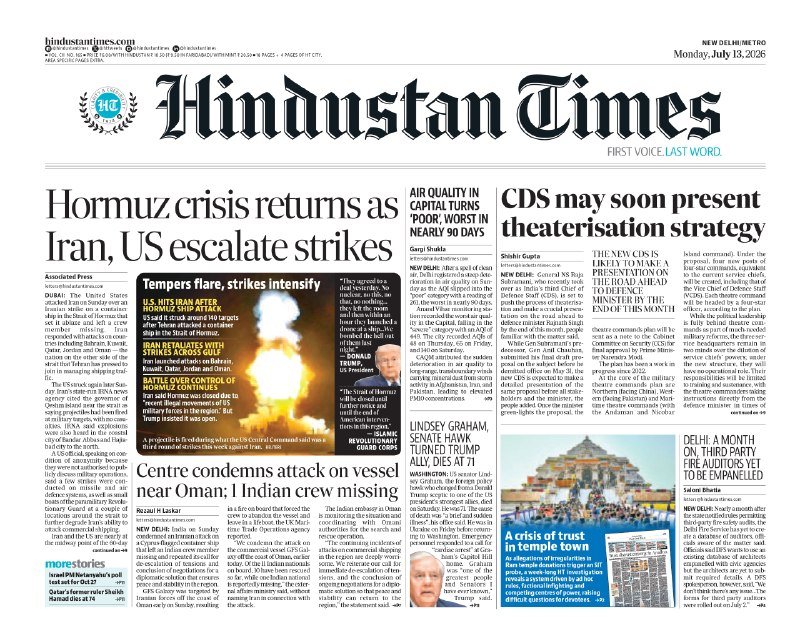
The United States launched a second wave of airstrikes against Iran on the night of 8 July 2026, roughly twenty-four hours after President Donald Trump declared the ceasefire between the two countries to be over. According to US Central Command, the new round of strikes is being carried out on the President's orders, in direct response to what Washington says was an Iranian assault on three cargo ships transiting the Strait of Hormuz two days earlier. Deutsche Welle, citing its own reporting, described the operation as a fresh wave inside a single day, and a Reuters wire flagged the attacks as having rattled several cities along Iran's southern coast.
Brent crude crossed $80 a barrel on the news, an early read on the energy bill the world is now being asked to absorb. The shape of that bill — and of the war itself — is still being negotiated between two incompatible theories of the case. Iran reads the strikes as naked aggression, and frames the oil price reaction as the cost of that aggression. Washington reads them as punishment for a Hormuz provocation, and is betting that a heavy enough punch will buy a more compliant maritime corridor and a more pliant negotiating partner. Neither story is wrong. The unresolved question is which one wins the next ten days.
What happened, and on whose authority
The proximate trigger was a Tuesday assault on three cargo ships in the Strait of Hormuz, which the United States attributes to Iran. The US response has been the most intense US military action against Iran since the ceasefire was declared, according to a Telegram channel monitoring the operations, and the second distinct wave inside roughly twenty-four hours. CENTCOM, the unified combatant command responsible for US forces in the Middle East, announced the resumption of strikes on the President's orders, an unusual degree of explicit political attribution that itself signals how far this has escalated beyond a routine tit-for-tat. The targets on the southern coast, by multiple accounts, included population centres — a fact that distinguishes this round from a strike package aimed only at missile sites, radar installations, or IRGC infrastructure.
The announcement language matters. By naming Trump directly as the authorising authority, CENTCOM has tied the operation to a single political decision, not to a standing operational plan. That makes de-escalation, if it comes, an equally explicit political act — and makes the current episode harder to walk back than a single, deniable strike package would have been.
The Iranian framing, in its own words
The official Iranian read is that this is unprovoked aggression. Iranian state-linked channels have taken to calling the US action "terrorist," and to framing the oil price spike as a direct consequence of American behaviour rather than of any Iranian act. That framing is not exotic. It is the standard register of a state under bombardment, and it does useful work for Tehran: it keeps the moral initiative with the victim, it gives the foreign ministry a clean line for Beijing, Moscow, and the Non-Aligned caucus, and it puts every price-pump-and-pump at Western forecourts onto the balance sheet of US policy. Iranian outlets have also used the language of "terrorist aggression" rather than "military operation," a choice that is doing real diplomatic work — it is meant to reclassify the strikes out of the law-of-armed-conflict frame and into the counter-terrorism frame, where the legal thresholds and the burden of proof are different, and where Tehran has more practice arguing.
A reader who only watched the Western wires would have missed the price line entirely. Tasnim, an Iranian state outlet, ran the $80 move as the lede — that is, the headline number of the day is being read in Tehran as a self-inflicted US wound. Whether or not one accepts the framing, the underlying observation is correct: the marginal cost of the second wave is being paid, in the first instance, by importers of Gulf crude, and only in the second instance by the United States.
The counter-narrative: what the second wave is actually for
The Western and Israeli-aligned read is that Iran took three commercial ships in Hormuz, and that the response is meant to (a) raise the cost of further seizure operations, (b) degrade the anti-ship missile and fast-attack craft infrastructure that makes those seizures possible, and (c) reopen a diplomatic lane in which Tehran negotiates from a weaker position. There is internal logic to that sequence. The original ceasefire, declared weeks ago, had visibly frayed as Iran-aligned forces probed the corridor. A one-off strike would have been absorbable; a second wave, with cities on the southern coast absorbing hits, is meant to communicate that the cost curve is now steep and one-directional.
That logic has a problem. Strikes that hit urban areas harden Iranian domestic opinion, narrow the political space in which any Iranian negotiator can compromise, and make the regime's survival argument — that the Islamic Republic is the only thing standing between Iran and humiliation at American hands — easier to make. The same air war that is supposed to bring Tehran back to the table is the thing that is most likely to keep it from the table for the duration of the campaign.
Structural frame: corridor politics under dollar-priced oil
Strip the rhetoric away and the underlying contest is over a maritime corridor and the price of the oil that flows through it. Roughly a fifth of the world's seaborne crude transits the Strait of Hormuz. Whoever can credibly threaten that traffic sets the global marginal cost of energy, and through it the inflation rate, the central bank reaction function, and the fiscal headroom of every importer. The United States is the security guarantor of that corridor; Iran is its most capable disruptor. The ceasefire that collapsed this week was, in effect, a price-stability arrangement dressed up as a peace deal. The second wave is the bill for its non-payment.
This is the larger pattern the event sits inside. The dollar-priced commodity system needs a stable Gulf. Every time that stability is interrupted, the disruption accrues to importers and to the political standing of the guarantor. A reader should expect, over the coming weeks, two parallel tracks: a military one, in which the US degrades Iranian anti-ship and air-defence capacity, and a financial one, in which the G7 and the Gulf petro-states work to cap the price reaction so that the second wave does not become a global growth shock. The two tracks will not always point in the same direction. When they diverge — and they will — the question of whether this is a war or a coerced re-negotiation gets answered for us.
Stakes, in concrete terms
If the trajectory continues, the winners in the short term are US defence primes, Gulf-based refining capacity running at full utilisation, and any political actor in Washington who can claim credit for a forceful posture. The losers are Iranian civilians absorbing the strikes, importers carrying the $80-and-rising bill, and any negotiating track that depended on the ceasefire holding. Over a longer horizon, the structural risk is that the corridor becomes a recurring site of confrontation — that the Hormuz price of insurance becomes a permanent surcharge on global trade, and that the next US administration inherits a more militarised and less negotiable relationship with Tehran than the one this administration broke.
The honest reading of the available sources is also that the picture is incomplete. CENTCOM has named the President as the authorising authority and described the operation as ongoing, but the targets struck, the casualties on the ground, and the Iranian response are not yet specified in the reporting in front of this publication. Iranian state outlets are framing the strikes as "terrorist" and the oil move as a US-engineered shock; Western wires are framing the strikes as a measured response to a Hormuz provocation. The facts the two sides agree on are narrower than the rhetoric on either side suggests. What is not yet contestable is that the strikes are real, that they are the second wave inside a day, and that the oil market is already treating them as a regime change event in pricing, if not yet in politics.
How Monexus framed this: wire reporting and Iranian state framing were read side by side, and the price-of-oil move was treated as a first-order fact rather than a footnote. The structural argument — corridor politics, dollar-priced energy, and the ceasefire-as-price-stability-arrangement — is this publication's, not any source's.
Wire provenance
This editorial synthesis draws on the following public wire/social posts:
- https://t.me/OANNTV
- https://t.me/GeoPWatch
- https://t.me/JahanTasnim