US opens new round of strikes on Iran as CENTCOM cites freedom of navigation in the Strait of Hormuz
Within minutes of one another on the evening of 8 July 2026, four Telegram channels confirmed fresh US strikes on Iran, framed by CENTCOM as punishment for what it called an Iranian bid to impose its will on the Strait of Hormuz.
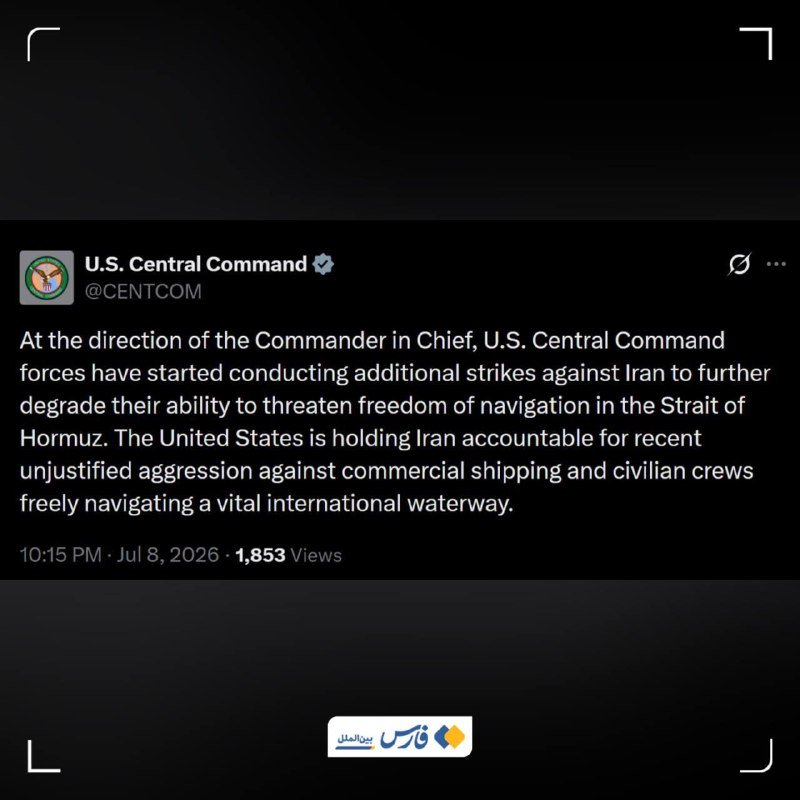
At 20:16 UTC on 8 July 2026, U.S. Central Command announced that, at the direction of the Commander in Chief, its forces had begun fresh strikes against Iran. Telegram channels monitoring CENTCOM feeds — Intelslava and Clash Report among them — reproduced the statement within a minute. By 20:24 UTC, Ukrainian military correspondent Andriy Tsaplienko was registering the news on his channel under a single weary emoji. The four-minute spread between the American military's release and the Ukrainian war reporter's bulletin captures how quickly kinetic events in the Gulf now travel through global feeds.
The U.S. strike notice frames the action in the language of maritime law. CENTCOM's text, as carried by Intelslava and Clash Report, holds that the strikes are intended "to further degrade [Iran's] ability to threaten freedom of navigation." Reporting from The Cradle paraphrases the same CENTCOM line more bluntly: the operation is intended to punish Iran "for imposing its will in the Strait of Hormuz." U.S. Central Command is operating under the 2025–26 posture that treats Iranian moves against commercial shipping in the Strait as a casus belli. President Donald Trump, as Commander in Chief, ordered the action, per the statement carried by disclosetv on X at 20:20 UTC.
What CENTCOM actually said
The CENTCOM text that circulated on the Telegram and X channels at 20:16 UTC and again at 20:21 UTC is short and uniform. U.S. Central Command forces have "started conducting additional strikes against Iran," at the direction of the Commander in Chief. The public-facing justification is the degradation of Iran's ability to threaten freedom of navigation in the Strait of Hormuz — a phrase that ties the strikes to the Iran-aligned disruptions that began escalating maritime insurance premiums through 2024 and 2025. CENTCOM did not, in the text that reached these channels, identify specific targets, weapon systems, or expected duration.
That opacity is itself the story. Telegram-channel monitoring of CENTCOM statements has become a primary record of the operational tempo of the U.S. Middle East campaign since late 2024. Where wire services would have carried a fuller strike package by 20:30 UTC, the four channels that confirmed the announcement here — Intelslava, Clash Report, disclosetv, and The Cradle — did so on the back of the CENTCOM release alone. The Cradle's framing of the strikes as punishment is more interpretive than the CENTCOM text strictly warrants; the channel's editors added a rationale ("to punish it for imposing its will in the Strait of Hormuz") that the original CENTCOM wording only implies.
The counter-narrative from Iran-aligned outlets
Reporting framed through Iran-allied channels presents the strikes as an act of economic siege. The Cradle, an outlet with a documented editorial line sympathetic to the Iranian-led "axis of resistance," argues that the U.S. campaign is directed at any Iranian attempt to assert control over the chokepoint through which roughly a fifth of seaborne oil passes. Iranian state media has historically characterised parallel U.S. operations in the Gulf as gunboat diplomacy aimed at preserving dollar-denominated oil settlement. The structural argument here, which Monexus has covered before, is that the freedom-of-navigation framing serves as much to insulate petrodollar circulation as it does to protect commercial vessels.
That is not a fringe reading. Inside the United States, Republican and Democratic administrations alike have treated the Strait as a strategic asset since at least the 1987 Tanker War. What distinguishes the 2025–26 phase is that Iran has, intermittently, treated the Strait itself as a negotiable instrument rather than a free passage. CENTCOM's wording — "further degrade their ability" — implies that an earlier round of strikes did not finish the job, and that a fresh round is being calibrated against the same metric.
How the framing reached the public
The Cradle's bulletin and Intelslava's bulletin arrived within three minutes of each other. disclosetv pushed the same news to X and to its Telegram channel at almost the same moment. Tsaplienko, whose channel is normally tuned to the Russia–Ukraine frontline, picked up the story within eight minutes. The spread suggests a regional news system in which CENTCOM press releases are no longer mediated by U.S. domestic outlets before reaching a global audience; Telegram and X distribute the text simultaneously to readers in Kyiv, Tehran, Beirut, and Washington. The substance has not changed, but the distribution has. The wire of record for the U.S. Iran campaign, in operational terms, is now CENTCOM's own release channel, redistributed by monitors.
This matters for how the strikes will be understood overnight. By the time Western morning broadcasts lead with the news, the U.S. statement will have already been read, annotated, and reframed in outlets that do not share Washington's editorial assumptions. Coverage tomorrow will arrive into a public already primed to see the action through one of two lenses: CENTCOM's freedom-of-navigation frame, or the Iran-allied frame of punishment for sovereign assertion in the Strait.
Stakes in the next 48 hours
Three things will determine whether this becomes a discrete operation or the start of a wider cycle: a confirmed target list, an Iranian response, and a market reaction in the first hours of Asian trading. The CENTCOM text does not yet name what was struck. Without that, casualty figures, target-type descriptions, and any Iranian retaliation are all speculative. If Iran replies — and it has a working playbook through the IRGC Navy, allied Houthis, and Iraqi militias — the strikes will be remembered as the opening move of a 48-hour cycle rather than a one-day event.
If Iran does not reply in the first 24 hours, the operation will likely be read as calibrated and conclude with a CENTCOM after-action summary. Either way, the Strait itself is the strategic prize. Roughly 20% of global seaborne oil traverses it; insurance rates already price in a permanent Iranian nuisance value; and the U.S. posture described in this CENTCOM release is the institutional answer to that nuisance. The Cradle's interpretive line — that the U.S. is punishing Iran for asserting control over a corridor it regards as sovereign — is the strongest non-Washington framing available on the open channel right now, and it will be the line Tehran's diplomats carry into the next UN Security Council session on maritime security.
What remains uncertain is the target set. The four channels here carried the announcement only. None named facilities struck, weapon systems used, or Iranian losses. Until CENTCOM publishes an after-action report, or Iranian state media acknowledges damage at a specific site, the operational scale of the round is genuinely unknown. What is known is narrower but sturdier: at 20:16 UTC on 8 July 2026, the United States reopened its direct-strike campaign against Iran under a freedom-of-navigation rationale, and the world heard about it from CENTCOM by way of Telegram.
This article was assembled from contemporaneous Telegram and X bulletins. Where the U.S. military and Iran-aligned monitors diverge in interpretation, both framings are reproduced above; structural claims about oil flow and dollar circulation rest on long-standing public record rather than this strike alone.
Wire provenance
This editorial synthesis draws on the following public wire/social posts:
- https://t.me/intelslava
- https://t.me/ClashReport
- https://t.me/thecradlemedia
- https://t.me/disclosetv
- https://t.me/Tsaplienko