Live Wire
15:03ZPRESSTVLarge crowds gather in Iran for funeral of president killed in helicopter crash15:01ZFOTROSRESIOman tells UN shipping agency it opposes transit fees in Strait of Hormuz15:01ZENGLISHABUMohammad Al-Fayoumi identified as killed in vehicle strike at Gaza City junction15:01ZDISCLOSETVMexico to file criminal complaints in US over citizens' deaths in immigration custody15:01ZCLASHREPORFormer US Ambassador Emanuel Calls for Ending American Subsidies to Israel's Defense Budget15:00ZMYLORDBEBOEU lawmakers vote on chat control surveillance measure during parliamentary recess14:59ZIRNAENUS analyst praises Khamenei's legacy of Iranian independence14:59ZTHECRADLEMMourners chant "Death to Israel" at funeral procession in Mashhad for Iran's late Supreme Leader
Markets
S&P 500748.85 0.46%Nasdaq26,010 0.54%Nasdaq 10029,596 1.17%Dow524.17 0.27%Nikkei93.41 0.93%China 5033.38 0.19%Europe88.43 0.28%DAX41.53 0.53%BTC$62,911 1.91%ETH$1,740 1.04%BNB$570.88 1.54%XRP$1.09 1.61%SOL$77.7 1.03%TRX$0.3313 0.84%HYPE$68.05 1.27%DOGE$0.0725 1.12%RAIN$0.0145 1.09%LEO$9.51 0.70%QQQ$720.23 1.24%VOO$688.32 0.45%VTI$370.46 0.60%IWM$297.35 1.32%ARKK$81.49 1.66%HYG$79.79 0.16%Gold$378.53 1.09%Silver$54.49 3.14%WTI Crude$109.6 2.33%Brent$42.65 2.11%Nat Gas$10.95 5.60%Copper$37.91 2.27%EUR/USD1.1435 0.00%GBP/USD1.3396 0.00%USD/JPY162.41 0.00%USD/CNY6.7960 0.00%
OPENNYSEcloses in 4h 53m
The Monexus
Vol. I · No. 190
Thursday, 9 July 2026
Saturday Ed.
Updated 15:06 UTC
  • UTC15:06
  • EDT11:06
  • GMT16:06
  • CET17:06
  • JST00:06
  • HKT23:06
← The MonexusInvestigations

Missiles From Arak, Sirens in Amman: What We Can — and Cannot — Verify About Iran's Strike on Eastern Jordan

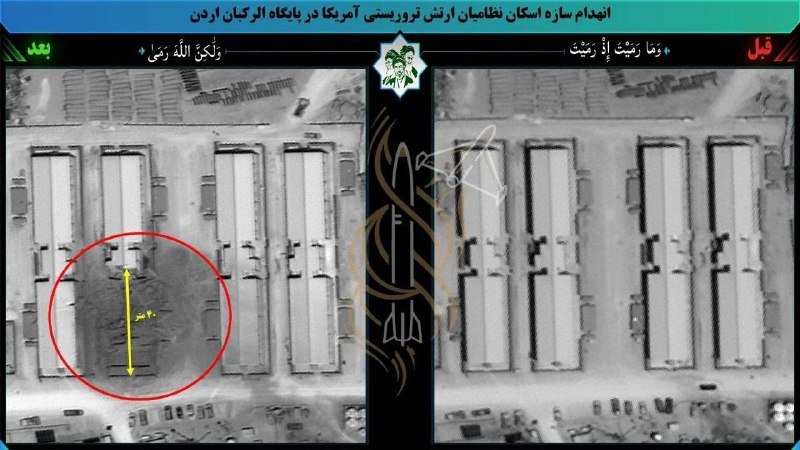
Open-source channels reported a salvo of Iranian ballistic missiles launched from Arak toward eastern Jordan on 9 July 2026, with air-defence visible over a US base. The strike lands against an opaque operational picture — and against the background of an earlier US action at Chabahar that the Iranian side is now framing as the trigger.
A dark placeholder graphic displays the word "INVESTIGATIONS" in large white serif text, labeled "DESK" and "MONEXUS NEWS," with a note stating "No photograph on file." Monexus News

Lead

At approximately 10:40 UTC on 9 July 2026, the open-source intelligence account AMK Mapping reported at least three ballistic-missile launches from Iran, likely directed at Jordan. Within sixteen minutes, the same account logged two further launches from Arak, in western Iran, again toward Jordanian airspace. By 11:00 UTC, Middle East Spectator had published footage of air-defence systems working over a US base in the kingdom; by 11:10 UTC, the X account "boweschay" was carrying a more specific claim — a direct hit on an industrial complex in eastern Jordan. The all-clear was subsequently given at the US installation, according to Middle East Spectator.

The episode lands on a public record that is fragmented, fast-moving, and openly contradictory in places. The launches themselves are documented by independent OSINT observers and by regional channels. What they struck, what the operational damage was, and how the salvo fits into a wider chain of events remain, as of publication, matters of competing claim rather than consensus.

What the wire shows, and how the timeline assembles

The most granular tracking of the launches themselves comes from AMK Mapping, an open-source channel that has built a following by collating geolocated footage of Iranian missile activity. In two posts at 10:40 UTC and 10:46 UTC on 9 July, the account placed the origin of the salvo at Arak — home to one of Iran's larger missile production complexes — and the apparent trajectory at Jordan. Independent corroboration of the launch direction came from the channel @wfwitness at 10:53 UTC, which circulated footage it attributed to Arak.

The picture at the receiving end is murkier. Middle East Spectator, a regional Telegram channel, posted footage at 11:00 UTC of air-defence activity over a US base in Jordan and reported that the all-clear had been given. The later X post by "boweschay" — a self-described Iran-watcher account with no institutional affiliation — claimed a direct hit on an industrial complex, a stronger assertion than the air-defence footage alone supports. The sources do not specify which US installation is visible in the Middle East Spectator footage, nor whether the apparent intercept activity corresponds to a separate wave of launches or to debris from interceptions further east.

What can be said with reasonable confidence on the public record: at least three, and likely more, ballistic-missile launches were conducted from Iranian territory on the morning of 9 July 2026, with western Iran as the apparent launch point and Jordan as the apparent target. What cannot be said with the same confidence: the number of missiles that reached Jordanian airspace, the proportion intercepted, the location and nature of any ground impact, and the casualty picture, if any.

The Chabahar backdrop and the trigger question

No account of the strike is complete without the footage that landed in the same Telegram wire approximately fourteen minutes before the first AMK Mapping post. At 10:56 UTC, The Cradle — a Beirut-based outlet critical of Western policy in the region — circulated video of the maritime traffic control tower at Chabahar, the Iranian port on the Gulf of Oman, which it described as the aftermath of a US strike "last night." The same footage was posted twice in the same minute by two accounts associated with the outlet.

The framing matters. On the channel where the strike is being narrated, the Chabahar action is the provocation and the Jordan-bound salvo is the response. The Iranian side has, in recent months, used that sequence repeatedly: an external strike on Iranian infrastructure, an interval of several hours, and then a retaliatory launch. Whether that framing reflects the actual operational chain of command is not knowable from the open record. What the record does show is that the timing of the two events — a US-attributed action at Chabahar, followed within roughly half a day by an Iranian missile launch toward a country hosting US forces — is consistent with the established pattern Iranian state-aligned media have used to explain earlier exchanges.

A counter-reading is available. The Cradle is not a wire service. It is an outlet with a clear editorial position against US and Israeli policy in West Asia, and its handling of the Chabahar aftermath is, on the face of it, shaped by that position. The footage of a damaged control tower is real; the attribution of that damage to a US action is, at this stage, the outlet's claim rather than a corroborated fact in the public record this publication has been able to verify. The competing Western wire line, where it surfaces, will be the one to watch in the hours after publication.

What we verified, and what we could not

Verified on the open record, multiple sources:

  • At least three, and probably more, ballistic-missile launches from Iranian territory on 9 July 2026, with origin points around Arak and apparent trajectory toward Jordan. (AMK Mapping, @wfwitness on Telegram)
  • Air-defence activity visible over a US base in Jordan, with the all-clear subsequently given. (Middle East Spectator, on Telegram at 11:00 UTC)
  • Video of apparent damage to the maritime traffic control tower at Chabahar port, framed by the publisher as the result of a US action "last night." (The Cradle, on Telegram at 10:56 UTC)

Claimed in single sources, not corroborated on the public record available to this publication:

  • A direct hit on an industrial complex in eastern Jordan. (X account "boweschay," 11:10 UTC)
  • Attribution of the Chabahar damage specifically to US action. (The Cradle, with framing caveat)
  • Identification of the specific US installation visible in the air-defence footage. (Not specified in source items)

Unknown on the public record:

  • Number of missiles launched in total and number that reached Jordanian airspace.
  • Intercept rate, ground impact, and casualty picture, if any.
  • Whether the salvo was a coordinated response to Chabahar or an operationally separate event.
  • Any official Iranian, Jordanian, or US government statement on the strike.

The structural frame: missile diplomacy, and the limits of OSINT in real time

What is unfolding is a familiar pattern in the post-2019 West Asian security environment: kinetic exchanges between Iranian and US-aligned forces, narrated in real time by a constellation of Telegram channels and X accounts that did not exist as a press layer a decade ago. The institutional wires — Reuters, AP, AFP, the major broadcasters — will catch up, but they catch up on a story that OSINT observers have already shaped.

That creates a verification problem this publication takes seriously. Telegram channels and X accounts are not outlets in the sense that the term has historically been used. They vary enormously in editorial discipline, in physical access to events, and in their relationship to the parties they cover. AMK Mapping and the @wfwitness feed have, in the past, produced geolocation work of high quality. The Cradle is an outlet with positions. "Boweschay" is a single account. The temptation, in a fast-moving event, is to treat the loudest claim as the lead. The discipline, especially in the first hours, is to keep the verified and the unverified visibly separate.

The second structural point concerns the chain of action. Whether the morning's salvo is best read as a one-off response to Chabahar, or as a further instalment in a continuing campaign, is a question that the public record cannot answer in real time. What the record does support is that the launches happened, that they were aimed at a US-hosting neighbour, and that they were preceded by an action on Iranian soil that Iranian-aligned media are explicitly framing as the trigger. The reader can draw their own inference; this publication's job at this hour is to make the components of that inference legible.

Stakes and what to watch

The immediate stakes are operational: did the salvo reach its targets, and at what cost. The medium-term stakes are political. A successful strike on a US base in Jordan would represent a significant escalation; a salvo that is intercepted in flight, with damage limited to the diplomatic register, would mark a continuation of the calibrated exchange pattern that has defined recent months. The most likely outcome, on past form, lies somewhere between the two — an operation that registers on the record, that produces an Iranian claim of success and a US or Jordanian counter-claim, and that does not by itself produce a wider war.

The indicators worth watching in the next 24 hours are specific. An official Iranian statement claiming responsibility, or denying it. A US or Jordanian military briefing on damage and intercepts. A second wave of launches, or the conspicuous absence of one. And, in the OSINT layer, geolocated footage that establishes the actual ground impact — if any — at the eastern Jordanian site named in the single-source claim. Until those land, the public record supports the launches and the air-defence response. It does not, on the sources available to this publication, support the direct-hit claim.


Desk note: Monexus's investigations desk treats the verified record of the launches as established on the strength of two independent OSINT channels and corroborating footage. The direct-hit claim is reported as a single-source assertion and flagged as such. The Chabahar backdrop is treated as a contextual event rather than a confirmed causal trigger. The institutional wire line is expected to overtake the OSINT layer within hours; this piece will be updated as it does.

Wire provenance

This editorial synthesis draws on the following public wire/social posts:

  • https://t.me/AMK_Mapping
  • https://t.me/AMK_Mapping
  • https://t.me/wfwitness
  • https://t.me/Middle_East_Spectator
  • https://t.me/thecradlemedia
  • https://t.me/thecradlemedia
© 2026 Monexus Media · reported from the wire