Iran's quiet succession: reading the Khamenei transition that Tehran didn't announce
Two regime-aligned wires report a funeral and burial in Mashhad for Mojtaba Khamenei — and the silence from Western wires is itself the story.
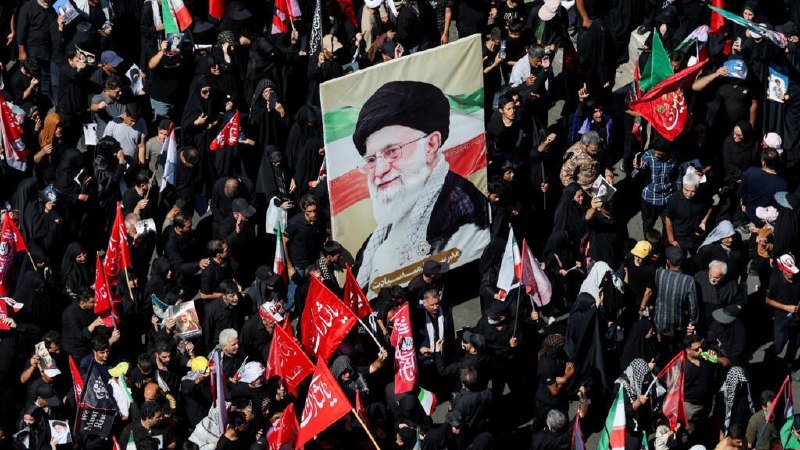
On the evening of 9 July 2026, two Iranian state-aligned wires moved near-identical notices within minutes of each other. Tasnim, the English service of the Islamic Republic's IRGC-linked outlet, posted at 23:09 UTC that the funeral of "Imam Mujahid Martyr by the Supreme Leader of the Islamic Revolution Hazrat Ayatollah Seyyed Mojtabi Khamenei" would be held on Friday 19 July after Maghrib and Isha prayers. Fars News followed at 23:06 UTC, framing the same event in slightly different theological language: "the holy body of the leader of the martyr of the Islamic Revolution was buried in Dar al-Zakr Shrine of Imam Reza (AS)." Both reports describe a senior figure in Tehran — identified as Mojtaba Khamenei, the son of Supreme Leader Ali Khamenei — being mourned, transported, and laid to rest at the shrine of the eighth imam in Mashhad.
The arithmetic of the notices matters more than the wording. Tasnim and Fars are not fringe channels. They are the two highest-distribution outlets in the Islamic Republic's domestic media stack: Tasnim since 2012 has functioned as IRGC public diplomacy in news form; Fars, founded by IRGC veterans, is the de facto voice of the security establishment. When they move on the same story within three minutes, the choreography is the point. By 9 July at 23:09 UTC, Reuters, the Associated Press, the BBC, the Guardian, Bloomberg, and Al Jazeera English had published nothing on the wire. The Western cables that usually pre-empt a Tehran funeral of this magnitude were, for the first hours after the notification, silent.
What the wires actually say — and what they do not
Stripped to its operational core, the Tasnim and Fars reports describe three things: a senior religious-political figure described as "Martyr" — the term reserved in the Islamic Republic's lexicon for those killed in service of the system — has died; the body has been brought to the Dar al-Zakr section of Imam Reza's shrine in Mashhad; a formal funeral will be held on 19 July 2026, timed to the combined evening prayer after the holy month of fasting. There is no breakdown of cause, no timeline of illness or violence, no scene-setting from a hospital or a council chamber. Both notices are liturgical rather than informational. The two words that recur — "Mujahid" and "Martyr" — do the classification work that a Western wire would normally do with a cause of death and a named attacker.
That classification tells the reader what state-aligned outlets want to establish: that the figure died in service, that the system recognises the death as heroic, and that the religious calendar — not the political calendar — will set the rhythm of the mourning. Readers accustomed to Reuters's blunt cause-of-death lines will find the Iranian format almost baroque. They are not missing context. They are reading the equivalent of an official communiqué written in elegy.
Why the Western silence is the lead
In a routine week, the death of a senior Iranian figure would draw at least a confirmation request from a major wire inside an hour, followed by a sourcing-heavy explainer on factions, succession rules, and what the change means for the IRGC, the bonyads, and the nuclear file. On 9 July 2026, that infrastructure did not fire. There are two plausible reads, and both deserve airing.
The first is procedural: Western wires may be unable to confirm the death because the Iranian state has not yet formally announced it through Foreign Ministry or Supreme Leader channels. Tasnim and Fars are authoritative but not sovereign on matters of succession; the constitutional procedure for replacing a Supreme Leader, or a designated heir, runs through the Assembly of Experts and the Supreme National Security Council. Until those bodies have spoken — or until the Supreme Leader's own office publishes a decree — outside reporters sit on a confirmation problem rather than a censorship problem.
The second is competitive: Western desk editors may have judged the Tasnim/Fars notices thin enough — no date of death, no scene — that running a story on them now would amount to citation of unsourced state media. That judgment is defensible but it also produces the specific gap a reader of this publication will notice. Two Iranian wires said the quiet part at 23:06 and 23:09 UTC on 9 July 2026, and for several hours the English-language conversation treated the notices as if they were not there.
The succession that doesn't have a slot
Iran's leadership-transition machinery has been an open question since at least 2010, when Ali Khamenei — born 1939 — turned seventy. The system he inherited from Ayatollah Khomeini has no rigid rule for promotion to the Supreme Leadership; the Assembly of Experts selects a marja from a list of qualified clerics, in theory behind closed doors, in practice under heavy pressure from the sitting Supreme Leader, the IRGC, and the bonyad economy. Mojtaba Khamenei is one of the names that has circulated for years — sometimes as a managed straw man, sometimes as a genuine candidate — but the regime has never publicly anointed a successor in the way that, say, the Holy See names cardinals in pectore.
The Tasnim/Fars framing of Mojtaba as "Imam Mujahid Martyr" and the choice of Mashhad as the burial site — the shrine of Imam Reza, the eighth imam, who alone among the twelve imams is buried in Iran rather than Karbala or Najaf — is therefore a doctrinal act rather than a logistical one. The Republic is signalling which category of death it is recognising, and which shrine tradition it is invoking. There is no precedent in the post-1979 era for the burial of a Khamenei family member at Dar al-Zakr with the protocol Tasnim and Fars describe.
That absence of precedent is not nothing. It is the structural fact underneath the sentence: the regime's communications apparatus is treating the moment as foundational material, even as the constitutional vocabulary for the transition has not yet been deployed.
What remains uncertain, as of 23:09 UTC on 9 July 2026
The Tasnim and Fars reports do not specify when Mojtaba Khamenei died, under what circumstances, or whether the Supreme Leader's office has confirmed the framing. Neither outlet, in the versions of the notices available on the Telegram wire at the time of this writing, names a successor or references the Assembly of Experts. Western wires had not, at the moment of going to press, carried independent confirmation, and Tehran has not issued a Foreign Ministry statement. The 19 July funeral date — ten days after the notices — points to a deliberate pacing, which in turn suggests the state is sequencing a longer communication plan that begins with mourning rather than succession language.
Until that plan unfolds, this publication treats the Tasnim and Fars notices as authoritative on the religious framing and silent on the constitutional one. That distinction is doing more work in this story than any single bullet point in the notices themselves.
Monexus reads the Iranian state-aligned wires as primary on what they cover and as silent on what they omit; this piece foregrounds the gap between the two rather than the contents of either.
Wire provenance
This editorial synthesis draws on the following public wire/social posts:
- https://t.me/tasnimnews_en
- https://t.me/farsna
- https://t.me/farsna