A rail line, a funeral, and the choreography of a regime under fire
Iranian Railways says it is repairing the Tehran-Mashhad line after a pre-dawn strike, while state media choreographs a documentary-grade funeral for a martyred supreme leader — two rhythms, one political hour.
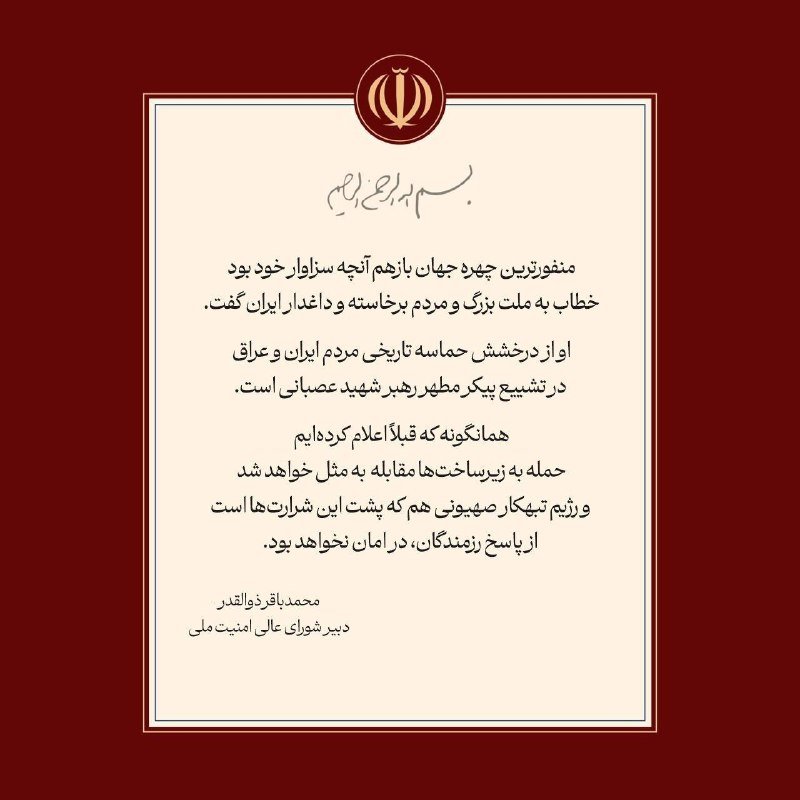
At 05:04 UTC on 9 July 2026, Iranian Railways announced it had suspended passenger services on the Tehran-Mashhad railway after what it described as a "criminal attack launched by the Zionist-American enemy this morning," according to the Beirut-based Al Alam Arabic channel. By 05:06 UTC the same operator was reporting reconstruction works were under way; by 06:57 UTC the head of the Iranian Cinema Organization had dispatched documentary teams to record "the funeral ceremonies of the martyred leader of the revolution from Tehran to Mashhad." By 07:28 UTC the railway was still being patched. The two bulletins — a damaged rail line and a state-organised farewell to a dead supreme leader — landed within a single two-and-a-half-hour window, and they are best read as a single piece of choreography.
What the official communiqués establish is the outline of a day that the Iranian state wants to control from end to end: a kinetic event on critical civilian infrastructure, followed by a ritual of national mourning that will route a cortege along the same corridor. Iranian Railways' own language — "the shortest possible time" for the repair, the formal naming of an enemy — does the political work of compressing geopolitics, infrastructure and grief into one narrative spine. The headline acts are joined by the geography they share.
The strike and the line
The Tehran-Mashhad railway is not a minor asset. It is the spine of the Islamic Republic's domestic passenger network, linking the capital to the holy city of Mashhad in the northeast — a route of roughly 900 kilometres that, in normal operation, carries millions of pilgrims a year to the shrine of Imam Reza. Damage to the line, even temporary, is a logistical as well as a symbolic event: freight corridors, pilgrimage traffic and military movement east toward the Afghan border all share the right of way. Iranian Railways' rapid pivot from "suspending" services to "reconstruction operations" within minutes, as relayed by Al Alam, is consistent with an emergency response to a discrete hit rather than a systemic outage, though the operator has not disclosed the precise location, cause or scale of the damage.
The framing matters. By attributing the incident to "the Zionist-American enemy," the Iranian Railways statement pulls the line into a familiar external-threat narrative that the Islamic Republic has used for decades to mobilise domestic opinion and discipline its own information environment. Whether the strike is treated as an act of war, a coercive signal, or a contained sabotage operation by an allied service, the public-facing effect is the same: a damaged piece of civilian infrastructure, named enemy, fast official response.
The cortege and the camera
If the rail line is the substrate, the funeral is the message. The head of the Iranian Cinema Organisation's announcement that documentary teams have been mobilised "from Tehran to Mashhad" is not a piece of arts administration; it is a directed instruction to the state-aligned media complex. The reference to "the martyred leader of the revolution" — used in Iranian state discourse specifically for Ayatollah Khamenei, who died on 7 June 2026 after nearly four decades as Supreme Leader — frames the route not as a logistical challenge but as a televised national event.
Mourning a supreme leader in Iran is a managed, choreographed, and centrally produced spectacle. The 1989 funeral of Ayatollah Khomeini set the template: a procession through central Tehran, a relay of mourners, a coordinated media product broadcast domestically and across the resistance-axis satellite channels. The Al Alam relay of a Cinema Organisation directive to record the Tehran-Mashhad leg suggests the new leadership intends to extend that template along the country's most legible corridor, with documentary teams positioned along the route to manage the visual record from multiple angles. The point is not just to be seen, but to be seen being mourned in a way the state controls.
Two clocks, one state
Read together, the bulletins describe a state running two clocks at once. The first is operational and defensive: a railway hit at dawn, services suspended, repair crews mobilised, all within minutes. The second is ritual and reproductive: a martyr, a route, a camera, a cortege. The first is what a sovereign does when its infrastructure is attacked. The second is what a sovereign does when it needs to be seen to grieve, in public and on its own terms, at scale.
This dual posture is not new to Tehran, but the sequencing is unusually tight. The Islamic Republic has spent the better part of two years fighting an overt war on at least two fronts while managing a leadership transition that was always going to be its most delicate political moment. The line between a real-time security event and a curated mourning event is being held with care: the enemy is named in the railway bulletin, the martyr is named in the cinema bulletin, and the two are made to rhyme geographically without ever quite being made to rhyme politically in the public message.
What remains unknown
The available reporting does not specify the location, extent, or technical character of the rail damage, nor does it identify a striking party by means other than the Iranian Railways attribution to "the Zionist-American enemy." No casualty figures, no repair timeline, and no independent confirmation of the strike have been disclosed in the source material. On the funeral side, the documentary directive is confirmed, but the date, the precise route, and the security architecture around it are not. The state, in other words, has framed the day; the day itself is still unfolding.
Desk note: Monexus is reporting the day as Iranian state media is staging it, on the working assumption that a state-aligned channel relaying an official directive is a reliable record of the directive itself — not of the underlying event. Western-wire confirmation of the rail strike has not been published as of this writing; the framing above will be revised if and when independent reporting surfaces.
Wire provenance
This editorial synthesis draws on the following public wire/social posts:
- https://t.me/s/alalamarabic
- https://t.me/s/alalamarabic
- https://t.me/s/alalamarabic
- https://t.me/s/alalamarabic