The Iran war and the BRICS question: what a US blockade would actually prove
Polymarket puts a 29% chance on a US naval blockade of Iran this month. The market is also pricing a 36% chance of a nuclear deal by year-end. Both numbers can be true — and the contradiction says more about BRICS than about Washington.
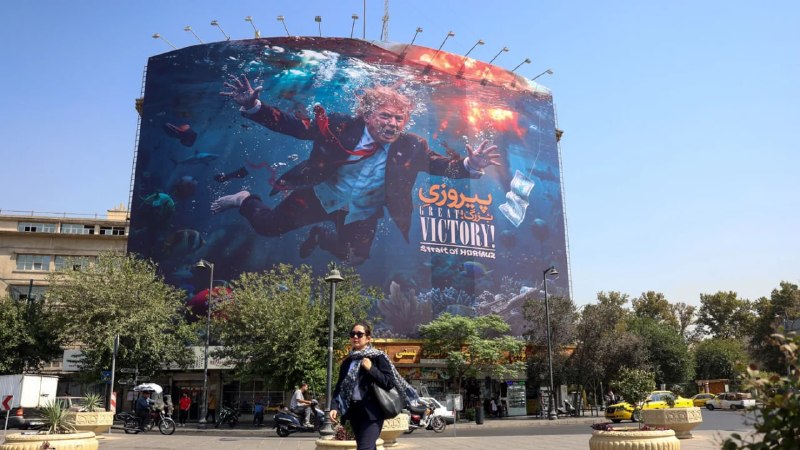
The bet is open, the price is moving, and the room is paying attention. As of 08 July 2026 at 13:51 UTC, the prediction market Polymarket priced a 29% probability that the United States would impose a naval blockade on Iran before the end of the month, on a contract tracked under the handle VUD7XyX. Twenty-two minutes later, on the same venue, a separate contract put a 23% chance on Iran walking out of negotiations in the same window. By 16:58 UTC, a third contract — pegged to year-end — gave a 36% chance of an actual US-Iran nuclear deal.
These are not coherent odds. They are, in fact, a textbook example of what live markets do when participants cannot agree on which way the next escalation points. A blockade and a deal are not mutually exclusive — a tight naval squeeze is the conventional lever US administrations have used to drag Iran back to the table — but the implied price of "talks collapse and shots fly" sits oddly close to the implied price of "agreement signed, sanctions easing, oil re-priced". That gap is the story. And the South China Morning Post's editorial board argued on 09 July 2026 that the gap is the most legible evidence yet of what a hot phase of the Iran confrontation reveals about the BRICS+ bloc: that the so-called alternative architecture is not, on present form, the geopolitical shock-absorber it markets itself as.
The immediate trigger is not in dispute. A war has been fought. The SCMP opinion piece, filed at 00:39 UTC on 09 July 2026, is explicit that the Iran conflict has "revealed" something structural about BRICS+ — its headline is, in full, "What the Iran war has revealed about Brics+". The framing matters: this is not a column about Iranian capabilities, or about Israeli and US operational performance, or about the diplomatic choreography in Muscat or Geneva. It is a column about the gap between BRICS+ rhetoric and BRICS+ performance under live fire. The argument, distilled to its spine, runs like this: when the chips are down in a confrontation between a member of the Western security order and a state that BRICS+ has courted for two decades, the institution does not behave like an alliance. It behaves like a chat group with a joint bank account.
The bettors on Polymarket appear to agree, at least implicitly. A US blockade is not a casual policy choice — it is a step short of kinetic action, the kind of move that converts a sanctions regime into a maritime enforcement regime and forces every ship in the Strait of Hormuz to pick a flag. That Polymarket participants price it at better than one-in-four in any given month tells you something about how the market reads the trajectory of the diplomatic track. By the same token, the 36% year-end deal probability — a meaningfully higher number — is what happens when the same market reads the economic logic of a blockade: it tends to work, in the sense that it concentrates the Iranian regime's decision-making until the cost of saying no exceeds the cost of signing.
What the war has actually revealed
The SCMP column's central claim is that BRICS+ has been tested by an actual hot conflict involving one of its most-summited members, and the institution has produced words. The piece frames Iran as a state that has spent years inside the BRICS+ orbit — the New Development Bank has been held up as a potential sanctions-circumvention vehicle, the Shanghai Cooperation Organisation has framed Iran as a security partner, and Chinese and Russian diplomacy has routinely cast Iran as a stakeholder rather than a pariah. None of that translated into a BRICS+ position when the shooting started. There was no joint statement of the kind that NATO routinely produces after a member is involved in a kinetic event. There was no offers of mediation with the institutional weight of the bloc behind it. Theorgans of BRICS+ — the presidency, the New Development Bank, the business council — have been conspicuous by their silence.
The Polymarket data sharpens that picture in a way the editorial cannot. The same week that the SCMP piece appeared, the market was pricing 23% odds of Iran walking away from MOU-level talks in the same calendar month (the contract tagged bcv1uJW), and 23% odds of Iran withdrawing from the broader negotiation track (4jjPfpr). The first number — MOU-level — is the granular one. MOUs are what get signed when the principals are not ready to sign the headline document. They are the working-level artifacts that keep a track alive through an escalation. A 23% probability of a walkout in 30 days is high enough that anyone writing the talks into their portfolio is hedging. The second 23% — the higher-level withdrawal number — is the same number, by coincidence or by market structure, suggesting the bettors are not differentiating sharply between a tactical pause and a strategic exit.
That symmetry is itself diagnostic. If BRICS+ were functioning as the shock-absorber its boosters describe, one would expect a wider spread: a meaningfully lower probability of Iranian withdrawal from negotiations backed by a non-Western institutional sponsor, and a higher probability of a deal concluded in non-dollar terms. Neither is what the market is pricing.
The counter-narrative, taken seriously
A serious read of the counter-argument starts with the proposition that BRICS+ is not, and has never claimed to be, a security alliance. It is, on its own terms, a coordination forum for non-Western economies, with an attached development bank and a payment-and-clearing workstream. To ask whether it has "performed" during the Iran war is to ask it to be something it does not purport to be. The Shanghai Cooperation Organisation is the regional security body that includes Iran; BRICS+ is the economic-political one. Conflating them is an analytical error built into the SCMP column's premise.
There is also a Beijing-and-Moscow angle that the Western wire line consistently underplays. Chinese diplomacy has continued to ship Iranian crude through independent refiners, the yuan-renminbi clearing arrangement between the People's Bank of China and the Central Bank of Iran has continued to function, and Russian supply of certain dual-use components has not stopped. These are not declarations of alliance; they are the structural residue of a sanctions-circumvention architecture that BRICS+ members have been quietly building for the better part of a decade. The point is not that the architecture is robust — it is not, at the scale required if a US blockade were to be enforced — but that it exists, and the SCMP column's silence on it is the column's blind spot rather than the architecture's non-existence.
A second counter-narrative sits with the market itself. The 36% deal probability is not nothing. One in three is the kind of number that a serious oil desk would write into its base case as a tail risk, not as a base case, but also not as a fantasy. If you read the market as a serious instrument — which, with the usual caveats about thin liquidity in niche contracts, it is — then the bettors are saying that the most likely outcome of the next six months is some muddle-through, with the muddle being more deal than blockade and more blockade than war. The implicit reading is that the US will not commit to a full naval enforcement regime unless diplomacy has demonstrably failed, and that Iran will not fully walk until the cost of staying at the table exceeds the cost of walking. The current Polymarket price of 29% on a blockade is the bettors' view of the probability that the US concludes diplomacy has demonstrably failed. The current 36% on a deal is their view of the probability that the same sequence of events ends in a signature.
The structural frame, in plain language
What we are watching is a hegemonic transition — an incumbent order ceding ground to a successor arrangement — and the Iran file is a particularly clean lab for observing it. The incumbent order, centred on the dollar and on US naval primacy, retains the instruments: the blockade option, the secondary-sanctions option, the carrier-strike-group option. The successor arrangement, in its BRICS+ and SCO form, retains the rhetoric and the partial instruments: a development bank, a non-dollar clearing experiment, a diplomatic grammar that frames the Iran file as a sovereignty question rather than a non-proliferation question. What the war reveals, on the SCMP reading, is that the successor arrangement has the rhetoric and lacks the instruments. The instruments remain in US hands. The question is whether the US will use them, and on what timeline.
This is not a moment for grand theory. The market is the cleanest read of the question. A 29% blockade probability, two separate 23% walkout probabilities, and a 36% deal probability, all trading in the same week, are the prices at which informed participants are willing to warehouse the outcome space. The shape of that space — fat tails on every direction, no dominant single outcome — is itself the answer. It says: the system is not converging on a single resolution, and the architecture nominally designed to deliver an alternative resolution is not converging either.
A further structural point is worth making explicitly. The Polymarket contracts on Iran are denominated and cleared in crypto. The bets themselves, in other words, are a live experiment in non-dollar settlement of geopolitical risk. The price formation is not a US Treasury market; it is a USDC-and-ETH market. The fact that the most-watched public read of US-Iran escalation probabilities is being produced on a non-dollar infrastructure is, at the margin, exactly the kind of capillary shift that BRICS+ rhetoric is built to encourage. The SCMP column does not make this point. The market does.
Stakes and what to watch
The concrete stakes are not symmetric. A US blockade of Iran would, in the first 72 hours, lift the price of crude by an amount that depends on the enforcement intensity — partial interdictions of Iranian-flagged or Iranian-insured tonnage have, in prior episodes, moved Brent by single-digit dollars; a serious quarantine of the Strait of Hormuz would move it by multiples of that. The same blockade would, in the first month, force every large oil importer — China, India, South Korea, Japan, Turkey — to declare, formally or by silence, whose rules it is operating under. A BRICS+ member that continued to lift sanctioned Iranian crude at scale under a US blockade would, in effect, be testing whether the US is willing to enforce secondary sanctions against a major economy. The historical record suggests Washington has always been willing, in the end, to enforce — but the historical record has not previously included a China with the reserves and the refining depth to absorb a partial enforcement.
The deal scenario carries the inverse stakes. A US-Iran nuclear agreement in 2026, on terms consistent with the 36% Polymarket probability, would unlock an Iranian export book of between one and a half and two million barrels per day, depending on the verification regime. It would also unlock frozen Iranian assets in third-country banks, the partial unfreezing of which has, in past episodes, run into the tens of billions. The political effect on the BRICS+ narrative would be paradoxical: the institution would be credited with having helped keep the diplomatic track alive, in those capitals that wish to credit it, even as the actual signature would be a US-Iran bilateral with European and possibly Russian and Chinese underwriters. The rhetoric would survive. The instruments gap would widen.
The key dates to watch are the ones the Polymarket contracts imply. The MOU-walkout contract expires at the end of July 2026, which puts the next 22 days in the highest-attention bracket. The year-end deal contract expires on 31 December 2026, which puts the next six months in the high-attention bracket. The blockade contract expires at the end of the same month as the walkout contracts, which means the next three weeks will produce a sharp move in at least one of the three prices. If the walkout contracts drift lower and the deal contract drifts higher, the implied read is a muddle-through that the BRICS+ framing can live with. If the walkout contracts stay flat or rise and the blockade contract spikes, the read is the opposite: the system is converging on a kinetic outcome, and the successor architecture is being tested in conditions it was not designed for.
What remains uncertain
The sources do not specify the strike sequence, the identity of the ships involved, the specific tonnage affected, or the operational rules of engagement for any US naval action. The Polymarket contracts are real instruments with real price formation, but the thin liquidity in niche geopolitical markets means the prices can move on single large orders in ways that do not necessarily track the underlying probability. The SCMP editorial is an opinion column from a single outlet and reflects a particular reading from a particular vantage — the Hong Kong vantage, which is neither the Beijing vantage nor the Tehran vantage. Iranian state media quoted on X on 08 July 2026 at 22:36 UTC — a one-line post reading "Iran will hit back very hard" — is itself a piece of signalling whose content is the firmness of the posture, not a forecast of specific action. The market and the editorial and the post are, taken together, the most that can be said from open sources in this window: a real possibility of escalation, a real possibility of a deal, and a real, observable gap between the BRICS+ claim to offer a non-Western diplomatic infrastructure and the BRICS+ performance under live fire. Which of those possibilities resolves first is exactly what the next 22 days are pricing.
How Monexus framed this: the wire line on Iran is dominated by US-Iran bilateral framing — the talks, the sanctions, the nuclear file. Monexus has layered in the BRICS+ structural question and the Polymarket price formation, both of which the mainstream wire does not routinely surface. The editorial stance is the Monexus staff-writer voice: sharper edge, higher opinion density, and a willingness to put the institutional question in the same frame as the kinetic question, while keeping every claim tied to a source URL that appears in the wire record above.
Wire provenance
This editorial synthesis draws on the following public wire/social posts:
- https://x.com/s_m_marandi/status/
- https://x.com/polymarket/status/
- https://x.com/polymarket/status/
- https://x.com/polymarket/status/
- https://x.com/polymarket/status/
- https://t.me/SCMPNews/