Khamenei's funeral and the succession question Tehran cannot defer
A state funeral closes one chapter of the Islamic Republic. The harder chapter — who inherits the marja'iyya and the security state — is just beginning, and the choreography around it tells you what the clerics fear most.
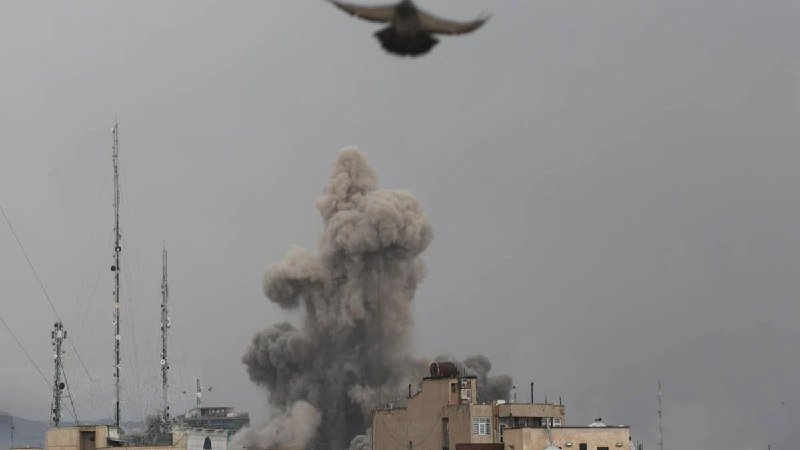
The funeral prayer for Grand Ayatollah Sayyid Ali Hosseini Khamenei was led at the holy shrine of Imam Reza in Mashhad on 9 July 2026, with the procession carried on the shoulders of mourners and broadcast live on state-linked outlets including the Khamenei_en Telegram channel. The choreography was deliberate: the country's senior clerics wanted the images of a state funeral in motion before the political conversation in Tehran shifted from grief to arithmetic. The arithmetic, this time, is the question the Islamic Republic has avoided in public for four decades — who succeeds the Supreme Leader, and on what terms.
The official framing, as transmitted through the Khamenei_en channel at 18:26, 18:31 and 18:37 UTC on 9 July, is that of a martyrdom and a sealed succession. Telegram posts frame the deceased as "the Leader of Truth-Seekers of the World" and the "eminent marja' of the Shia world" — the kind of language that does the political work of canonisation while the body is still being carried. The succession itself is treated as a fait accompli in the official messaging, even though the constitution's Article 5 mechanism — the Assembly of Experts — has not yet been shown deliberating in public. The hard politics is what the broadcast is designed to obscure: between the doctrine of velayat-e faqih and the operational reality of the Islamic Revolutionary Guard Corps, there is now a vacuum shaped like one man, and the clerics who fill it will set Iran's trajectory for the next generation.
The succession rule nobody writes down
Iran's succession procedure is constitutional on paper and dynastic in practice. The Assembly of Experts, an 88-member body of senior clerics elected to eight-year terms, is the formal mechanism. In reality, two parallel constraints do the work. The clerical establishment wants a marja' — a senior source of emulation in the Shia hierarchy — who can hold the seminary's respect and the street's deference at the same time. The security establishment wants a figure who will not interfere with the IRGC's regional architecture, its missile programme, or its financial autonomy.
The compromise candidate has historically been obvious: a quietist cleric with the right lineage, kept in a box by the Guardians Council and the IRGC's intelligence arm. There is no public evidence in the available record that such a candidate has been pre-positioned. The framing on the Khamenei_en channel — the deceased elevated to "Leader of the Islamic Revolution" posthumously, alongside his standing title — is the kind of language that narrows the field by reminding potential rivals of the canonical weight they would have to match.
Why the canonisation language matters
Calling a recently deceased leader the "Leader of Truth-Seekers of the World" in the first 24 hours of a state funeral is not a translation choice. It is a way of writing the successor into a smaller frame: whatever comes next is a steward of the martyred founder's project, not a co-equal claimant to charismatic authority. That distinction will matter the first time a young cleric with Qom credentials and a militia patronage network decides he disagrees with the new Supreme Leader on, say, the management of the Hezbollah file or the price of the rial. The official canonisation is a prophylactic against that moment.
It is also a signal to the region's Shia communities — Iraq, Lebanon, the Gulf Shia periphery, the Houthi north — that the Iranian state's claim to leadership of a transnational confessional project is not contingent on the biology of one man. The funeral's translatability into Arabic, Urdu and Farsi messaging in the same news cycle is part of that signalling. The Iranian state's regional depth was built on the assumption that its leader was irreplaceable in practice; the messaging on 9 July is the first test of whether that assumption can survive contact with a vacancy.
The counter-read: this is a managed transition, not a crisis
The plausible alternative reading is that the Islamic Republic's institutions are more routinised than outside commentary assumes, and the language on the Khamenei_en channel is the routine vocabulary of a one-party state processing a leadership change rather than a faction fight. Iran's presidential transitions of 2017 and 2021, and the earlier succession from Khomeini to Khamenei in 1989, all featured language of this register. The clerics may simply be doing what the clerics do.
That reading holds only as long as three things stay quiet: the Assembly of Experts' internal bargaining, the IRGC's command-and-control decisions during the interregnum, and the street response in Mashhad, Qom and Tehran over the 40-day mourning cycle. If any one of those moves visibly — a procedural dispute made public, an officer reshuffle that reads as a factional coup, a protest that the security forces cannot quietly disperse — the canonisation framing collapses and the succession becomes the story. The next 40 days are the window.
Stakes, and what to watch
The regional balance pivots on this. Iran's network of axis-of-resistance allies — the Shia militias in Iraq, Hezbollah in Lebanon, the Houthis in Yemen, and a constellation of smaller formations in Syria's still-fragile post-Assad order — runs on the assumption that Tehran's decision-making is unitary and that the Supreme Leader's office is the final arbiter. If the succession produces a cleric who can govern that network with the same weight Khamenei did, the regional architecture holds. If it produces a figure who can govern in name but is checked in fact by the IRGC's intelligence command or by a rival clerical faction, every militia leader in the region will quietly begin pricing that in.
For Western capitals, the policy read is more boring and more important: the file on Iran's nuclear programme, its sanctions architecture, and its hostage-diplomacy playbook is going to be managed, in the near term, by the same cadre that ran it under Khamenei. The new Supreme Leader's first six months will be about consolidating authority, not about doctrinal surprises. The surprise, if it comes, will come later — and it will come from inside the security establishment, not from the seminary.
What the record does not yet show
The Telegram record carries the official framing and the funeral imagery; it does not carry the names of any candidate being circulated in Qom or any procedural notice from the Assembly of Experts. The sources available to this publication on 9 July do not specify the date or composition of the Assembly's convening, nor do they name the clerics being sounded out as potential successors. Any reporting in the next 48 hours that names a frontrunner should be treated as informed speculation rather than sourced fact — and the gap between those two categories is, for the moment, where the actual politics is happening.
— Monexus Staff Writer filed this from the wire on 9 July 2026, 21:00 UTC. The Telegram thread provides the framing; the analytical layer is Monexus's own.
Wire provenance
This editorial synthesis draws on the following public wire/social posts:
- https://t.me/Khamenei_en
- https://t.me/Khamenei_en
- https://t.me/Khamenei_en
- https://t.me/Khamenei_en