Three million in Karbala: what Khamenei's funeral procession actually shows
A reported three million mourners in Karbala is less a crowd count than a statement about who in the Shia world recognises Tehran's authority — and who may be moving on.
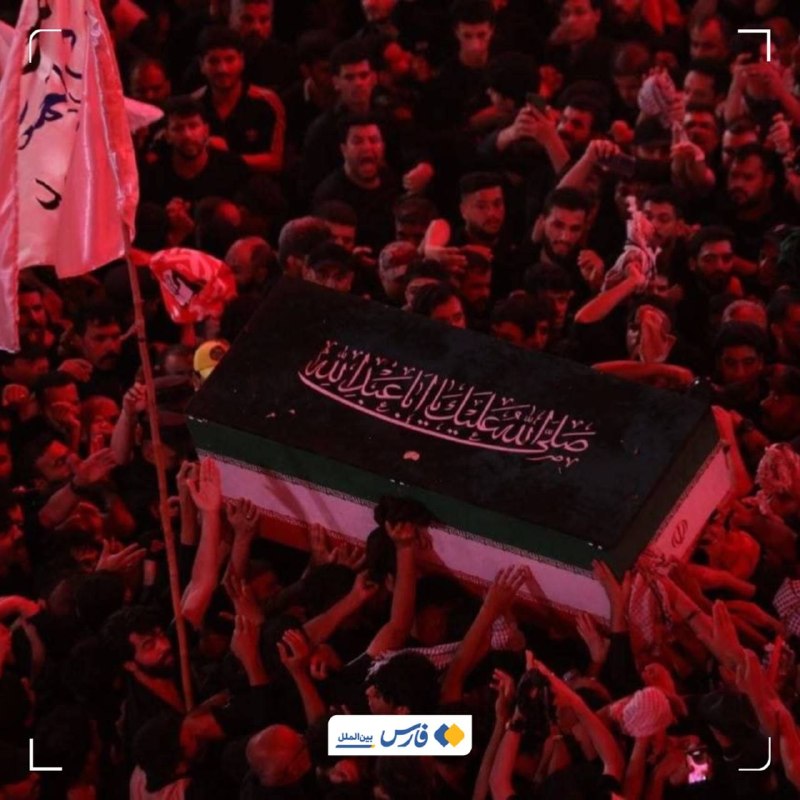
Crowds in Karbala, choking the approaches to the shrine of Imam Husayn, were estimated by 22:43 UTC on 8 July 2026 at roughly three million, according to the Telegram channel Middle East Spectator, which has been tracking the procession in real time. The coffin of Ayatollah Ali Khamenei — described in procession coverage as a "martyr" — was still struggling to enter the shrine half an hour later, the volume of mourners so dense that movement had stalled. Funeral prayers were reported under way inside Karbala shortly before midnight UTC.
Whatever one makes of the crowd figure, the route matters more than the number. Karbala is not an Iranian city. It is one of the holiest sites in Shia Islam, in Iraq, and the choice to bring the body of Iran's supreme leader there — past the shrines of Husayn and Abbas — is a deliberate theological and political statement. It says the Iranian Republic is the custodian of the wider Shia world, and it asks Iraqi Shia to acknowledge that custodianship in the most public way possible.
What three million on a Telegram channel actually proves
Crowd counts at state funerals are, by long tradition, a form of propaganda-by-addition. Tehran has every incentive to maximise the figure; Iraqi hosts have a counter-incentive to display legitimacy by association; and the channels transmitting the images sit somewhere in between. What the visuals from Karbala do establish, independently of any exact number, is scale and composition: this is not a small sectarian crowd, it is a multi-generational Shia turnout that includes men, women, children and tribal delegations. The procession was filmed, the shrine was filled, and the prayers were held. Those are facts, regardless of the precise tally.
That distinction — between the soft claim ("three million") and the hard claim ("a very large Shia crowd gathered in Karbala for Khamenei") — is exactly where Western coverage of Iranian funerals tends to go wrong. The number is treated as evidence either for or against the regime's legitimacy, when the real evidence is in the willingness of Iraqi Shia authorities to host the event in a city of this significance at all.
The Iraqi Shia tier
Karbala was not a passive backdrop. It is administered by an Iraqi Shia political-religious class that has spent two decades carving out autonomy from Baghdad and, at times, from Tehran. Hosting Khamenei in the shrine city of Husayn is therefore a signal from Baghdad's Shia partners — Muqtada al-Sadr's movement, the Coordination Framework parties, the Marja'iyya's representatives in the holy cities — that whatever reservations they hold about Iran's regional behaviour, the religious bond is being renewed in public. The procession footage is, in effect, an Iraqi receipt.
That receipt matters because it complicates a story Western analysts have been telling for at least five years: that the Iranian-led "axis of resistance" is hollowing out, that Iraqi Shia are drifting toward a Saudi or Gulf order, and that Tehran's regional gravity is fading. Karbala suggests the opposite — or at least that the religious register, which sits beneath the political one, is being deliberately reactivated.
What it does not settle
None of this answers the obvious question on every desk in Washington, Tel Aviv and Riyadh: what happens next inside Iran. The funeral is a stress test of a particular kind of power — the capacity to summon bodies, chants and grief across borders — and it passed. But succession in the Islamic Republic has never been settled by a single test. It is settled by the Assembly of Experts, by the IRGC's preferences, by the Supreme National Security Council, and by a candidate able to thread the gap between principlist factions and the still-influential reformists around figures like Khatami and Rouhani. Karbala tells us the regime can still perform legitimacy in the region; it tells us nothing about whether the men who decide the next Supreme Leader will choose continuity or fracture.
There is also a quieter reading. If three million Iraqis really did turn out, that is also three million witnesses — including a younger, urbanised Iraqi Shia generation that is less deferential to Iranian religious authority than its parents — watching the ritual up close. Funerals confer legitimacy on the deceased; they also disclose the distance between the mourned and the mourners.
Stakes
For Tehran, Karbala is a win on the only register it still fully controls: Shia transnational solidarity. For Baghdad's Shia parties, it is a calculated bet that the cost of hosting Iran publicly is lower than the cost of refusing. For Gulf states, it is a reminder that the religious map of the Middle East runs through Iraqi shrine cities, not through summit hotels. And for Western governments still arguing about whether Iran's regional influence is rising or declining, Karbala is a useful prompt to stop treating the question as binary. The body arrived. The shrine was filled. The prayers were held. The succession begins now.
*Desk note: Monexus treated the unverified "three million" figure as a soft claim sourced to a single Telegram channel, while treating the procession itself — the coffin, the shrine, the funeral prayers — as the hard, visually corroborated fact. Coverage elsewhere will probably lead on the headline number; this publication prefers to lead on the route.
Wire provenance
This editorial synthesis draws on the following public wire/social posts:
- https://t.me/Middle_East_Spectator
- https://t.me/Middle_East_Spectator
- https://t.me/Middle_East_Spectator
- https://t.me/Middle_East_Spectator
- https://t.me/Middle_East_Spectator