NATO's Ankara reprieve: what Trump's alliance theatrics actually cost Ukraine
A one-day Ankara summit bought NATO another Trump-sized headache and Ukraine a Patriot missile licence. The bargain underneath is less reassuring than it looks.
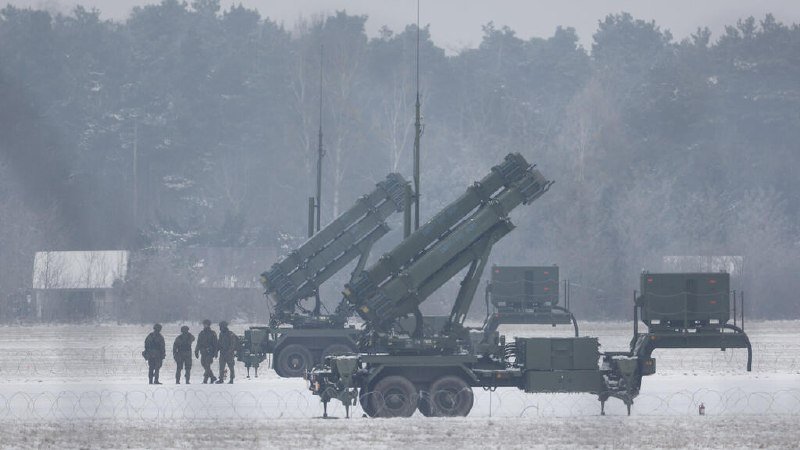
The NATO summit in Ankara closed on 8 July 2026 the way NATO summits have closed for the better part of a decade: with Donald Trump on the premises, an unscripted flare-up over Ukraine somewhere in the margins, and a communiqué that survived contact with him. Reuters reported on 9 July that the alliance "weathers another Trump storm but braces for more," a construction that has become boilerplate in Atlantic coverage and, for that reason, easy to underestimate. The harder fact in the room is the licensing news that came out of New York the same day: Trump has told Kyiv he will grant a licence for Ukraine to manufacture Patriot air-defence interceptors, according to a New York Times report flagged by Unusual Whales on 8 July at 15:58 UTC.
That pair of moves — public reassurance inside the alliance, quiet capability transfer to the invaded party — is the real product of the week. Read together, they reveal the transactional logic that now governs American commitments to European security, and they raise a sharper question than the wire framing has so far asked: what is Ukraine actually buying, and what is it conceding, when the licence for a missile system arrives as a presidential favour rather than a NATO programme?
The Ankara theatre, then the licence
At the summit itself, Trump told allies he wants the United States to remain inside NATO, according to a Reuters dispatch carried by Unusual Whales on 8 July at 14:57 UTC. That sentence has done enormous work in the post-summit coverage. It has been treated, in much of the Western press, as the headline reassurance — proof that the alliance's worst-case scenarios about a second Trump term were, again, deferred rather than realised.
But "I want the US to remain in NATO" is not the same sentence as "the US will honour Article 5 unconditionally." It is a posture, not a guarantee. Ukrainian observers, watching from Kyiv, noted that Trump's surprise remarks on Ukraine during the summit — recorded by TSN and circulated on 9 July at 09:14 UTC — produced a separate, less comfortable signal: a US president still willing to use the war as material for live political theatre in front of the cameras, even as the country he has armed for three and a half years runs short of the interceptors that keep its cities lit.
Why a Patriot licence, and why now
The Patriot question is not new. Kyiv has been pressing Washington on the air-defence gap since at least 2024, when Russian glide-bomb and ballistic-missile campaigns made a handful of Western-supplied systems load-bearing for the country's survival. A licence to manufacture domestically — rather than to receive donated launchers — would in principle let Ukraine build the interceptors on its own soil, at its own tempo, with Ukrainian labour and Ukrainian supply chains.
The trade is not free. Patriot technology is owned by RTX (formerly Raytheon); the interceptors run through a constrained US industrial base; and any production licence typically bundles technology-transfer conditions, pricing tiers, export controls, and an end-use regime that re-anchors Kyiv to Washington's political decisions on a multi-year horizon. The NYT-sourced report is also, at this point, a presidential statement rather than a signed contract. There is no published licence, no schedule, and no disclosed volume. Ukraine is being offered a future, not a delivery.
What the counter-narrative gets right
A plausible alternative read holds that this is exactly the deal structure the Trump White House prefers. Licence-based transfers cost the US Treasury less than donated hardware, advertise an industrial-policy win to a domestic defence constituency, and bind the recipient country into a long-term procurement relationship — which is, in itself, a form of leverage. From a Kyiv vantage point, the same arrangement can look like salvation: at last, indigenous production of the system that determines whether its power grid survives the winter. Both readings are partly correct, and the article of faith that NATO summits "delivered" for Ukraine rests on which framing one weights more heavily.
The Kremlin's counter-frame, predictably, is that licence or no licence, NATO's eastern flank is being rearmed against Russia in violation of earlier pledges. That line should be treated as Russian-state positioning, not analysis — but it does name one genuine structural fact: every escalation in long-range systems on Ukrainian soil is also, by definition, an escalation in the threat calculus in Moscow, which raises the cost of any future negotiation as much as it raises the cost of the war.
The structural pattern under the headlines
What we are watching is the slow privatisation of an alliance commitment. The Article 5 guarantee, the air-defence pipeline, the Patriot production licence — each used to be a collective NATO problem with a NATO answer. They are now increasingly bilateral US decisions, delivered in presidential remarks and NYT scoops, enforced by the credibility of one man's word. That is not a NATO problem in the alliance's institutional sense; it is a NATO problem in the alliance's political sense, and the two are no longer the same thing.
The stakes over the next twelve months are concrete. If the licence converts into running production in 2027, Kyiv gains a survivable air-defence industrial base and a plausible seat at the post-war reconstruction table. If it stalls — as similar announcements have during the Biden years — Ukraine will have spent political capital on a headline that did not move interceptors, and Russian aircraft will have spent another year exploiting the gap. For NATO as a whole, the deeper stake is whether the alliance's deterrent credibility is now a function of summit choreography or of the hardware actually arriving. Ankara suggests, again, that the choreography is doing more work than it should.
This piece treats the Ankara summit as an event whose headline reassurance and its quiet industrial announcement must be weighed separately, against the prior record of each track. The wire framing tends to fold both into a single "alliance holds" verdict; Monexus finds that the licence is the more consequential of the two, and that it deserves its own audit.
Wire provenance
This editorial synthesis draws on the following public wire/social posts:
- http://reut.rs/4f1lUOR
- https://t.me/TSN_ua