Live Wire
08:51ZTASNIMNEWSThe attack on the nuclear power plant and Khark Island is not trueGovernor of Bushehr:Following the violation…08:51ZINTELSLAVA4x US Airstrike on Bushehr08:49ZDDGEOPOLITAs millions poured toward Mashhad for Khamenei's burial, the Epstein Coalition struck the Tehran-Mashhad rail…08:49ZPRESSTVPlane carrying coffins of late Islamic Revolution leader, family arrives in Mashhad08:48ZIRNAENMashhad's Hasheminejad Airport is preparing to receive the body of the martyred Leader of the Islamic Revolut…08:48ZDDGEOPOLITFSB says it foiled Ukrainian assassination plot against Russian officer near Moscow with drone08:48ZPRESSTVBody of Iran's late president, others arrives home with fighter jet escort08:47ZOSINTLIVEIran launches drone, missile strikes on U.S. military in region
Markets
S&P 500746.98 0.21%Nasdaq25,871 0.20%Nasdaq 10029,253 0.27%Dow523.07 0.06%Nikkei92.64 0.10%China 5033.22 0.66%Europe88.26 0.09%DAX41.31 1.76%BTC$62,872 1.18%ETH$1,753 0.81%BNB$572.19 1.66%XRP$1.1 1.33%SOL$78.1 0.86%TRX$0.3309 0.98%HYPE$68.04 0.03%DOGE$0.0729 1.93%RAIN$0.0145 1.79%LEO$9.5 0.86%QQQ$716.07 0.65%VOO$686.55 0.19%VTI$368.62 0.10%IWM$294.25 0.26%ARKK$80.5 0.42%HYG$79.66 0.00%Gold$376.97 0.67%Silver$53.48 1.23%WTI Crude$110.38 1.63%Brent$42.87 1.61%Nat Gas$11.59 0.09%Copper$37.07 0.00%EUR/USD1.1404 0.00%GBP/USD1.3348 0.00%USD/JPY162.49 0.00%USD/CNY6.8002 0.00%
CLOSEDNYSEopens in 4h 36m
The Monexus
Vol. I · No. 190
Thursday, 9 July 2026
Saturday Ed.
Updated 08:53 UTC
  • UTC08:53
  • EDT04:53
  • GMT09:53
  • CET10:53
  • JST17:53
  • HKT16:53
← The MonexusOpinion

A slip of the tongue, or a slip of the mask?

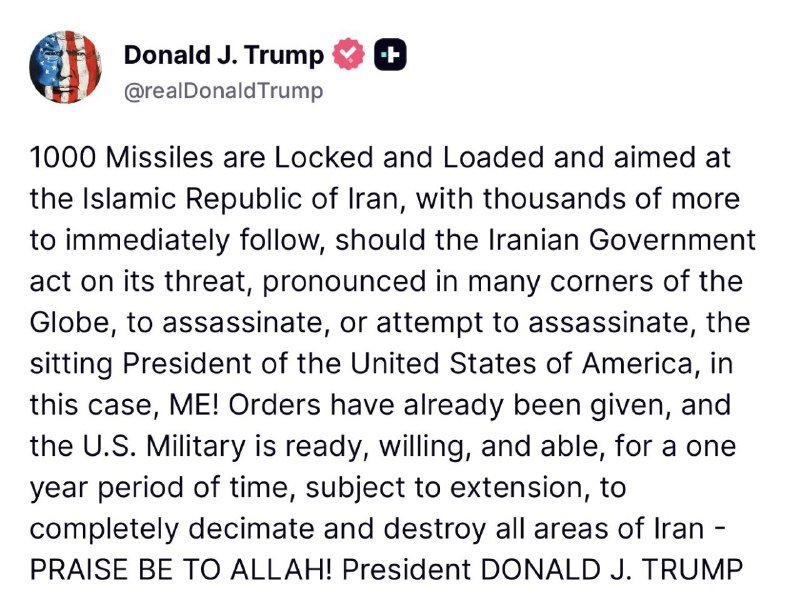
A NATO summit aside in which Donald Trump referred to Japan as the 'Islamic Republic of Japan' has been filed as a gaffe. The label is doing too much work.
@The_Jerusalem_Post · Telegram

At a NATO summit on 8 July 2026, Donald Trump told allies that an American ship had been fired upon, and named the attacker as the "Islamic Republic of Japan." The line circulated within hours. The Insider Paper wire carried the quote at 07:25 UTC on 9 July; the South China Morning Post's Asia desk ran it as a summit gaffe at 06:54 UTC the same morning, under the headline noting that the US president had attributed missile fire to a country whose constitutional order is, in plain terms, the opposite of a theocratic republic. The same day, an account tracking Washington capital flows reported that Trump had used the same NATO platform to tell allies he wants the United States to remain inside the alliance — a reassurance that, until the slip, had been the lead.

The instinct, in any Western newsroom, is to file the moment under "gaffe." The word is a useful piece of furniture. It puts the slip in a small box, attributes it to fatigue or improvisation, and allows the rest of the summit's substance to be reported as if it had happened on a clean stage. This publication is not yet convinced the box fits.

What the word "gaffe" papers over

A gaffe, in the classic sense, is when a politician accidentally reveals what they actually think. The press treats these as embarrassments; political scientists treat them as data. When the US president reaches for the name of a US adversary when describing a missile incident at sea, the obvious question is what catalogue he is reading from. The "Islamic Republic" formulation is, in 2026, a near-uniquely Iranian descriptor. It is the formal name of a state the United States has spent four decades contesting, sanctioning, and at points bombing. Reaching for it instead of "Japan" is not a Freudian slip in the vulgar sense; it is a routine one. Adversarial mental furniture is closer to the hand than allied mental furniture, and gets picked up first.

The SCMP framing treats the moment as a foreign-policy stumble to be politely noted and moved past. That framing assumes the slip is noise. It is more parsimonious to read it as signal: that when the US president is asked, off the cuff, who fires missiles at American ships, the answer he reaches for is not a NATO ally, not a treaty partner, not Japan, South Korea, or Australia. The answer is Iran. The geography of menace, in his head, runs through the Gulf, not the Pacific.

The reassurance that bracketed the slip

Read in isolation, the slip is a curiosity. Read against the same day's other reporting, it becomes a more revealing pair. The Unusual Whales account, citing Reuters, reported at 14:57 UTC on 8 July that Trump had used the NATO gathering to tell allies he wants the US to remain in the alliance. That is a non-trivial commitment from a president who, in his first term, openly questioned the alliance's value and has spent the years since trading public doubts for transactional pressure on European defence spending. The reassurance is real. It is also being delivered to allies who, at this summit, watched their host refer to one of Washington's most important Indo-Pacific partners as a theocratic Middle Eastern enemy.

The two messages are not contradictory. They sit, however, in tension. The reassurance tells NATO that the United States still wants the alliance as a vehicle. The slip tells the same room that the United States' threat picture, when summoned without a script, is Middle Eastern. For Tokyo and Seoul — both treaty allies, both within range of a North Korean or Chinese missile, both watching Iran-adjacent crises draw down US attention and platforms — the reassurance is necessary but not sufficient.

The structural point, stated plainly

The Western security architecture of 2026 is being asked to do two jobs at once. It must deter a peer competitor in the Indo-Pacific while continuing to project power into the Middle East, and it must do so on budgets that have not grown to cover both theatres. When the US president reaches for the wrong continent in a single sentence, that is what the strain looks like in plain language. Coverage that confines itself to "the president misspoke" is not wrong; it is just uninterested in what the misspeak is telling us about the wiring underneath.

There is a counter-reading, and it deserves airtime. It is possible that the slip is genuinely nothing — a tired man at a podium, two syllables that rhyme, a brain searching for any noun phrase. Many slips are just slips. The Reuters-sourced reassurance at the same summit suggests the policy substance remains intact. Allies will, in public, treat it as an unfortunate phrase. In private, intelligence briefings will note it.

What remains genuinely uncertain

The sources do not specify the exact context of the missile remark — which incident Trump was referring to, whether he was describing a historical event or a recent one, whether staff corrected him on the record. The two wire items in this cluster, the SCMP report and the Insider Paper pull, agree on the quote but offer no transcript. The Reuters-sourced reassurance, carried via a market-data account, does not specify which allies received the message or how. There is no claim here about the policy direction of US alliances that the available reporting does not support; there is also no claim that the slip will produce any immediate consequence. The honest position is that a NATO summit, on 8 July 2026, produced one piece of scripted reassurance about the alliance's future and one unscripted moment in which the US president described Japan with Iran's name. The press called the second moment a gaffe. The question worth sitting with is whether the press was right to.


Desk note: Monexus read the SCMP wire as a "summit gaffe" piece and treated it here as the entry point to a structural question about alliance bandwidth. The Reuters-sourced reassurance was carried by a market-data account rather than directly; that provenance is preserved in the source list rather than upgraded to a direct attribution.

Wire provenance

This editorial synthesis draws on the following public wire/social posts:

  • https://t.me/insiderpaper
© 2026 Monexus Media · reported from the wire