Iran installs a successor before the body is cold
Ayatollah Mojtaba Khamenei will lead Friday's commemorative prayer for his father. The choreography of the transition is well underway — and almost everything about it is being decided behind closed doors.
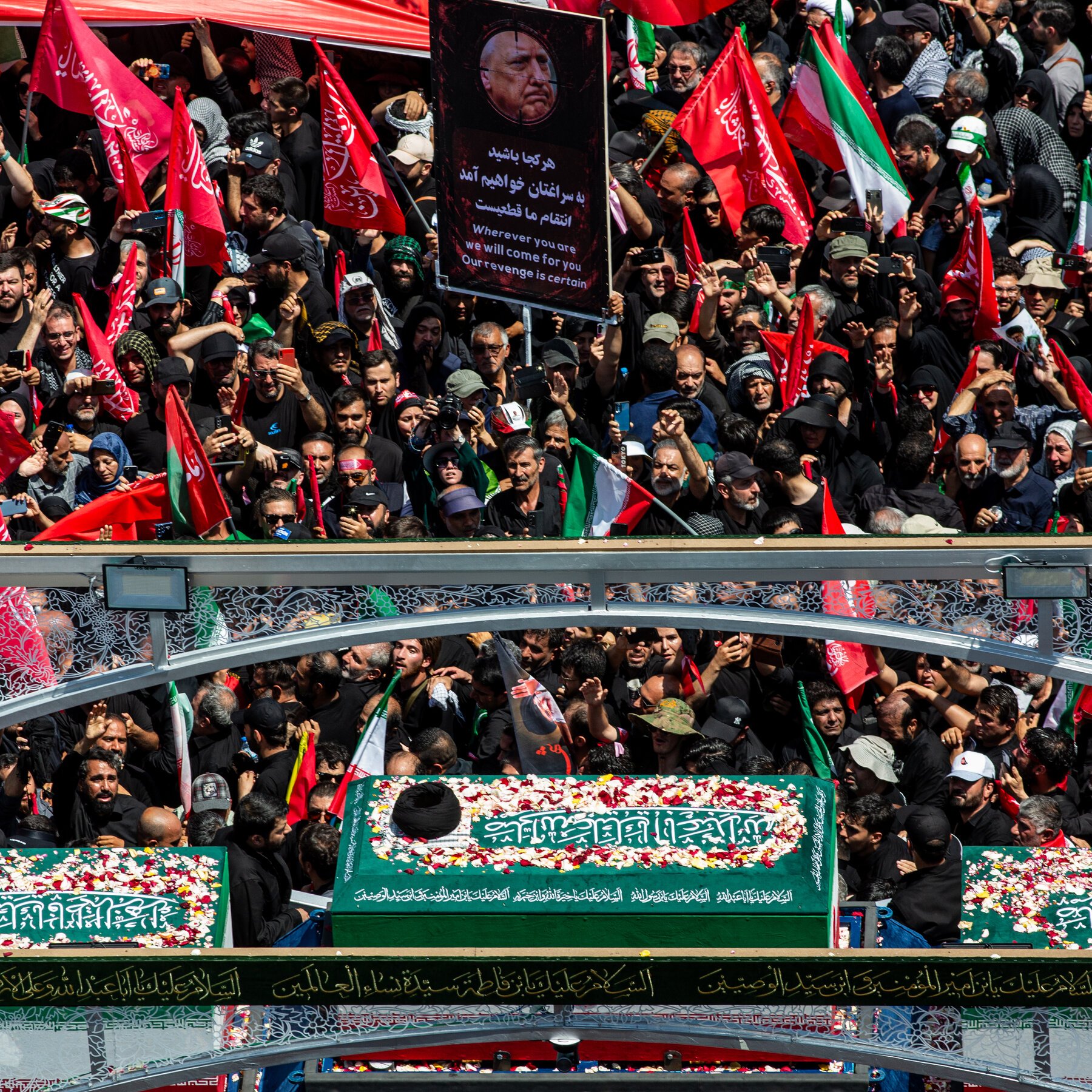
The announcement landed just before midnight in Tehran. State broadcaster IRIB reported on 9 July 2026 that a commemorative prayer marking the death of Ayatollah Ali Khamenei would be held "on behalf of" his son and designated heir, Ayatollah Seyyed Mojtaba Khamenei — and that the younger Khamenei would not attend in person. Within minutes, Telegram channels close to the Iranian establishment were amplifying the line verbatim, framing the absence not as grief but as deference to the office he is about to inherit.
This is the shape of succession in the Islamic Republic: a ritual held before the predecessor's body has even left the shrine, with every camera angle choreographed by an institution that has been preparing for this moment for years. The Friday service at the shrine of Imam Khomeini was always going to be the public face of the handover. The fact that Mojtaba Khamenei is being shielded from the room — directed to perform prayer through a stand-in while remaining, presumably, in a secure compound — tells the more interesting story. He is the heir before he is the figurehead.
What the two-line IRIB statement actually says
The Iranian state has spent four decades perfecting the language of senior moments, and the wording matters. By announcing the service as held "on behalf of" Mojtaba Khamenei, IRIB is doing two things at once: constitutionally positioning the son as the legitimate successor — the only name with the standing to be named in that sentence — and politically insulating him from the optics of the funeral itself. Body language at a state funeral is, in Tehran, a contested text. A figure as poorly known internationally as Mojtaba Khamenei cannot afford an unflattering frame on global television.
Telegram channels including @Middle_East_Spectator carried the wire shortly after 23:39 UTC on 9 July 2026, then the IRIB clarification near 23:48 UTC, both within nine minutes of each other. That timing is itself a tell: this was not a reporter breaking a story. It was an authorised message being repeated through friendly amplifiers.
The press that did not ask
The structural fact of Iranian succession is that it does not, by design, involve a public competition. The Assembly of Experts names the Supreme Leader; the Guardian Council ratifies the choice; state media announces it. There are no televised debates, no opposition challengers, no exit polls. The press that Iranian readers encounter today is reporting a fait accompli and pre-recording its obituaries for the father.
The Western wire coverage of Iranian leadership contests almost never lingers on this. American and European outlets tend to frame Tehran as a place where things simply happen, to a closed elite, beyond outside scrutiny — and then move on. That framing is accurate about the secrecy and misleading about the stakes. The decision over who occupies the Office of the Supreme Leader is the most consequential single personnel choice in the Middle East: it sets Iran's posture on nuclear files, on regional militias, on relations with Washington and Beijing. It is also a decision in which global audiences get, by design, no voice at all.
Iranian-aligned channels have already begun the work of framing Mojtaba Khamenei as a continuity figure — defender of the Islamic Revolution's ideological line, keeper of the martyred father's legacy. That line is plausible; it is also, by construction, unverifiable from outside Iran for years. The gap between the briefing language and the lived reality is the entire story of Iranian governance.
Reading the body language from a thousand miles away
Two structural reads are plausible, and the available evidence does not yet adjudicate between them. The first is that Mojtaba Khamenei is being deliberately elevated through protective exposure management — kept physically distant from ceremonial appearances while his institutional authority is consolidated. That is a reading consistent with how other closed systems (Moscow's Politburo transitions, Beijing's leadership interregna) have handled the months between a leader's weakening and a successor's full assumption of office.
The second is that the heir is more fragile than the choreography suggests — that the distance from the public prayer is being justified publicly as reverence but is operationally a security precaution, and that the sealed succession is not yet sealed in the way the messaging implies. State media prefer the first reading, because it makes the system look seamless. Independent observers cannot currently verify which reading is closer to the truth.
The stakes, in plain terms
If the continuity frame holds, the practical consequences for the region are immediate and significant: Iran's positions on Lebanon, Iraq, Syria and Yemen are unlikely to be recalibrated in the near term; the nuclear file remains in suspension-or-resumption limbo without a counterpart in Tehran empowered to close it; and the architecture of sanctions diplomacy with Washington — already sporadic — stays slow.
If the brittle-succession reading is closer to reality, the region should expect an internal power negotiation that surfaces, if at all, only in late-night IRIB bulletins and special communiqués from the offices of senior clerics. Markets that price Iranian risk will continue to do so on inference. European and Gulf chancelleries reading the same two Telegram messages will draw opposite conclusions.
The Friday commemorative prayer at the shrine of Imam Khomeini will be carried on Iranian state media in full, and the rest of the world will read about it from a safe remove. That is the system working as intended. It is also the reason no outside observer can say with confidence whether Mojtaba Khamenei is already the Supreme Leader in everything but name, or whether the hardest part of the transition still lies ahead.
Desk note: where Western wires have yet to file on the death of Ayatollah Ali Khamenei or the elevation of his son, Monexus has relied on the IRIB readout and the Telegram channels carrying it, with appropriate caveats on access. Iran's succession is the rare story where the gap between what is officially said and what is independently verifiable is itself the substantive beat.
Wire provenance
This editorial synthesis draws on the following public wire/social posts:
- https://t.me/DDGeopolitics
- https://t.me/Middle_East_Spectator
- https://en.wikipedia.org/wiki/Supreme_Leader_of_Iran