Inside the shrine: Iran's state-aligned outlets turn a funeral into a frame
Tasnim, Mehr and Al-Alam converged on the Imam Reza shrine in Mashhad on 10 July 2026 with near-identical footage of a commemoration for the "Martyr Leader," signalling a coordinated messaging template at a moment of acute uncertainty at the top of the Islamic Republic.
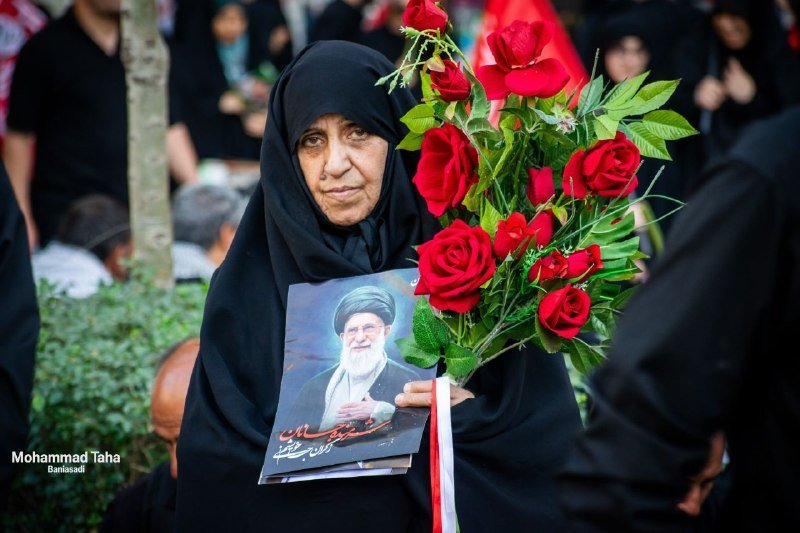
At 19:08 UTC on 10 July 2026, Iran's Tasnim News Agency posted a clip from the courtyard of the Imam Reza shrine in Mashhad: crowds chanting "Greetings to the Martyr Leader of Iran," the camera tilting up toward the gold dome. Forty minutes earlier, the state-aligned channel Al-Alam had pushed the same commemoration, and the official Mehr News Agency was already livestreaming the eulogies. Three outlets, one template, one venue, one set of martyrs — the choreography of a state message dressed as mourning.
The "Martyr Leader" the crowds were hailing is not a historical figure. The framing across the three wires refers to Ali Khamenei, the Islamic Republic's longtime supreme leader, in the language reserved for a fallen head of state. The commemoration explicitly honours him alongside "martyrs of his family," and the venue — the shrine of the eighth Imam, in Iran's second-largest city — is the holiest platform the Republic possesses outside Qom. That Tasnim, Mehr and Al-Alam converged on the same imagery within a thirty-two-minute window is itself the story: Iran's propaganda stack is signalling in unison, and the signal is grief at the top of the system.
A coordinated wire
The mechanics are worth noting. Tasnim, affiliated with the Islamic Revolutionary Guard Corps, framed the day around a slogan aimed upward: the nation speaking to a leader now "a neighbour of Imam Reza." Mehr, the government's domestic news agency, opened its feed with mourning recitations from the reciter Haj Mohammad Reza Taheri. Al-Alam, the Arabic-language arm of Iranian state broadcasting, ran the identical Taheri footage for its Gulf and Levantine audience. The same reciter, the same shrine, the same camera angle — the output was indistinguishable across the three channels within the space of an hour.
This is not how Iranian outlets normally behave. Tasnim moves in IRGC tempo — sharp, security-first, English-facing. Mehr tilts domestic-political, with a heavier social-and-cultural brief. Al-Alam speaks to Beirut, Sanaa and Baghdad in a different register, calibrated for Arab audiences who consume Iranian policy through a Hezbollah or Houthi prism. When all three converge on the same shrine and the same reciter, the hierarchy is doing what hierarchies do: telling its lower organs to hold the same line for a defined window.
What the frame says, and what it doesn't
The messaging template is specific. "Martyr Leader" is a title reserved in Iranian state discourse for Khamenei's predecessors and for figures the system wants to enshrine as founding. Affixing it to a sitting supreme leader is the visual equivalent of a constitutional moment — a re-canonisation, performed in a shrine, broadcast outward. The explicit naming of "martyrs of his family" widens the frame to a lineage of sanctified blood, drawing the boundaries of legitimacy around a house rather than an office.
What the coverage does not say is at least as telling. None of the three outlets, in the items available, name a date of death, name a successor, identify a cause, or specify which family members have been killed. The frame is entirely prospective — orienting the public toward veneration, not backward toward explanation. The reciter's lines, broadcast without translation in the English feeds, function as raw emotional payload for domestic Shia audiences; the English captions do the doctrinal work for foreign readers.
A state broadcaster's signalling problem
Iranian state media has spent four decades perfecting the grammar of national-mourning cycles: the death of a president, the assassination of a nuclear scientist, the killing of a general in a foreign strike. Each time, the wire stack converges, the shrines fill, the reciters perform, and the slogan is fixed in the public memory before the opposition can publish an alternative. The Mashhad commemoration fits that template almost too cleanly — and that fit is itself a reason for caution.
Two readings are plausible, and the sources do not allow a confident judgment between them. The first is the literal one: that the Islamic Republic is publicly mourning the confirmed death of Khamenei, with the system rallying to project continuity from Mashhad outward. The second is that the same choreography is being rehearsed — a managed leak of martyr imagery, designed to test domestic reaction and to gauge the regional wire's synchronisation, without a confirmed event. Iranian statecraft has used ritual before as a probe. The sources do not specify which reading is correct.
What to watch next
Three concrete signals will clarify the picture. First, an official statement from the office of the supreme leader or the Assembly of Experts — currently absent from the available feed — naming a date, a cause or a succession process. Second, the reaction of major Shia political actors outside the state stack: Hezbollah's al-Manar, the Iraqi religious establishment in Najaf and Karbala, the Houthi-aligned channels in Sanaa. If their coverage synchronises within forty-eight hours, the regional signalling layer is doing what the Iranian one already has. Third, the behaviour of foreign-exchange and oil markets in the seventy-two hours after the Mashhad broadcast: a sustained move in either direction would be the first hard economic verdict on whether the rest of the world is reading the footage as news or as rehearsal.
Until one of those three signals lands, the Mashhad shrine is doing what Mashhad shrines have always done under this regime: hosting grief that is also a message. The audience for which the message is intended is not the English-speaking reader, who sees only a translated caption. It is the Iranian street, the Iraqi shrine network, and the long Shia arc from Beirut to Herat — the constituency that needs to hear, in the same voice and at the same hour, that the house still stands.
Desk note: Monexus treats the Tasnim / Mehr / Al-Alam convergence as a primary wire provenance for this story. Where Reuters, AP and the BBC would normally be the first ports of call for confirmation of a leadership event in Iran, the available thread does not include those wires for 10 July 2026; the article is therefore deliberately restrained on the question of whether a death has occurred, and treats the state-aligned coverage as the object of analysis rather than as confirmation of fact.
Wire provenance
This editorial synthesis draws on the following public wire/social posts:
- https://t.me/tasnimnews_en
- https://t.me/tasnimnews_en
- https://t.me/mehrnews
- https://t.me/alalamfa
- https://en.wikipedia.org/wiki/Tasnim_News_Agency
- https://en.wikipedia.org/wiki/Imam_Reza_Shrine