Patriot on Ukrainian soil: what the Trump-Zelensky production licence actually changes
Kyiv says Washington has agreed in principle to license Patriot production inside Ukraine. The announcement is big on optics, narrower on hardware — and the harder questions about transfer of know-how are still open.
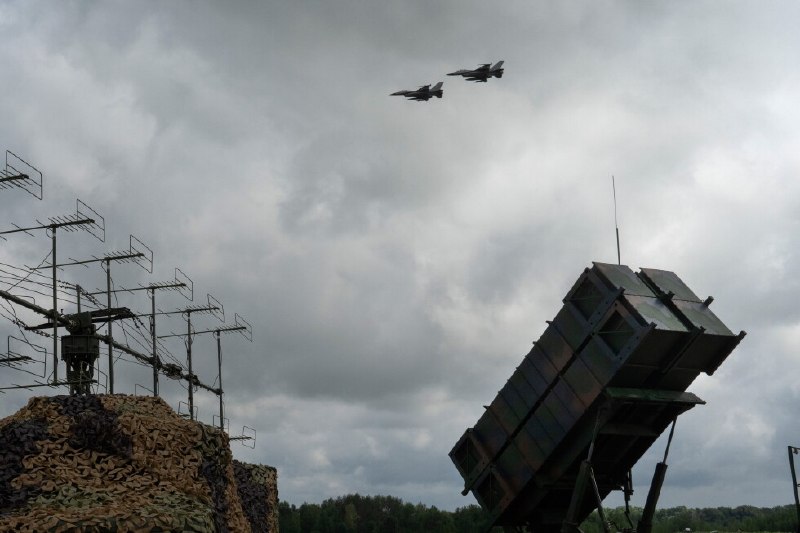
A Patriot battery costs roughly as much as a small bridge. Producing one inside Ukraine — rather than waiting on a constrained American production line — is the practical difference between a country that can replace the interceptors it burns through and a country that cannot. On 10 July 2026, that gap narrowed, at least on paper, when President Volodymyr Zelensky said Washington and Kyiv had reached political agreement to license Patriot air-defence production on Ukrainian soil.
The announcement is the headline. The substance is thinner, and that is where the story actually lives. A political agreement is not yet a signed contract, a disclosed price, a transfer of the specific tooling needed to assemble a Raytheon PAC-3 seeker, or a roadmap for the trained workforce such a plant would require. What the two governments have, today, is the public posture of a deal — and a posture, in wartime, is itself an asset.
What "political agreement" actually buys
Zelensky's framing, as carried by the @wartranslated channel at 17:33 UTC on 10 July, was that the two sides had "reached political agreements" on licensing Patriot production in Ukraine. The phrasing is deliberate. Defence-industrial transfers of this kind — particularly anything touching the PAC-3 missile and its radar-seeker chain — are governed in Washington by a layered process: an executive-branch commitment, an inter-agency review under ITAR, a congressional notification, and finally a negotiated technical-assistance package that specifies what know-how, and at what classification level, crosses the Atlantic.
Political agreement is the layer at which the White House signals it will not block the deal. Everything below it is negotiable, slow, and conditional. The reporting carried by @ourwarstoday at 18:56 UTC described a Trump pledge to grant a licence, not a signed licence. The distinction matters because the binding instruments here are not statements read in front of cameras; they are the licensing instruments themselves, the technical-data packages, and the eventual site-clearance decisions that put a missile plant on Ukrainian soil.
What an actual production licence would unlock, if it lands, is the right to assemble, integrate and test a system whose critical components — the GaN-based AESA radar, the solid-fueled PAC-3 seeker stack, the in-flight data link — are still expected to come from the United States. The first-tier Ukrainian contribution, by any realistic read, would be the launcher, the canister, the ground vehicles and the integration work that turns foreign subsystems into a battery that fires on Ukrainian grid coordinates.
Why the American line moved
Two pressures pushed Washington's posture from refusal toward conditional openness. The first is the production-rate problem. The Patriot production base has run hot since 2022, with allied demand — Poland, Romania, Germany, the Gulf — outrunning the rate at which Raytheon's Camden, Arizona facility can deliver missiles. Ukraine, burning interceptors faster than any other operator, has become the loudest customer in the queue. A licensed production line in Kyiv does not, in the near term, free Raytheon capacity. But it does give Washington a political exit ramp: a way to promise Kyiv more interceptors without promising Raytheon's existing customers less.
The second pressure is the war itself. Russia's sustained campaign against Ukrainian energy infrastructure has turned the country's air-defence fight into a budget question as much as a tactics question. Each cruise missile and Shahed-style drone intercepted is a PAC-3 round that has to be replaced from a finite stockpile. Domestic production — even partial, even at a slow ramp — would, over a multi-year horizon, change that equation. It would also change the political economy of Western aid: an interceptor built in Ukraine is one that does not require a fresh US drawdown to fund.
What stays unanswered
Three questions will define whether this announcement is remembered as a turning point or a press release. The first is the missile itself. A Patriot licence that covers ground equipment, without the PAC-3 round, is a licence to build launchers, not deterrence. The most consequential elements of the Patriot system are the components the United States has historically been least willing to share, and the Zelensky statement does not specify which tier of technology is on the table.
The second is money. Patriot-class production is capital-intensive and requires a workforce trained to electronics-integration standards not yet present in Ukraine's defence-industrial workforce at scale. A realistic programme implies multi-year Western financing, a European or American prime contractor willing to operate under Ukrainian authority, and a regulatory framework that satisfies both ITAR and Ukrainian wartime conditions. None of this is impossible; all of it is slow.
The third is industrial base. Ukraine's defence industry in 2026 is producing drones, artillery rounds, armoured vehicles and a growing share of its own air-defence munitions — including, in selected cases, derivatives of Soviet-era systems. Adding a Patriot-tier integration line is a different category of capability, and one that will be judged by whether Ukrainian serial production can hit the quality and safety thresholds the system requires. Early reporting does not disclose a target throughput.
The deeper stake
The frame that matters is not Patriot versus no-Patriot. It is whether Ukraine, by the end of this decade, runs a defence-industrial base capable of sustaining its own air defence under wartime attrition, or whether it remains a customer dependent on the production rates of three or four allied countries. The 10 July announcement moves the needle toward the former — by an inch, not a mile.
A separate, quieter stake sits in Washington. A licensed Ukrainian production line is, in effect, a US defence-industrial footprint on NATO's eastern flank. It binds the two countries' industrial futures more tightly than any single aid package has done. That is the kind of commitment that survives changes of administration in a way that appropriations do not.
What remains genuinely contested, on the evidence available today, is the timetable. The Zelensky statement names the outcome — political agreement on licensing — without committing either side to a date, a missile variant or a production site. Until those specifics appear in a binding document rather than a press appearance, the most honest reading is that a door has been opened. Whether Kyiv walks through it with interceptors in hand, or stands in the doorway holding a licence, is a question the next several months will answer.
This article was framed against wire and channel reporting from the day of the announcement. The sourcing window is narrow by necessity; the substance of the deal will outlast the headlines.
Wire provenance
This editorial synthesis draws on the following public wire/social posts:
- https://t.me/ourwarstoday
- https://t.me/wartranslated
- https://t.me/osintlive