Strikes on Azov: Ukraine Hits the Machinery of Russia's Targeting
A Ukrainian drone strike on Rostov-region plants that feed Moscow's front-line optics and fuels is a reminder that attrition runs both ways.
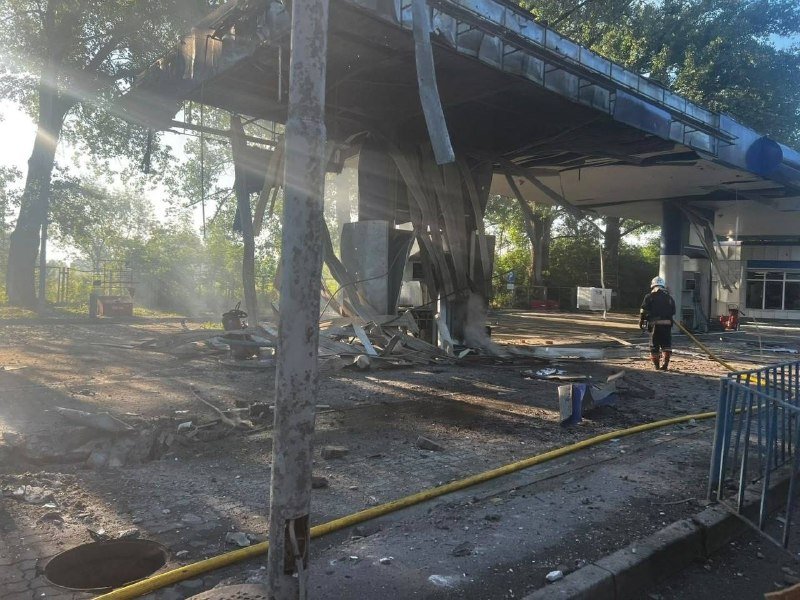
In the small hours of 10 July 2026, two fire points lit up the industrial fringe of Azov, a port city of roughly 80,000 on the Don river in Russia's Rostov region. Open-source investigators using commercially available satellite imagery pinpointed the burns: one inside the Azov Optical-Mechanical Plant, a facility long associated with electro-optical and precision systems for Moscow's defence industry, and a second at the adjacent DonTerminal oil depot. Ukrainian drones, according to the same channels, carried out the strike.
The headline worth writing is not that the war reached Rostov region again — it has, repeatedly, for two and a half years. It is what got hit, and why those two sites sit on the same industrial lot. Optics and fuel are the unglamorous half of long-range strike: the first tells a missile or drone where the target is, the second keeps the trucks and launchers mobile. Hitting them together is a quietly sophisticated move.
The optics question
Russia's war effort depends on components most consumers never see. Electro-optical seekers, radar homing heads, stabilised guidance units and the calibration tooling that keeps them accurate are produced by a relatively small number of Soviet-era plants, and Azov is one of them. The same complex has been named in open-source inventories as a producer of optical instruments for tanks, guided artillery shells and reconnaissance drones.
That makes the site the kind of target that does not photograph well — no mushroom clouds, no collapsed apartment blocks — but chokes the supply chain all the same. Replacing a precision optical line is not a question of months but of years. Sanctions, export controls and the slow evaporation of imported components have already stretched Russian lead times; a direct hit on the assembly hall lengthens them further. The economic read on the strike is less about the buildings and more about the line stoppage.
The fuel question
The DonTerminal depot next door is the more photogenic half of the story, and the one Western commentary will tend to lead with. Oil infrastructure burns spectacularly, and Rostov-region depots have featured in Russian domestic reporting on wartime fuel pressure for months. A working depot supports rail and road logistics into the occupied south and into the Ukrainian theatre proper; an empty one is a tax on every subsequent Russian convoy.
The structural point is that the two sites share more than geography. Russian targeting on the Ukrainian side has long paired munitions depots with the production sites that feed them. Kyiv's reciprocal doctrine — pair the fuel depot with the plant that calibrates the missiles — is the same logic applied to its own constraints. Both sides are now operating inside an attrition economy in which a single coordinated strike costs Moscow several months of front-line capacity and Ukraine a handful of long-range drones.
The frame that does not hold
The standard Western framing treats each Ukrainian strike inside Russian territory as either symbolic, escalatory or a distraction from battlefield failures in Donbas. None of those readings fits this event. Symbolic strikes do not target precision-optics lines; escalatory strikes do not pair themselves with adjacent fuel infrastructure to compound the effect; distraction strikes do not come from open-source investigators who can, within hours, geolocate the damage to specific factory sheds. The available evidence points the other way: this is industrial logic, applied with industrial patience.
The counter-reading worth taking seriously is that the strike's effect is more limited than the imagery suggests. Optical-mechanical production lines are dispersed, partially pre-positioned, and partly substitutable through third-country supply chains that have proved harder to police than arms-control advocates hoped. A fuel depot burns and is replaced. The wins are cumulative, not decisive. Ukraine's drone designers are running a long-distance, low-cost attritional campaign; success is measured in delays to Russian production, not in single spectacular hits.
What it changes, and what it does not
In the short term, the strike complicates Moscow's ability to replenish front-line targeting packages and pushes fuel logistics in southern Russia onto less convenient routing. Over the medium term, it contributes to a pattern that is becoming visible in the open-source trade: the per-unit cost to Ukraine of degrading Russian military-industrial capacity is falling, while the per-unit cost to Russia of replacing that capacity is climbing.
What remains uncertain is the depth of the disruption. The available open-source footage and geolocation confirm fire at two named sites; they do not specify which production halls were hit, the state of the equipment inside, or whether the strike triggered secondary damage to stored fuel. Russian state-aligned channels have not, as of the time of writing, published a damage assessment, and Western wires have not independently confirmed the operational status of either facility. The picture that holds is the picture of an industrial strike on an industrial target — and that picture alone is enough to redraw the conversation about who is setting the tempo of the long war.
This publication frames the strike through industrial and supply-chain logic, not through the escalation vocabulary that dominates Western commentary; the open-source record, not official communiqués, is the basis for that framing.
Wire provenance
This editorial synthesis draws on the following public wire/social posts:
- https://twitter.com/wartranslated/status/2075490219286020360/photo/1
- https://t.me/wartranslated
- https://t.me/wartranslated
- https://t.me/osintlive