Strikes, an "errant part," and an unsigned deal: a Friday deadline for US-Iran
US strikes inside Iran killed 17 people, Tehran says, while senior US officials insist there is no deal without the nuclear material — and a Geneva signing ceremony remains scheduled for Friday.
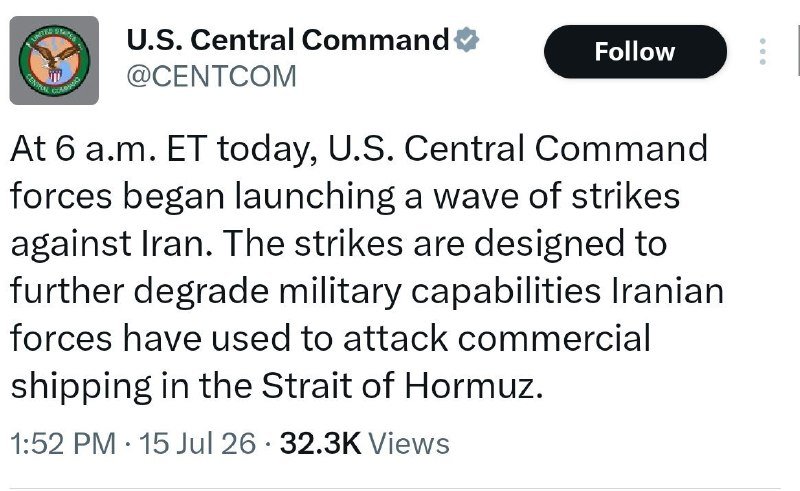
Iran's health ministry said on Friday that US strikes killed 17 people inside the country, the first confirmed Iranian casualty count since a new round of US-Iran fighting broke out earlier in the week. The figure, reported by Middle East Eye on 10 July 2026 at 22:46 UTC, sits awkwardly next to a separate US statement, relayed by Telegram channel Clash Report at 22:00 UTC, that Iran had told Washington a spate of recent shipping attacks came from "an errant part of their system." A peace accord is still due to be signed in Geneva on Friday, though senior US officials quoted by Clash Report at the same timestamp warned that without the nuclear material — the so-called "nuclear dust" — there is no deal.
What is unfolding, in other words, is a diplomatic calendar running ahead of the military reality on the ground. Strikes, denials, shipping incidents and a hard pre-condition have piled into the same 36 hours, and oil traders have noticed. Reuters reported at 21:01 UTC on 10 July 2026 that US pump prices climbed again as renewed fighting lifted crude benchmarks — the second leg of a price move that began earlier in the week.
What Tehran is putting on the table
The Iranian counter-frame, as relayed through the same channels, is that the escalation is contained and explainable. The "errant part of their system" formulation — an unattributed Iranian explanation picked up by US officials and repeated by Clash Report at 22:00 UTC on 10 July — reads as an effort to recast recent attacks on shipping in the Gulf as a malfunction rather than a policy. It is a familiar Iranian technique: concede the event, dispute the intent, narrow the scope of accountability. For Tehran, the strategic value is obvious. As long as the attacks are characterised as accidental, the legal and political case for further US escalation narrows.
The cost of the alternative framing — that Iran is acting deliberately — would be measured in lost revenue at the negotiating table and, more immediately, at the pump. Firstpost India's reporting on 10 July 2026 at 21:37 UTC frames the current standoff as the latest episode in a longer "power struggle behind Iran's legacy," a contest over who inside the Iranian system gets to define what is and is not on offer in Geneva.
What Washington says it needs
The American ask, as summarised by Clash Report on 10 July 2026 at 22:00 UTC, is granular rather than rhetorical: surrender of the nuclear material itself. Senior US officials told the channel that without the "nuclear dust" — the enriched uranium stock at the heart of Iran's programme — there is no deal. That formulation matters because it relocates the negotiation away from caps, monitoring arrangements and verification timelines, and onto a single physical object. The demand is, in effect, a demand for handover of a sovereign asset.
The US strike toll published by Iran's health ministry on 10 July 2026 — 17 people killed, according to Middle East Eye — gives that ask a backdrop. Strikes have occurred, casualties have been counted, and a deadline for signing is still on the calendar. The dissonance is the story.
Oil markets are the third negotiator
Pump prices in the United States climbed again on 10 July 2026 after renewed US-Iran fighting lifted crude, Reuters reported at 21:01 UTC. For a White House that has spent much of the year coping with inflation pressure at the consumer end of the barrel, that price action is not neutral. It is also a constraint on the Iranian side: every basis point added to global crude tightens the fiscal arithmetic of any sanctions package.
The shipping incidents that triggered the current escalation are not free-standing events. They sit inside a longer pattern of attrition around the Strait of Hormuz — a chokepoint through which a significant share of seaborne oil moves. Whether the recent attacks are characterised, in Tehran's preferred reading, as the product of an "errant part of their system," or, in the Washington reading, as deliberate signalling, the price response is the same. Insurance premia rise, routings lengthen, and the political bandwidth for a deal narrows.
What Friday actually tests
The Geneva signing scheduled for Friday 10 July 2026 is, on present evidence, a ceremony in search of a document. The American pre-condition — the nuclear material — has not been met on any public timeline. The Iranian pre-condition — that the strikes and the casualties do not become a precondition themselves — is being asserted through casualty counts and through the "errant system" framing. And the oil market is repricing the gap between the two.
The most plausible read is that Friday tests whether a face-saving formula can be found in which Iran hands over a partial stock under a staged timeline, the US scales back its strike tempo, and both sides claim the architecture of a deal without its most contested clause. That is a thinner agreement than either side's public language suggests. It is also the only kind of agreement that survives the next 48 hours without a further round of casualties.
What remains genuinely uncertain is the precise relationship between the shipping attacks and any Iranian command authority. The "errant part" line is an Iranian offer to US interlocutors; it has not been corroborated independently, and the casualty count reported by Middle East Eye on 10 July 2026 at 22:46 UTC will fuel the alternative reading in Washington and in Gulf capitals. The Geneva room will have to absorb that ambiguity, not resolve it.
Desk note: Monexus framed this as a deadline story — strikes, an unsigned deal and a market repricing inside a single news day — rather than as a triumph-or-collapse binary. Wire reporting on the casualty count and the "nuclear dust" pre-condition is treated as the load-bearing claim; the "errant part" line is reported as an Iranian offer to the US side, not as an established fact.
Wire provenance
This editorial synthesis draws on the following public wire/social posts:
- https://t.me/ClashReport
- https://t.me/FirstpostIndia