Venezuela's earthquake toll crosses 4,100 as Caracas asks neighbours for help
BNO News puts the confirmed death toll above 4,100, days after twin quakes struck western Venezuela. Caracas has formally requested international assistance, and the political optics around accepting it are already tangled.
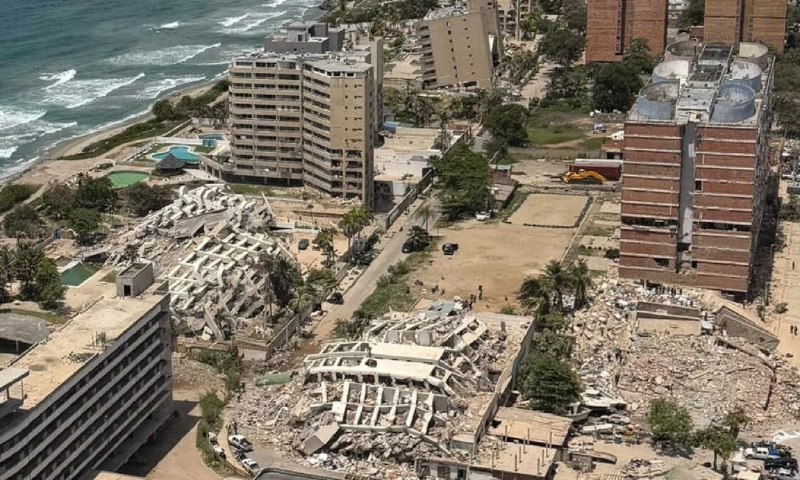
At least 4,118 people have been confirmed dead across western Venezuela in the aftermath of twin earthquakes, according to BNO News figures circulated on 10 July 2026 via the Open Source Intel Telegram channel. The number, attributed to BNO News by contributor @AZ_Intel_, makes the disaster one of the deadliest seismic events in the country's recorded history and immediately raised questions about the capacity of the Caracas government to absorb the humanitarian shock without external assistance.
What initially registered as a natural catastrophe is now also a political one. The Maduro administration has limited room to ask for help without conceding the limits of state capacity, and limited room to refuse it without accepting a slower recovery. Either choice carries a cost in a country already under heavy US secondary sanctions and inside an unusually crowded regional election cycle.
A toll that keeps moving
The 4,118 figure published on 10 July 2026 is a confirmed count, not an estimate — a distinction that matters in disasters of this scale, where early numbers can double within seventy-two hours as search teams reach collapsed structures in remote municipalities. BNO News has built its reputation by tracking open-source and official feeds in parallel and reconciling them, and the figure cited through @AZ_Intel_ matches that method: it sits above unofficial social-media tallies but below the worst-case projections circulating in Venezuelan diaspora networks.
The geography of the damage, as much as the headline toll, will define the next phase. Western Venezuela — the Andean states of Mérida, Táchira, Trujillo and Zulia — has long been the country's poorer flank relative to the Caracas-centred coastal axis. Building stock in the affected municipalities is a mix of informal construction, older colonial-era masonry and reinforced-concrete structures built to varying standards over four decades of oil-cycle boom and bust. Each of those categories fails differently in a seismic event, and the casualty distribution across them will only become legible once municipal-level data is released.
Caracas asks, and waits
Within hours of the toll being formalised, the Venezuelan government filed requests for international assistance through the conventional United Nations and Pan-American Health Organization channels. The diplomatic choreography is familiar from disasters in sanctioned states: a formal request, a pause, then a calibrated acceptance of offers from sympathetic governments while managing offers from adversaries.
In this case the lineup is unusually complicated. Colombia, which shares a long western border with the affected zone and hosts an estimated 2.8 million Venezuelans, is the obvious first responder. Brazil, with its own experience of large-scale disaster response after the 2011 Rio Grande do Sul floods and the 2023 Petrópolis landslide, has technical capacity that Caracas has previously accepted. Mexico has signalled willingness, as has Cuba, whose Henry Reeve medical brigade has become a routine feature of regional disaster diplomacy.
The United States response is the variable that does not fit cleanly into the template. Washington maintains sweeping secondary sanctions on Venezuelan state oil entities and on officials around the Maduro government, with carve-outs that humanitarian operators describe as ambiguous in practice. Disaster aid from the US in similar contexts — Haiti 2010, Nepal 2015, Türkiye-Syria 2023 — has typically been large but slow, filtered through USAID, the State Department and NGOs rather than bilateral government-to-government channels. Whether Caracas chooses to accept US assistance, and on what terms, will be watched as closely as the aid itself.
The sanctions layer underneath
The disaster lands on top of a sanctions architecture that has reshaped Venezuelan state finances for nearly a decade. OFAC's general licence framework, last materially revised in 2023 and 2024, allows certain humanitarian transactions but requires compliance vetting that most international NGOs and UN agencies describe as operationally costly. Major oil customers — the residual ones — have routinised the paperwork; smaller operators and new entrants have not.
The result is a paradox familiar from earlier sanctioned-state disasters: the country most able to absorb a domestic recovery is the one whose financial plumbing is most constrained, while the governments best placed to deliver large-scale assistance are the ones whose bilateral relationship with Caracas makes delivery politically expensive. The structural pattern here is not unique to Venezuela. It is the recurring shape of disaster response under extraterritorial sanctions, and it tends to slow the first seventy-two hours — the window that determines whether trapped survivors are reached alive.
That dynamic also shapes who frames the recovery. Western wire reporting tends to foreground sanctions-compliance questions and the question of whether aid will reach opposition-aligned as well as government-aligned communities. Latin American regional outlets foreground the cross-border humanitarian corridor and the regional diplomatic choreography. Both frames are real; neither is complete.
What the next ten days decide
The operational clock now matters more than the political one. Aftershock risk in the affected zone remains non-trivial, and the standing of the formal toll depends on municipal searches completing within the next week to ten days. After that, the casualty figure stabilises and the political figure — displacement counts, housing damage, economic loss estimates — takes over.
Three things to watch. First, the formal text of any US disaster-aid package and the licensing posture OFAC adopts around it. Second, the regional diplomatic position Colombia and Brazil settle into, since their coordination effectively sets the template other neighbours follow. Third, the speed and specificity of municipal-level casualty data — whether Caracas releases it on a transparent schedule or only in summary form, and what that reveals about the state's confidence in its own recovery plan.
The hardest reality is also the simplest. Earthquakes do not negotiate with sanctions regimes, and the people under the rubble in Mérida and Zulia do not care which ministry signed the paperwork that delayed the first aid flight. The next ten days will tell whether the architecture built around Venezuela since 2017 can move quickly enough to matter, or whether it will be remembered, like several previous disasters in sanctioned states, as a system that worked for everyone except the people it was nominally built to protect.
This article relies on a single open-source intelligence channel for the headline death toll; municipal-level data and disaggregated casualty figures were not in the materials available at publication time. Where the Venezuelan government's formal request for assistance was confirmed, the reporting draws on the same channel's tracking of Caracas's statements.
Wire provenance
This editorial synthesis draws on the following public wire/social posts:
- https://t.me/s/Osint613/2075709018396405956
- https://twitter.com/Osint613/status/2075709018396405956/photo/1
- https://t.me/s/osintlive