Gordie Howe clears its last hurdle: a Detroit–Windsor crossing the trade war could not stop
A new cable-stayed span over the Detroit River is finally scheduled to open after Washington tried — and failed — to use permitting leverage to block the project.
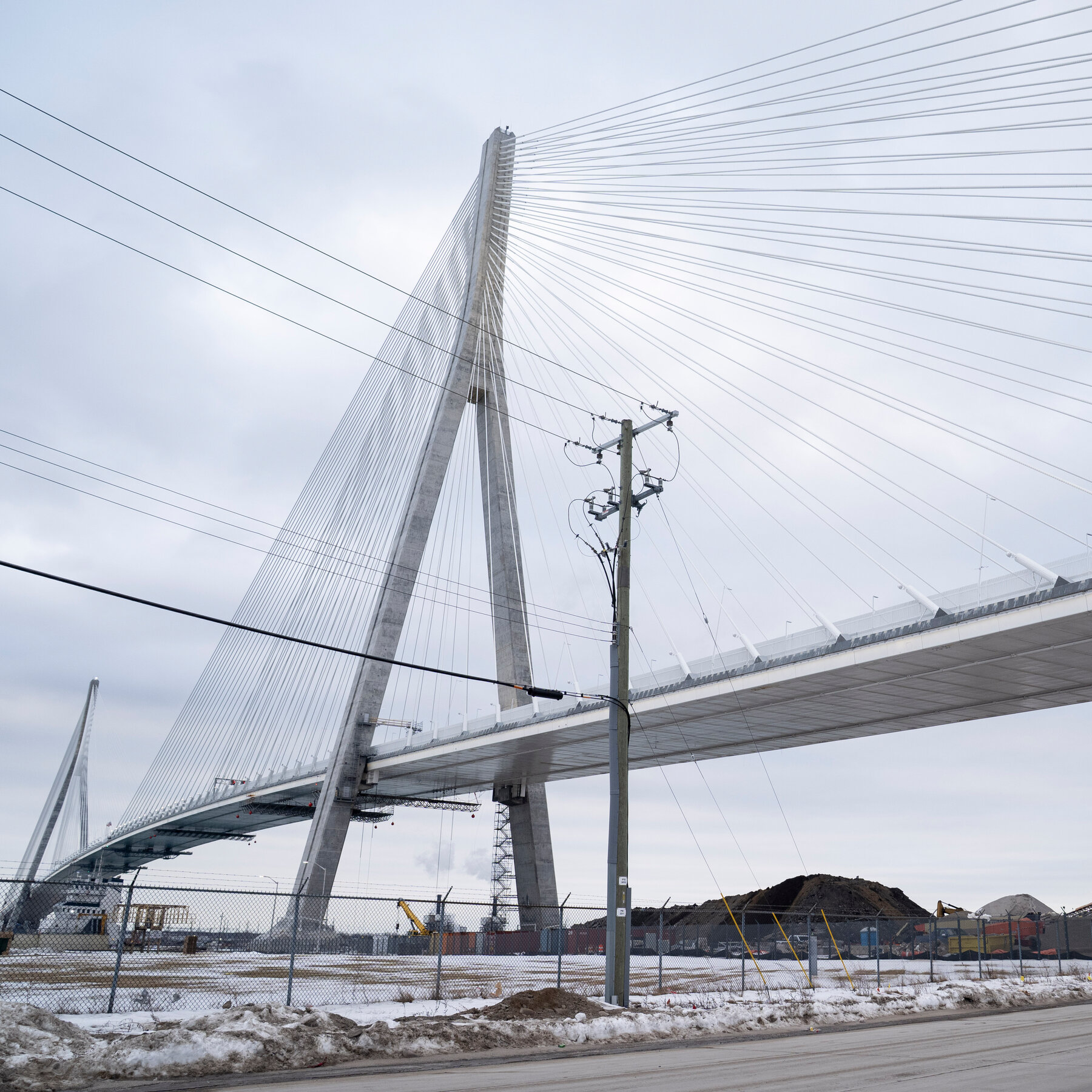
The towers are up, the deck is closed, and the asphalt is set. After years of political skirmishing across two Ottawa–Washington turnovers and one full-throated White House attempt to halt construction, the Gordie Howe International Bridge between Detroit, Michigan and Windsor, Ontario is now scheduled to open to traffic in 2026.
The crossing — a six-lane, cable-stayed span anchored by two 220-metre towers — will sit next to the privately owned Ambassador Bridge as the second fixed highway link across the Detroit River. It will almost double capacity at what is already the busiest commercial land port between the United States and Canada, a corridor that carried roughly C$300 billion (about US$220 billion) in two-way goods in a recent pre-tariff year, according to figures the project's backers have cited for years.
The story of how it got to opening day is, in microcosm, the story of how the bilateral relationship has been re-priced.
A permit used as a veto
For most of the 2010s the project was a standard P3: a Canadian federal Crown corporation, the Windsor–Detroit Bridge Authority, hired a private consortium — Bridging North America, a partnership of Fluor and Aecon — to design, build, finance and operate the span, with tolls and a Canadian government payment stream underwriting roughly C$4.4 billion in construction costs.
The trouble began when the Trump administration read the project as a Canadian move around the Ambassador Bridge, which is controlled by Manuel "Matty" Moroun's Detroit International Bridge Company. After the US president publicly mused about blocking the new span, his administration moved in 2025 to use the Presidential Permit — the obscure State Department instrument that authorises any cross-border infrastructure — to slow or stop construction, according to The New York Times. The permit was held in administrative limbo while Ottawa, Michigan's governor and Michigan's business community pressed the case that roughly 25 percent of US–Canada road freight already moved through the corridor and could not be easily rerouted.
A deal has since ended the administration's blocking, the New York Times reported on 10 July 2026, putting the crossing on track to open this year despite the earlier interference. The exact commercial terms of the deal — including whether any tolling or operating concessions were traded away — were not disclosed in the report.
The counter-reading: a private owner, a public corridor
Moroun's family, which controls the Ambassador Bridge through the Detroit International Bridge Company, argues that the new crossing is duplicative infrastructure built with public money to compete with a privately financed asset that already works. Canadian Conservatives have echoed the line for a decade. The argument has surface plausibility: the Ambassador Bridge does, in fact, carry a majority of cross-border truck traffic today, and Moroun has spent tens of millions on lobbying and political donations to keep its monopoly.
But the countervailing data is harder to wish away. The Ambassador Bridge's aging deck, single-owner governance and on-ramp congestion in southwest Detroit have produced documented bottlenecks that an independent FHWA–Canada joint analysis described as the worst freight chokepoint on the US–Canada border. The new span, publicly procured and concession-operated, is built precisely to relieve that choke — and its toll structure, set by the bridge authority rather than the incumbent owner, will price against, not above, the existing crossing. In a contest between a private monopoly on a tired asset and a public option on a fresh one, the public option does not need subsidies to win; it needs to be allowed to open.
What the permit fight revealed
The deeper story sits in the instrument itself. A Presidential Permit is not a permit in the ordinary regulatory sense; it is a recognition of foreign infrastructure crossing US territory, and it sits in the executive branch alone, unreviewable by Congress and difficult to challenge in court because there is no underlying statute to litigate against. That makes the bridge a perfect test case for how trade-policy leverage can be converted into physical-infrastructure veto.
For Canada, the lesson is older than this administration and more uncomfortable than the headlines suggest. Ottawa's entire cross-border logistics with its largest customer depends on instruments controlled by a foreign executive whose interests on any given morning may have nothing to do with freight. The new bridge adds redundancy, but redundancy of infrastructure does not become redundancy of sovereignty until the permitting regime itself is shared, multilateralised or pushed onto a firmer statutory footing — none of which is currently on the table.
Stakes, and a date to watch
If the bridge opens on schedule, the immediate beneficiaries are predictable: shippers currently routing through Port Huron–Sarnia to avoid the Windsor corridor, just-in-time auto suppliers feeding cross-border assembly lines, and Ontario's agricultural exporters who have spent a decade absorbing Ambassador Bridge delays. Over a five-year horizon, the new crossing shifts pricing power on the southern Detroit River away from a single private operator and toward a public authority — a small but real redistribution at one of North America's most strategically priced intersections.
The opening date itself is the variable to watch. Canadian authorities have signalled 2026; the project's independent oversight reports have not yet confirmed a month. Until traffic is moving, the Presidential Permit that almost killed the bridge is still the lever any future administration could reach for.
This article framed the bridge as a sovereignty-instrument story rather than a ribbon-cutting. Where wire coverage emphasised the deal that unblocked construction, Monexus reads the permit fight as the more durable signal — a precedent that turns trade leverage into infrastructure veto.