Oman courts Tehran as Gulf mediators widen the diplomatic aperture
Oman's foreign minister welcomed his Iranian counterpart Abbas Araghchi in Muscat on 11 July 2026, the latest signal that the sultanate intends to keep operating as the Gulf's quiet interlocutor with Tehran.
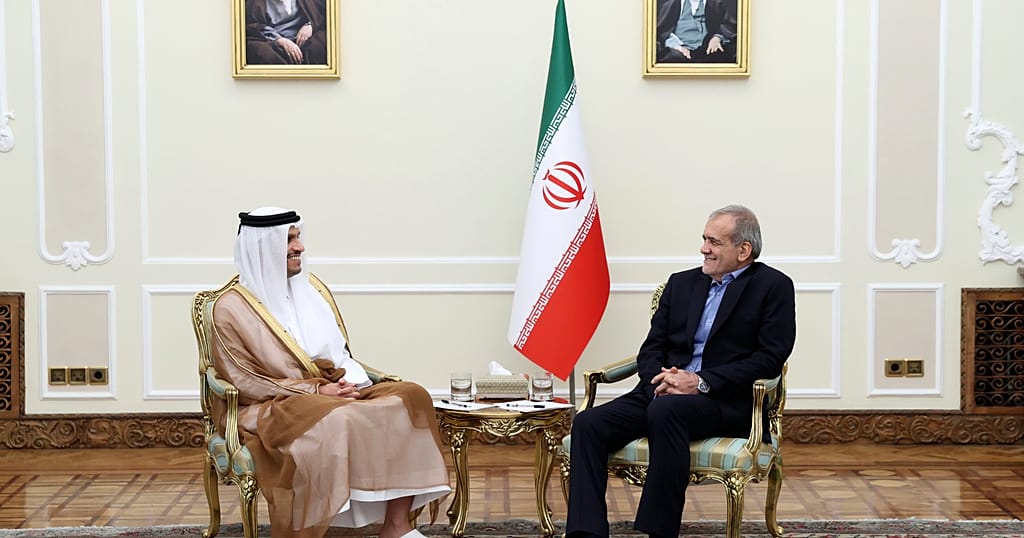
At 09:29 UTC on 11 July 2026, Oman's Foreign Minister Badr Albusaidi welcomed his Iranian counterpart Abbas Araghchi at the Ministry of Foreign Affairs in Muscat, in a meeting staged for the cameras and then allowed to disappear from the official readouts. Africa News Agency distributed the handshake photograph within the hour, the kind of image the Gulf's small neutral states have perfected over a decade of back-channel diplomacy: two men in dark suits, both smiling, both projecting the careful neutrality that allows Muscat to keep talking to Tehran when louder capitals have stopped.
What looks like routine courtesies is in fact a deliberate positioning. Oman has spent the past several years carving out a niche as the only Gulf monarchy that has refused to treat Iran as a pariah, while declining to be drawn into the rhetorical maximalism of the Saudi-Emirati line. The Araghchi visit, against a regional backdrop of tense nuclear-file negotiations and recurring speculation about a wider Gulf-Iran détente, is the sultanate reminding both Washington and Tehran that the channel still functions.
The mediator that neither side wants to offend
Oman's value is precisely its smallness. The sultanate does not host American combat bases, has never joined the public denunciations of Iran's regional behaviour that issue periodically from Riyadh and Abu Dhabi, and has not normalised relations with Israel. That posture makes Muscat useful in moments when larger Gulf states cannot afford to be seen talking directly. Araghchi's trip fits a pattern: Iranian foreign ministers have used Muscat as a waypoint for messages meant for Western capitals, and Omani ministers have hosted Iranian delegations even at the height of regional crises.
The visit also tracks the rhythm of Tehran's external diplomacy. Araghchi has spent much of 2026 shuttling between Ankara, Moscow and Beijing as part of a wider effort to demonstrate that Iran has options even under sanctions pressure. A stop in Muscat costs Tehran little and reinforces the message to Washington that engagement routes exist outside the official negotiating table, where trust is thin and the gaps between positions have widened.
What Tehran gets out of Muscat
For Iran, the calculation is straightforward. A friendly, predictable Gulf interlocutor gives Tehran a place to float talking points, test language and quietly signal flexibility without the political cost of speaking directly to adversaries. Muscat's willingness to host is itself a form of recognition. It tells the Islamic Republic that at least one Arab government still treats it as a normal state, and not as a regional outlier.
That recognition matters more than the joint communiqués, which on these visits tend to be thin. Iran's regional influence runs through networks in Iraq, Syria, Lebanon and Yemen rather than through formal Arab-Iranian summits, so the value of the Oman channel is symbolic and procedural. It keeps the diplomatic architecture warm.
What the sultanate actually wants
Muscat's motives are less romantic. Oman is a small state wedged between Saudi Arabia, the UAE and Iran, dependent on hydrocarbon revenues and acutely exposed to any Gulf-wide flare-up. It has spent a decade building relationships with all three regional hegemons precisely so that it is never forced to choose. Hosting Iran's foreign minister is the visible half of that balancing act; the invisible half is the constant quiet lobbying in Washington, Riyadh and Brussels that the sultanate's strategic value lies precisely in its refusal to take sides.
There is also a commercial dimension. Omani ports sit on the Strait of Hormuz, and any sustained regional confrontation would close the waterway on which the country's own energy exports depend. Keeping dialogue open with Tehran is, in part, an insurance policy on shipping lanes.
What remains unseen
The readouts that emerged from the meeting, distributed through Africa News Agency and a small number of Iranian outlets, did not specify whether any concrete file was on the table. The sources do not disclose whether Araghchi carried a message to the United States via Muscat, whether nuclear-file talks featured, or whether the discussion touched the recurring crisis in Yemen, where Oman has historically tried to mediate between the Houthis and the Saudi-led coalition. That ambiguity is itself the point: Oman prefers that its meetings produce quiet movement rather than headlines.
For now, the photograph tells readers as much as the communiqués. Two foreign ministers, in a room in Muscat, smiling for the camera before the doors close and the real conversation begins.
Desk note: Monexus framed this as the continuation of a multi-year Omani balancing strategy rather than as a one-off courtesy visit. The available sourcing is limited to a Telegram-distributed agency photograph, so claims about substance remain deliberately narrow.
Wire provenance
This editorial synthesis draws on the following public wire/social posts:
- https://t.me/s/AfricaNewsAgency
- https://en.wikipedia.org/wiki/Foreign_relations_of_Oman
- https://en.wikipedia.org/wiki/Abbas_Araghchi
- https://en.wikipedia.org/wiki/Badr_Albusaidi