Iran strikes Al Azraq: what the 20th wave of Operation Nasr 2 actually tells us
Press TV reports the IRGC's 20th wave of Operation Nasr 2 hit Al Azraq airbase in Jordan, with air defences failing to intercept. The claim is extraordinary; the sourcing is single-channel.
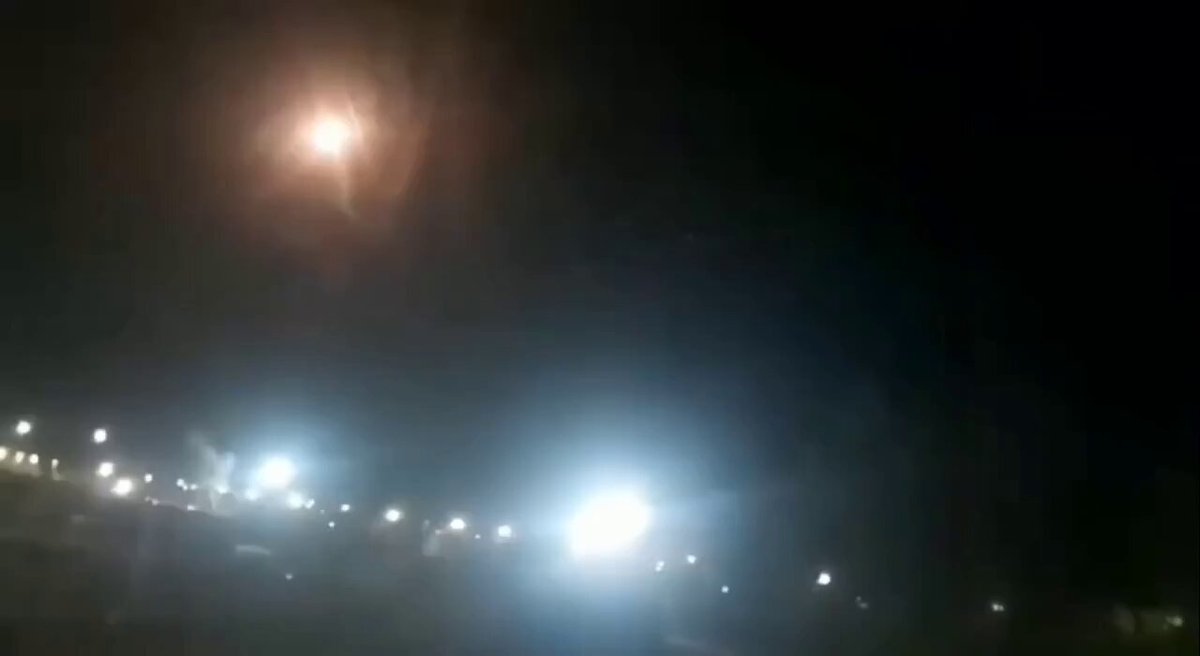
At 07:58 UTC on 18 July 2026, Iranian state television reported that the IRGC Aerospace Force had launched the 20th wave of Operation Nasr 2, a coordinated missile and drone strike on what it described as fighter aircraft shelters and a large parking apron at a US-occupied base. Just over two hours later, at 10:05 UTC, the same outlet reported several explosions in Jordan, and at 10:09 UTC it added that the target was the US military's Al Azraq base and that its air defences had failed to intercept the incoming missiles. The single-channel provenance is the story almost as much as the strike itself.
The claim, if accurate, is the most direct Iranian missile attack on a US installation in Jordan to date, and the first publicly named failure of US air defences at an active base in the theatre. It also lands in the middle of a multi-week escalatory cycle that Tehran has publicly numbered, wave by wave. What it does not yet have, at least on the public record available at publication, is independent corroboration from Western wire services, from the US Central Command, or from the Jordanian government.
What Press TV is actually asserting
The reporting chain runs entirely through Press TV, the English-language outlet of Islamic Republic of Iran Broadcasting. Its 07:58 UTC bulletin identified the IRGC Aerospace Force as the operator, named Operation Nasr 2, and specified the target set as "fighter aircraft shelters and a large aircraft parking apron." The 10:09 UTC bulletin narrowed the geography to Al Azraq, in central Jordan, and added the operational detail that "air defences at the US base in Al Azraq, Jordan, fail to intercept the incoming missiles." Press TV frames these as on-the-record IRGC statements rather than speculation, though no IRGC primary release is cited in the bulletins themselves.
The framing is consequential. Press TV is not a neutral wire; it is the external broadcasting arm of the Iranian state, and it routinely carries official Tehran communiqués verbatim. The bulletins should be read, in the first instance, as a Tehran announcement, not as an independent account of events on the ground. The 20-wave numbering implies a campaign structure that has been underway for some time; the Al Azraq detail implies an evolution in target selection.
What we cannot yet verify
Three load-bearing facts in the Press TV account remain uncorroborated. First, the failure of US air defences. Patriot and Avenger systems at Al Azraq have not, on the public record, been confirmed by US or Jordanian spokespeople to have failed. Second, the strike's physical effect: whether the named aircraft shelters and apron were actually hit, and with what ordnance, is not yet established by satellite imagery or by Pentagon readout. Third, the casualty picture. Press TV makes no claim of US personnel casualties in the bulletins; nor do the bulletins indicate whether Jordanian forces at the base were targeted, were warned, or took any role. Until at least one of these three legs is confirmed independently, the bulletin chain stands as a single-source claim of extraordinary scope.
The sourcing caveat matters not because Press TV is uniquely unreliable, but because the cost of an unverified Iranian claim of a successful strike on a US base is high in both directions. A confirmation would harden Iranian claims of deterrence reach; a denial, or a CENTCOM statement describing the strike as a failed overflight, would reframe the bulletins as domestic Iranian signalling aimed at a domestic audience rather than an operational report.
Why Al Azraq, and why now
Al Azraq is one of the smaller and older US footprints in Jordan, hosting a mix of US and coalition air assets and serving as a logistics node. Its air-defence architecture is not publicly detailed, which is itself part of the operational problem: any claim that intercepts failed carries an evidentiary burden that the public record cannot yet meet. The base sits far enough from Iranian territory that a missile strike would require either a launch from forward-positioned Iranian assets in Iraq or Syria, a long-range ballistic profile from western Iran, or, and this is the structurally significant option, a one-way attack drone corridor launched at extended range.
The 20-wave numbering, if it holds, places the current exchange inside a calibrated campaign rather than a single retaliatory action. That framing matters for the Western policy response. A one-off strike invites a tit-for-tat answer; a numbered series invites a strategic one. Tehran is communicating, through the numbering, that this is the latter: a deliberate, ongoing pressure campaign against US posture in the region, with each wave calibrated rather than maximal.
Stakes and what to watch
The immediate stakes sit in three capitals. In Washington, the question is whether the Pentagon will publicly confirm, deny, or stay silent on Al Azraq; each carries its own escalatory signal. Silence, in particular, would itself be read as confirmation by Tehran. In Amman, the political exposure is severe: a missile exchange on Jordanian soil, even at a US-occupied base, places the Jordanian armed forces in a position they have spent decades avoiding, that of a public party to the Iran-US contest. In Tehran, the bulletins serve a domestic political function regardless of operational outcome: the IRGC Aerospace Force is being showcased as capable of reaching and striking named US bases, which is a deterrent claim even if the strike itself is later contested.
Three dates will tell the story. The first is the next CENTCOM briefing, where a US acknowledgement, denial, or non-response will clarify whether the strike happened as described. The second is any Jordanian government statement, which will indicate whether Amman treats this as a violation of its airspace and sovereignty or as a US operational matter. The third is the next IRGC numbered wave, if it comes on schedule: a 21st wave within days would confirm a campaign structure; a pause would suggest the 20th was meant as a one-off demonstration.
Until then, the public record contains one state broadcaster's account of a missile strike on a US base with failed air defences. It is a serious claim from a serious source, and it deserves to be reported as such, but it is not, at the moment of writing, an established fact.
Desk note: Monexus is reporting the Press TV bulletins at face value as claims, with explicit attribution to Iranian state media, rather than as confirmed events. We have chosen not to amplify the air-defence-failure assertion as fact until independent corroboration emerges. Western wire services had not, at the time of writing, published on-the-record confirmations or denials from US Central Command, the Jordanian government, or NATO-allied air-defence operators.
Wire provenance
This editorial synthesis draws on the following public wire/social posts:
- https://t.me/presstv/
- https://t.me/presstv/
- https://t.me/presstv/
Follow the event.
These dated source records provide context. They do not retrospectively verify this archive article.
Separate what the nuclear watchdog reported from what it could not determine after the June 2025 strikes.