Iran's military chief issues direct warning to Washington as rhetoric hardens
The head of Iran's Khatam al-Anbiya Central Headquarters publicly warned Washington that the armed forces would deliver a 'crushing response' to any 'atrocity,' sharpening the rhetorical standoff between Tehran and the United States.
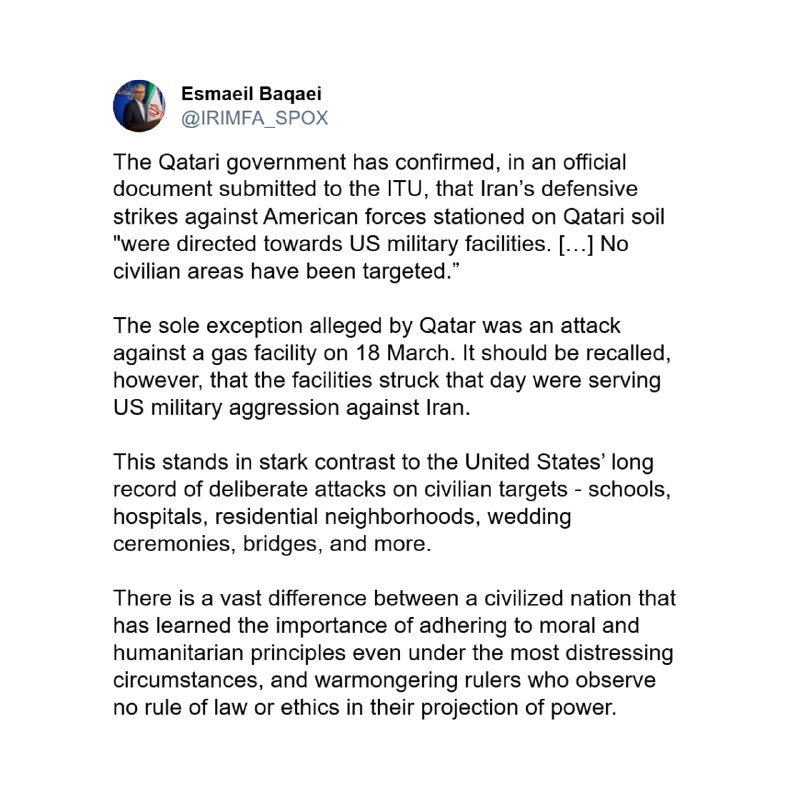
At 02:27 UTC on 19 July 2026, the Arabic-language channel Al-Alam published the full text of a public message from the commander of Iran's Khatam al-Anbiya Central Headquarters, addressed to the "cunning American enemy." The message warned that the Iranian armed forces would deliver a "devastating" response to any "brutality" committed against the country. Iran's English-language state outlets Press TV and Tasnim News carried the same statement within minutes, identifying the commander as Major General Abdollahi.
The phrasing matters less for its content, which mirrors a familiar Iranian rhetorical register, than for the choice of platform: a written message from the central command hub, distributed in lockstep across state-aligned media in Farsi, Arabic, and English. It is the kind of calibrated signalling that arrives not as a stray outburst but as a deliberate communication, intended for at least three audiences simultaneously: the Iranian street, the wider Axis of Resistance network, and the policymakers in Washington who track these statements line by line.
A message, not a press release
Khatam al-Anbiya is the formal name for the joint operational headquarters of the Islamic Republic's armed forces, the institutional body that nominally coordinates the regular Army, the Islamic Revolutionary Guard Corps, and the broader defence apparatus under the supreme commander-in-chief. Statements issued under its banner carry more weight than commentary from any single service branch. That the central headquarters chose to publish a written warning, rather than have a general make off-the-cuff remarks, signals deliberate institutional weight behind the language.
Press TV's English service reported the warning at 02:15 UTC, identifying Major General Abdollahi as the message's author and characterising the Iranian armed forces' intended response as "crushing." Tasnim, the outlet closest to the IRGC, ran its own distribution at 02:05 UTC. The synchronised timing across state-aligned channels, with Al-Alam adding the full Arabic text twelve minutes later, points to a coordinated release rather than a leak.
What the message actually says, and what it does not
According to the text reproduced by Al-Alam, Press TV, and Tasnim, Abdollahi addressed the "cunning American enemy" directly and pledged a "devastating response" to any "brutality." None of the three outlets quote the message as specifying a trigger event, a timeline, or a target list. The frame is conditional rather than operational: it names a contingency, not an action. That distinction is not decorative. Tehran has historically reserved this register for moments when it wants the deterrent signal on the record without committing to a specific move, a posture that lets the leadership retain deniability while keeping the threat legible to Western intelligence consumers.
What the published excerpts do not contain is at least as telling as what they do. There is no mention of a specific provocation, no reference to recent incidents at sea, in Iraq, or in Syria, and no deadline. The absence leaves the warning elastic, an open commitment that can be activated at a time of Tehran's choosing if the leadership reads any future US action as meeting the threshold of "atrocity."
The information environment around the statement
The three outlets carrying the message are state or state-adjacent: Al-Alam operates as the Iranian state broadcaster's Arabic-language arm, Press TV broadcasts internationally in English under state oversight, and Tasnim News Agency is widely characterised as close to the IRGC. Independent corroboration of the message from non-Iranian outlets was not visible in the wire within the reporting window. Reuters, the Associated Press, the BBC, and Al Jazeera English had not, as of the items in hand, posted independent confirmation or commentary. That is worth flagging plainly: the sourcing is at this point exclusively Iranian.
For a reader in Washington, Tel Aviv, or Riyadh, the analytical question is not whether the message is real (the institutional voice is identifiable, and the cross-channel synchronisation is consistent with how Iranian state communications are typically released), but how to weigh it. Iranian military messaging has historically oscillated between genuine pre-strike signalling and deterrence theatre, and the line between them is often only legible in hindsight. Western intelligence agencies will look for changes in force posture, naval movements in the Strait of Hormuz or the Persian Gulf, or shifts in IRGC proxy activity to determine which side of that line this particular message falls on.
What it sets up, and what to watch
The message lands inside a wider pattern of hardened rhetoric between Tehran and Washington that has run for decades, punctuated by episodes ranging from the US killing of General Qasem Soleimani in January 2020 to periodic maritime confrontations in the Gulf. Each cycle has followed a familiar shape: a triggering event, an Iranian rhetorical escalation, a calibrated demonstration of capability, and then a slow de-escalation as both sides manage the cost of a hot exchange. This message fits the shape without yet supplying the trigger.
The watch items in the days ahead are concrete. Any movement of IRGC naval assets into the Persian Gulf or the Strait of Hormuz, a change in the operational tempo of Iranian-backed groups in Iraq, Syria, Lebanon, or Yemen, or a US force-posture adjustment in the region, would convert rhetorical signalling into operational preparation. Absent those signals, the warning functions as a price-setting gesture: a reminder, broadcast in three languages, that the cost calculus on any future US action against Iran runs through the central command's red lines rather than through routine diplomatic channels.
The honest limit on this analysis is the sourcing itself. The statements published by Iranian state outlets are authoritative for what Iran's leadership wants its audiences to read; they are not authoritative for what comes next. Between a written warning and a launched strike lies a long sequence of decisions, and on those decisions the available reporting is, for now, silent.
This article was prepared from the three wire items available on 19 July 2026. Monexus will update if and when non-Iranian outlets, including Reuters, AP, the BBC, or Al Jazeera English, publish independent confirmation or contextual reporting.
Wire provenance
This editorial synthesis draws on the following public wire/social posts:
- https://t.me/alalamfa/
- https://t.me/presstv/
- https://t.me/tasnimnews_en/
- https://en.wikipedia.org/wiki/Khatam_al-Anbiya_central_headquarters