Qatari shuttle stalls as US-Iran deadlock widens over blockade and nuclear file
Per Axios, Doha's mediation has produced no breakthrough; Iran conditions any nuclear concession on Washington returning to the June memorandum of understanding, and the US position is itself split.
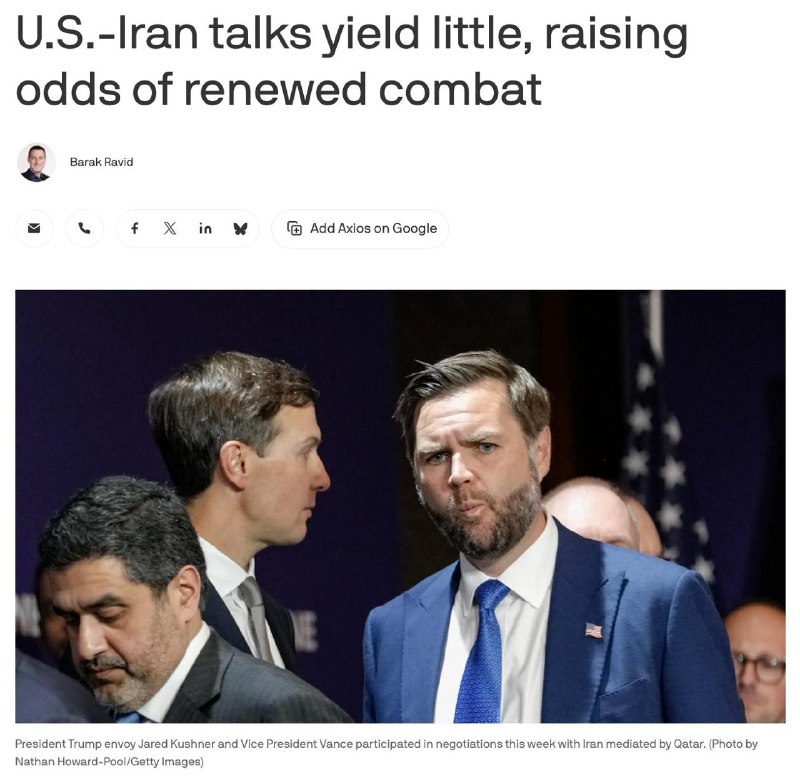
Qatari mediators spent the week ending 29 September 2026 trying to convert a thin opening between Washington and Tehran into something written, and the result, per Axios's reporting, was "little progress." Telegram channels Tasnim News, Middle East Spectator, Rn Intel and Clash Report all relayed the Axios framing on Tuesday evening, with the earliest timestamp at 22:33 UTC and the latest at 23:05 UTC.
The geometry of the failure is narrow and asymmetric. Iran is asking for the US naval blockade to be lifted, and is conditioning any nuclear concession on Washington returning to the June memorandum of understanding. The United States is asking for nuclear constraints, and on the available reporting cannot move on the blockade. Around those two pivots the rest of the conversation has arranged itself.
The blockade that won't move
The naval blockade is the harder of the two files, and Middle East Spectator's relay of Axios at 22:44 UTC on 29 September places Iran's demand to lift it at the centre of the stalemate. A blockade is a coercive instrument: it does its work because it is not lifted on demand, and Washington has no obvious incentive to withdraw a pressure tool in exchange for a nuclear concession whose verification timeline runs in years. Rn Intel's relay of the same Axios scoop, at 22:41 UTC, captures the impasse from the American side in a line attributed to a US official: "It is stuck. The Iranians are asking for things the U.S. can't accept and the U.S. thinks it is winning so there is no need for compromise." The sentence does two things at once. It concedes that the Iranian asks are not on offer, and it concedes that the American side's internal posture is to wait rather than to bargain.
What Iran's precondition actually is
The Iranian position is more specific than "nuclear concessions for sanctions relief." Per Axios, relayed by Clash Report at 22:33 UTC, Tehran's precondition for any nuclear concession is the United States returning to the June memorandum of understanding, a document whose contents the cited Telegram items do not detail. The distinction matters. A negotiating position that can be retitled, traded or split is one thing; a precondition that names a specific prior document is another. Until Washington accepts the framing that the June MOU is the relevant baseline, every discussion of "nuclear concessions" is happening on a clock the Iranian side does not recognise.
Monexus analysis: read together, the Iranian precondition and the American wait-it-out posture describe a negotiation in which neither side is offering anything the other side can accept without first publicly conceding the framing. Tehran cannot drop the June MOU requirement without surrendering the document it has chosen as the political anchor of the talks. Washington cannot move on the blockade without telling its own audience that a coercive instrument was retired in exchange for a paper commitment.
Doha, and the wider mediation geometry
Qatar is the lead mediator on this track, and the role fits the country's positioning: it hosts the largest US air base in the region at Al Udeid and it also maintains a working relationship with Tehran that survived the post-2017 Gulf rift. Rn Intel's relay of the Axios reporting describes the Qatari effort as having hit a wall because "neither side is willing to concede to the other's demands."
Qatar is not the only intermediary trying to keep a conversation going. Per the same Axios reporting relayed by Rn Intel and Middle East Spectator, Egypt and Pakistan have also reportedly urged Iran to agree to nuclear concessions. The cited Telegram items do not specify the content of those Egyptian or Pakistani messages, or whether Doha, Cairo and Islamabad are operating in sequence or in parallel. What they establish is that the Qatari track is one of at least three.
A split American position
The US posture, as reported, is not unified. Clash Report's relay of Axios notes that "U.S. officials initially described the talks as positive and said Trump was open to sanctions relief and releasing frozen funds for nuclear concessions. Hours later, Trump said he had offered Iran nothing." The contradiction is on the record, and it is the contradiction that does most of the diplomatic work in the current phase. A negotiating counterpart can absorb a hard "no"; it cannot absorb a "yes, then no, then yes if the political weather changes." Until the American side resolves its own internal split on what it has offered and what it is willing to offer, the Doha track has no reliable anchor to negotiate against.
The cited Telegram items do not specify how the gap between the initial US-official characterisation and Trump's denial is being managed inside the American side, and this article has not independently established whether the two formulations reflect tactical positioning or genuine disagreement.
What the next weeks look like
Clash Report's summary of the Axios reporting captures a "fear of renewed fighting rising" as the talks stall, and Rn Intel's relay adds that Trump could order a new round of strikes on Iran after the midterm elections. The cited items do not establish whether such strikes are being actively planned or whether the formulation is a negotiating posture, and this article has not independently verified either. Middle East Spectator's relay notes that Qatari officials have said they will continue their mediation efforts, which on the available evidence suggests the channel remains open at diplomatic level even if it is not producing movement.
Monexus assessment: the next two to four weeks are most plausibly a continuation of procedural meetings rather than breakthrough communiqués. Two triggers would change that reading: a clearer American internal reconciliation between the "open to sanctions relief" line and the "offered nothing" line, and any movement on the June MOU as the framing baseline. Until one of those moves, Doha is likely to keep producing the same kind of week.
Desk note: Monexus has framed this around the impasse Axios identified and around the internal contradictions the Axios reporting itself records, rather than around either side's preferred narrative of who is to blame. The cited Telegram channels relay an Axios scoop; the primary reporting sits with Axios and is treated here as the authoritative frame.
Wire provenance
This editorial synthesis draws on the following public wire/social posts:
- https://t.me/tasnimnews_en/39691
- https://t.me/Middle_East_Spectator/37164
- https://t.me/rnintel/67041
- https://t.me/ClashReport/98961
Follow the event.
These dated source records provide context. They do not retrospectively verify this archive article.
Separate what the nuclear watchdog reported from what it could not determine after the June 2025 strikes.