Iranian strike on Kuwait's Al-Ahmadi port breaks a long stretch of Gulf quiet
Satellite imagery on 21 July 2026 shows damage at Kuwait's Al-Ahmadi oil export terminal after an Iranian drone and missile attack, the first such strike on Kuwaiti energy infrastructure in the post-2019 Gulf arc.
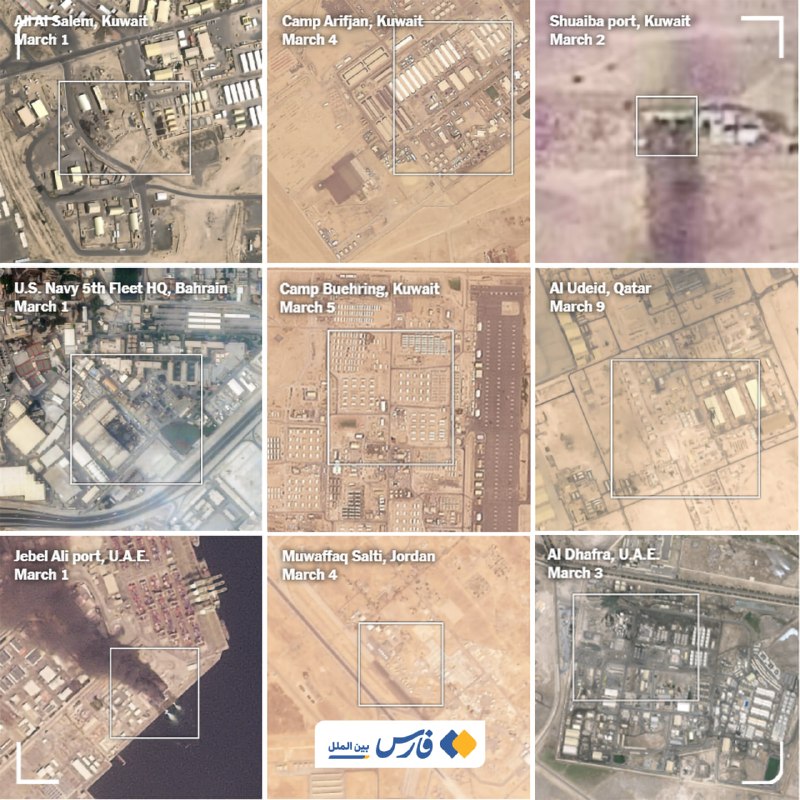
Kuwait's Al-Ahmadi oil export terminal was hit on the afternoon of 21 July 2026, according to social-media footage and satellite imagery reviewed across open channels. A Telegram post at 18:35 UTC carried frames described as showing "extensive damage caused by Iranian missiles or drones" to the port complex, the main loading point for Kuwaiti crude. By 19:04 UTC, the same open-source channel posted a short clip identifying the weapon overhead as an Iranian Ababil-3 drone. Kuwait's own account, posted at 14:03 UTC by an account monitoring regional military traffic, said the country was "currently responding to Iranian drones and missiles."
This is the first publicly documented Iranian strike on Kuwaiti energy infrastructure in the current escalation arc. Tehran has, in the past year, calibrated its attacks around Gulf states that host US basing, dual-use ports, or critical hydrocarbon chokepoints. Kuwait fits two of those categories: a forward headquarters for US Central Command forward-deployed elements and the operator of the regional oil-tanker fleet through the Strait of Hormuz. Hitting Al-Ahmadi tests a different hypothesis: that neutral Sunni Gulf monarchies can absorb punishment without reciprocating, on the assumption that their calculus favours de-escalation.
What the available imagery shows
The 18:35 UTC satellite release is grainy but consistent in one respect: the loading piers at Mina Al-Ahmadi appear damaged at multiple points, with at least one storage-tank farm showing scorching along the perimeter. The video released at 19:04 UTC is taken from a wider angle, looking up, and shows an airframe that the filmer identifies as an Ababil-3. The Ababil-3 is an Iranian-produced, piston-engine, surveillance-and-strike drone with a roughly 200-kilometre combat radius when launched from a forward platform, and it has appeared in Iranian-aligned footage from the Red Sea, Iraq and Syria over the past three years. The footage is open-source only. There is no Kuwaiti government read-out in the available thread, no OPEC statement, and no independent confirmation from the Kuwait Petroleum Corporation.
That absence is itself a fact. Kuwait's information ministry has historically been quick to acknowledge attacks, partly because the country's oil-export economy depends on the credibility of its installations to international underwriters and tanker charterers. Silence inside the first six hours after a strike on a flagship terminal is unusual. It suggests either the scale of the response is still being assessed or the government is holding release pending coordination with partners.
Why Kuwait, and why now
Kuwait has spent the last decade investing in diplomatic insulation. It has kept channels open with Tehran while hosting American and British forces under formal defence agreements. It has not joined the Saudi-Emirati-Qatari line against the Islamic Republic at full intensity, and its mediation under successive foreign ministers has leaned on quiet back-channels rather than public condemnation.
That insulation is now being stress-tested. An Ababil-3 is not a strategic weapon. It is a low-cost, mass-producible platform that can be launched from a truck or a small coastal vessel and reach targets deep inside Kuwaiti territory. If the airframe in the 19:04 UTC footage is correctly identified, the strike's centre of gravity is not the munition's yield. It is the demonstration that Iran can reach Al-Ahmadi, Mina Abdullah and the refineries around Shuaiba simultaneously, on a single operational cycle, without crossing sovereign airspace that Kuwait's air-defence network treats as hardened.
The framing from Western wires in comparable episodes has been that Iranian drones and missiles are imprecise and partly intercepted by allied air-defence. The counter-frame, common in Iranian-aligned commentary, is that low-cost drones impose asymmetric costs: each air-defence interceptor costs more than the inbound airframe by orders of magnitude, and sustained salvos deplete magazine depth in days rather than months. Both frames hold up against prior episodes in the Gulf. The new variable is the target set.
What to watch this week
Three indicators will tell readers whether the 21 July strike is a single coercive signal or the first node of a wider campaign.
First, whether Kuwait's National Petroleum Corporation issues a load-by-load disruption notice in the next 24 to 48 hours. Mina Al-Ahmadi handles the bulk of Kuwaiti crude exports; even a partial outage moves the Brent–Dubai spread.
Second, whether the US Navy's Fifth Fleet issues a public posture change from its base at Manama. Bahrain sits within the same Gulf littoral and shares air-defence architecture with Kuwait; an American movement order would be the cleanest signal that Washington reads the strike as the opening move of a campaign rather than a one-off.
Third, whether Iran's permanent mission to the United Nations frames the strike as retaliation for an earlier episode or as a warning against an announced move, for example a tighter enforcement posture on oil tankers in the Gulf of Oman, or a sanctions designation against an Iranian shipping entity. The diplomatic framing inside 48 hours will determine whether Kuwait is being asked to absorb a price or to alter behaviour.
The structural point underneath the tactical question is older than this strike. Gulf monarchies have built security architectures that depend on American extended deterrence and on quiet intra-Gulf mediation. An Ababil-3 over Al-Ahmadi does not collapse that architecture, but it punctures the assumption, held in some Gulf capitals and in parts of Washington, that energy infrastructure below a certain strategic threshold is essentially untouchable. That threshold was theoretical before 21 July 2026. It is operational now.
What the available sources do not yet establish is the casualty picture at the terminal, the operational status of the loading berths, and whether the strike was a single package or part of a coordinated salvo. None of those can be reported without corroboration that is not in the open record as of 19:04 UTC on 21 July 2026.
How Monexus framed this versus the wire: the open-source thread carries two image-led posts and one short text acknowledgement. Where Western wires have yet to publish on Al-Ahmadi specifically, Monexus foregrounds the satellite and ground-level footage from Sprinterpress and the operational-status note from unusual_whales, then sets out the structural stakes rather than guessing at casualty counts or operational shutdowns that the sources do not yet support.
Wire provenance
This editorial synthesis draws on the following public wire/social posts:
- https://t.me/sprinterpress
- https://t.me/unusual_whales