A single clan, 112 names: Gaza City buries remains recovered three years after the strike that killed them
Mourners in Gaza City held one of the largest mass funerals of the war for 112 members of a single extended family, whose remains were recovered three years after the Israeli strike that killed them.
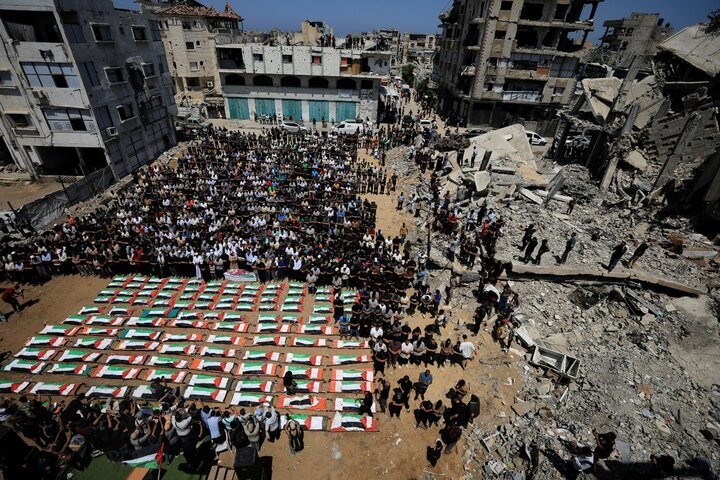
On 4 August 2026, mourners in Gaza City carried the recovered remains of 112 Palestinians from the same extended family to a mass funeral, three years after the Israeli strike that killed them. Reuters reported the burial as one of the largest single-family funerals held in the Strip since the war began, with coffins laid out in rows beside relatives still searching for closure. The scene, captured in wire footage carried by Reuters on the same day, marks a rare moment in which the forensic machinery of recovery has caught up with the scale of the original loss.
What the recovered remains reveal is not a new casualty count but a delayed accounting. Monexus assessment: the funeral is the visible end-point of a slow process of exhumation, DNA matching and family notification that has run in parallel to the fighting, often out of public view. Its political weight comes less from the number itself than from the demonstration that, three years on, large single-event death tolls are still being formally returned to relatives.
The strike and the delay
Middle East Eye reported on 4 August that the 112 were members of a single clan killed in one Israeli strike in 2023, with their bodies recovered only now. The wire did not identify which specific 2023 strike the clan was caught in, and the available source items do not specify the date, the neighbourhood struck, or the munition used. Reuters carried the broader Gaza City funeral without naming the family. The Cradle Media, on the same day, separately reported that Gaza Civil Defense teams had pulled the bodies of eight Palestinians from beneath the rubble of a house in southern Gaza City, a reminder that the recovery of remains is ongoing alongside the funeral of the previously recovered.
The asymmetry is worth holding in mind. The strike was an event; the recovery is a process. The first is decided in seconds by a pilot, a targeteer or a forward observer. The second is decided by bulldozers, forensic teams, DNA laboratories and the bureaucratic willingness to match a jawbone to a name. The lag between the two is itself a measure of how a war's accounting gets done.
What the wires agree on, and what they do not
The Reuters and Middle East Eye accounts converge on the headline facts: Gaza City, 4 August 2026, 112 members of one extended family, recovered remains returned three years after a single 2023 strike. Reuters frames the event as "one of the largest mass funerals" of the war. Middle East Eye calls it "one of its largest mass funerals since the beginning of the war." Both phrasings stop short of a single canonical tally; the wire language describes scale relative to other funerals, not a definitive casualty ledger for the war as a whole.
The source items do not specify several pieces of context a reader would normally expect: the family's name, the precise location of the original strike, the Israeli account of the targeting, whether the strike was the subject of any subsequent investigation, and whether any of the remains were returned through a formal channel such as the International Committee of the Red Cross or through informal local recovery. The available reporting does not record an Israeli military statement on the 4 August funeral or on the recovery operation that preceded it; this article treats that silence as an absence in the cited material, not as a proven fact about Israeli policy. Where this article asserts a fact, it does so on the basis of the Reuters and Middle East Eye wire language quoted above; where it is silent, the source material is silent too.
The structural frame: war, forensic lag, public memory
Monexus assessment: the funeral sits inside three overlapping timelines. The first is the tactical timeline of the war, in which strikes are authorised, executed and, in most reporting, immediately subsumed into larger daily counts. The second is the forensic timeline, in which bodies are recovered from rubble, identified, and returned, often years after the original event. The third is the public-memory timeline, in which a single large funeral can briefly restore the granular human weight of a number that had become statistical.
The pattern is not unique to Gaza. Mass graves and delayed exhumations have shaped how earlier conflicts enter public consciousness, from the Balkans in the 1990s to Iraq in the years after 2003. What differs in Gaza is the combination of density, the live continuation of hostilities during recovery, and the speed at which recovered remains are being catalogued while the war itself is still being fought. The Cradle Media's same-day dispatch on eight bodies pulled from a single southern Gaza City house shows that the recovery apparatus is operating in real time, not after a ceasefire.
The structural read, in plain terms: wars generate two ledgers, a kinetic one and a forensic one, and the gap between them is where accountability either accumulates or erodes. The 4 August funeral is, in effect, the forensic ledger catching up with the kinetic one for one extended family.
Stakes and what to watch
The immediate stakes are familial and communal: 112 sets of relatives receive remains they have waited three years to bury, and the clan closes a chapter that the wider war has forced open. The wider stakes are evidentiary. Each formally identified remains a recoverable physical record of a specific strike; that record can in principle be matched to operational logs, munition fragments, and post-strike damage assessments, even if the political will to conduct that matching does not currently exist.
Three things to watch in the days ahead. First, whether any further reporting identifies the family or the specific 2023 strike by name and coordinates, which would convert the headline figure into an individually traceable casualty record. Second, whether any of the 112 are formally identified through a third-party channel such as the ICRC, which would establish a paper trail independent of the Gaza Civil Defense and Hamas-run health apparatus. Third, whether the recovery operation described by The Cradle Media, in which eight bodies were pulled from a single southern Gaza City house on the same day as the mass funeral, signals an intensification of rubble-clearing efforts in specific neighbourhoods, or whether it is a routine single-house operation of the kind that has occurred throughout the war.
The honest uncertainty here is large. Reuters and Middle East Eye give the headline figure and the clan scope; The Cradle Media gives a parallel data point on continued rubble recovery. The sources do not specify the family's name, the original strike's coordinates, or whether the recovery was conducted by Gaza Civil Defense, by an international team, or by family members themselves. This article does not fill those gaps, and a reader should not assume that the gaps are filled elsewhere.
Desk note: Monexus framed this against the editorial compass for Israel-Palestine coverage, with Reuters and Middle East Eye leading the sourcing and The Cradle Media's same-day recovery dispatch used as parallel evidence on the continuing forensic lag. The piece treats the funeral as a delayed-accounting event rather than as a fresh casualty report, and it does not infer an Israeli response where the sources do not record one.
Wire provenance
This editorial synthesis draws on the following public wire/social posts:
- https://reut.rs/45JwV2Y
- https://x.com/Reuters/status/2084674472246960202
- https://x.com/MiddleEastEye/status/2084666985699303811
- https://t.me/thecradlemedia/65582
- https://t.me/TheCradleMedia/65582