Abbas tells UN General Assembly: 'do not allow another Nakba,' warns of 'an even greater danger ahead'
In a pre-recorded video address to the UN General Assembly on 24 September 2026, Palestinian Authority President Mahmoud Abbas warned of 'an even greater danger ahead' and appealed to the international community to prevent 'another Nakba,' framing Israeli policies as a threat to Palestinian existence.
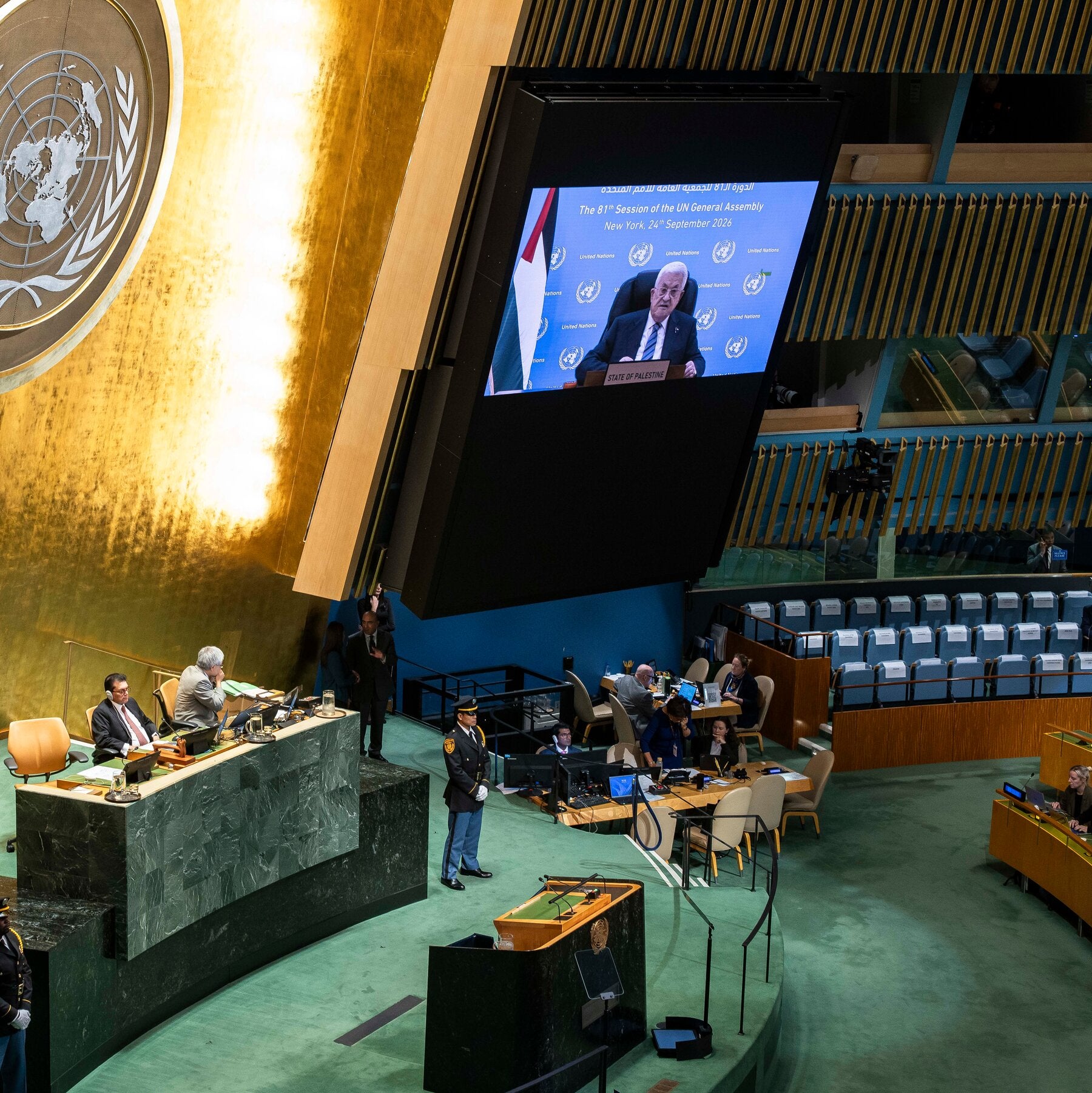
Mahmoud Abbas addressed the United Nations General Assembly on 24 September 2026 by pre-recorded video, according to The New York Times's UNGA live coverage. The available source items, a New York Times live-blog entry plus a cluster of Telegram channels monitoring the address in real time, record the speech in fragments rather than as a continuous text, and that sourcing mix shapes what can and cannot be said about it. Reporting relayed by multiple wire-syndicated outlets, published outside the source set Monexus received, separately identifies that Abbas had again been denied a US visa to attend the General Assembly in person, a circumstance the source set itself does not record and which the available excerpts do not explain.
What the available excerpts establish is a sequence of appeals: a warning that the danger 'is no longer limited to undermining the two state solution' and that 'today, we warn of an even greater danger ahead,' an inventory of conditions in the West Bank including East Jerusalem, a refusal of displacement, an explicit ask that the international community prevent a 'new Nakba' or 'further massacres like those that occurred in 1948,' and a reiteration of the Palestinian Authority's longstanding position in favour of 'a democratic Palestinian state' alongside Israel, alongside a stated commitment to combat antisemitism and to a culture of 'peace, dialogue, and coexistence.' The New York Times characterised the address as Abbas pressing the case for a Palestinian state.
The warning and the wording
The strongest line on the evidence available is the framing of Israeli policies as something stronger than the customary two-state erosion language. According to excerpts relayed by The Cradle channel, Abbas claimed Israeli policies had 'escalated into a threat to the very life and existence of the Palestinian people on their homeland.' A separately sourced excerpt from the Witness channel carries a closely related formulation: 'today, we warn of an even greater danger ahead,' followed in the same relayed excerpt by the qualifier 'one that requires international action to address it' and the connecting clause 'the danger is no longer limited to undermining the two state solution.' Reading those two excerpts together, the speech appears to position the 'greater danger' line as the headline framing, not as a free-standing warning detached from the two-state frame.
That matters for analytical reading. Israeli policies as a threat to 'the very life and existence of the Palestinian people' is a stronger formulation than 'undermining the prospects for a two-state solution,' the standard UNGA register. The available wording is about Palestinian people and homeland rather than about the state apparatus, and the available excerpts do not establish whether Abbas framed the threat as one to 'the viability of a Palestinian state' as such. The distinction matters to anyone reading the speech as a potential shift in the PA's diplomatic position: a stronger existential framing of the people, layered onto the longer-standing statehood demand, is not the same as a substitution of one for the other.
What the excerpts actually show on the ground
Abbas's West Bank paragraphs are the most concrete section of the available material. Three separate Telegram relays contain overlapping language on the West Bank, with the same core clauses about settler expansion and fragmentation present across them, while the surrounding sentences vary. From the Clash Report relay: 'in the West Bank, including East Jerusalem, "settler" expansion is accelerating. The West Bank is being fragmented, and Jerusalem is being isolated and Judaized.' From the Witness relay: 'in the West Bank, including East Jerusalem, settler expansion is accelerating.' A separate Witness relay repeats the same settler-expansion clause in shorter form. The convergence across the three relays is on the 'settler expansion is accelerating' sentence and on the inclusion of East Jerusalem in the framing, not on a word-for-word identical block.
On displacement, Abbas stated, in a separate excerpt relayed by Clash Report, that 'the Palestinian people will remain on their land,' that they 'will not accept displacement and will not disappear,' and in a further excerpt that the Palestinian Authority 'will not remain in waiting, nor will we accept whatever the governments of the Israeli occupying state decide for us,' adding that 'no lasting security can be built upon the occupation.'
The Nakba and 1948 passages are the section where Abbas moved into the historical frame, and they appear in at least three separately sourced excerpts rather than as one unified quoted block. From Clash Report: 'Do not allow another Nakba to occur. Do not allow further massacres like those that occurred in 1948. Do not allow terrorist gangs protected by the Israeli occupation to burn Palestinian homes while their occupants are sleeping inside them. Do not allow our children to live afraid and threatened.' From Witness: 'We warn you today do not allow another Nakba to occur.' From the Gaza Alanpa relay: 'We call for preventing another Nakba or massacre against our people and for putting an end to settler violence.' A separate Clash Report excerpt records Abbas asking 'what is this international community waiting for in order to protect the Palestinian people, ensure their continued presence on their land, end the Israeli occupation…'
Reading those excerpts together, the speech's 1948 references are consistently anchored in two distinct but related appeals: an injunction ('do not allow') directed at the international community, and a parallel call ('call for preventing') anchored in the present-tense settler-violence frame. Treating them as a single unified statement would overstate the convergence of the source material.
Structural read on the format
Monexus analysis: the pre-recorded choice changes the diplomatic geometry of a UNGA address, and the available source set does not explain it. In-person UNGA appearances generate bilateral meetings, press availabilities, and the corridor exchanges that often produce the concrete outputs of General Assembly weeks. Pre-recorded addresses produce a textual record on the General Assembly feed without that politics. Reporting carried by multiple wire-syndicated outlets outside the source set, identified above as material the source set does not contain, treats the visa-denial context as the explanation; the source set Monexus received notes only the pre-recorded fact. The honest reading is that the address's diplomatic yield is the speech as written, plus whatever the Palestinian Authority and its interlocutors put on the record in the days that follow.
Monexus analysis: on the available evidence the speech stayed inside the PA's established lanes: a call for a Palestinian state alongside Israel, an insistence on Palestinian permanence on the land, and an appeal to the international community to act, layered with a sharper rhetorical framing of the threat to Palestinian existence. The novelty on the evidence available is rhetorical, in the existential framing and in the sequencing that places the 'even greater danger' line ahead of the West Bank description, rather than substantive. The available excerpts do not record a doctrinal shift, a recognition of new counterparts, or a public re-framing of PA security coordination with Israel.
What to watch next
The proximate test of the address is whether any delegation in the General Assembly hall cites the speech in formal interventions over the remainder of UNGA high-level week, and whether the PA pushes for a draft resolution in the coming days. A second test is whether Abbas or the PLO office follows the video with a written statement containing the operative paragraphs, as the more consequential UNGA addresses often do. A third is whether the Israeli government responds in writing, through the foreign ministry channels or a posted UNGA reply, and how it characterises the 'Nakba' framing and the existential-turn wording.
On the ground, the West Bank including East Jerusalem remains the territory Abbas named most specifically. Any acceleration or contraction of settlement activity in the weeks following the address will be read, by all sides, as the empirical answer to his words. Monexus will watch the UNGA record, the OCHA and UN humanitarian reporting cycle on the West Bank, and the diplomatic readouts from capitals that have been moving on the recognition question.
The honest reading is that the speech, on the evidence available, changed no one's position in real time. It restated the PA's foundational claims at the volume the moment demanded, and it put on the international record the Palestinian Authority's view that the present trajectory is heading toward a danger 'one that requires international action to address it.' What the international community does with that warning is the question the address was designed to leave open.
Desk note: Monexus framed this around the textual content of the available excerpts and the diplomatic register Abbas adopted, rather than around the Gaza war or the wider Israeli-Palestinian conflict, on which the cited source set contains no reporting. The source set is dominated by Telegram relays of excerpts from a single address; no wire-service translation of the full text, no official PA transcript, and no Israeli-government response appears in the material Monexus received. Where the available excerpts establish a claim, the article cites them; where they do not, including on the recording location, the duration, the language of delivery, and the reason for the pre-recorded format choice, the article says so plainly. Independent wire reporting outside the source set identifies the US visa-denial context for the pre-recorded format; the article references that reporting as material the source set does not contain rather than asserting it as established fact.
Wire provenance
This editorial synthesis draws on the following public wire/social posts:
- https://www.nytimes.com/live/2026/09/24/world/un-general-assembly-news/abbas-presses-the-case-for-a-palestinian-state-in-a-prerecorded-video-address
- https://t.me/ClashReport/98187
- https://t.me/TheCradleMedia/68396
- https://t.me/ClashReport/98186
- https://t.me/ClashReport/98185
- https://t.me/ClashReport/98181
- https://t.me/gazaalanpa/25588
- https://t.me/ClashReport/98175
- https://t.me/wfwitness/112918
- https://t.me/wfwitness/112915
- https://t.me/wfwitness/112912
- https://t.me/ClashReport/98166
- https://t.me/wfwitness/112908
- https://www.nytimes.com/live/2026/09/24/world/un-general-assembly-news/abbas-presses-the-case-for-a-palestinian-state-in-a-prerecorded-video-address
- https://t.me/ClashReport/98187
- https://t.me/TheCradleMedia/68396
- https://t.me/ClashReport/98186
- https://t.me/ClashReport/98185
- https://t.me/ClashReport/98181
- https://t.me/gazaalanpa/25588
- https://t.me/ClashReport/98175
- https://t.me/wfwitness/112918
- https://t.me/wfwitness/112915
- https://t.me/wfwitness/112912
- https://t.me/ClashReport/98166
- https://t.me/wfwitness/112908